
Have you ever stood somewhere and wondered, “Okay, but how far is 100 feet, really?” A number like 100 sounds fairly simple, yet once you step away from the ruler and try to imagine that distance in the real world, it becomes surprisingly difficult. 100 feet is long enough to stretch across a meaningful part of a sports field, yet short enough to walk in well under a minute.
Understanding what does 100 feet look like becomes much easier when the measurement is connected to familiar things. Instead of staring at a number, you can picture several cars lined up, a blue whale stretching through the ocean, or a little more than one-third of a football field. Suddenly, the number has a shape.
Whether you are trying to estimate a property boundary, plan a construction project, understand a landmark’s scale, or simply satisfy your curiosity, having a reliable visual reference makes a huge difference. So let’s turn 100 feet visually into things you can actually picture, because honestly, numbers alone can be a bit stubborn.
What Does 100 Feet Look Like in Simple Terms?
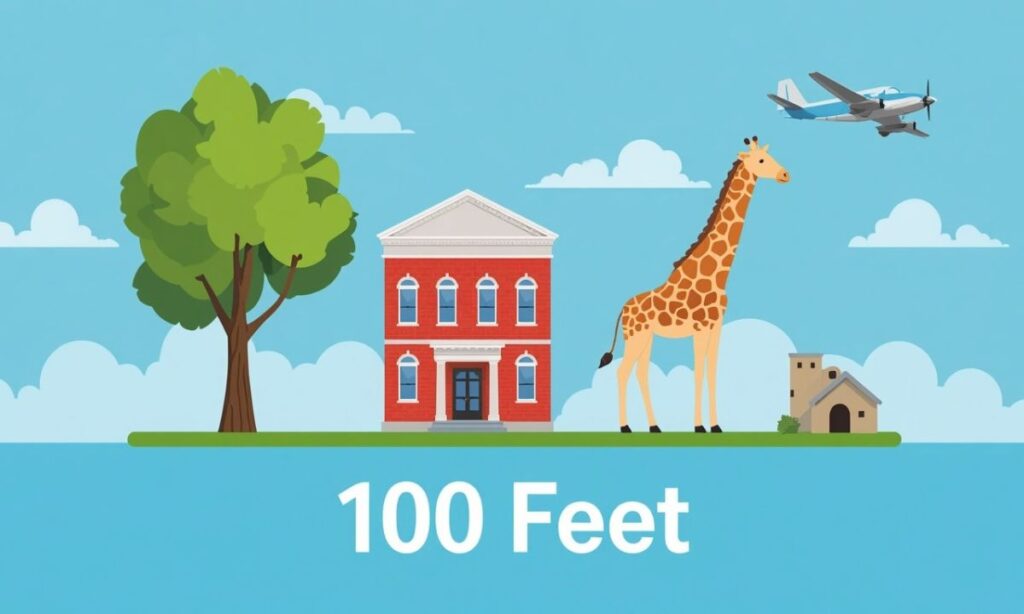
The easiest way to understand 100 feet is to imagine a straight line extending roughly the length of a basketball court. A regulation basketball court is 94 feet long in the NBA, so 100 feet is only about 6 feet longer. NOAA also uses a basketball court as a familiar comparison for a blue whale reaching about 100 feet.
Another useful mental image is a row of average passenger cars. If an ordinary sedan is around 14 to 16 feet long, approximately six or seven cars placed bumper-to-bumper can approach 100 feet. The exact count changes with the vehicle, but the image is surprisingly easy to remember.
You can also think about people. An adult may stand around 5.5 to 6 feet tall, meaning roughly 17 to 18 adults standing head-to-toe would create a combined length close to 100 feet. Of course, people aren’t measuring sticks, and this is only an informal estimation, but it gives your brain something familiar to hold onto.
That is the real trick behind 100 feet in real life: don’t memorize the number by itself. Connect it with objects and spaces you already understand.
How Long Is 100 Feet?
In the simplest sense, how long is 100 feet? It is a 100-foot length from one endpoint to another, or a 100-foot distance when you’re talking about the space between two points.
Here are the most useful conversions:
- 100 feet = 30.48 meters
- 100 feet = 3,048 centimeters
- 100 feet = 1,200 inches
- 100 feet = 33.33 yards
- 100 feet = 0.03048 kilometers
- 100 ft = 100 feet
These conversions show how the same length measurement looks different depending on the measurement system. In the imperial system, 100 feet feels like a fairly large everyday distance. In the metric system, 30.48 meters gives you another way to visualize exactly the same space.
The conversion itself is straightforward because a foot contains 12 inches, a yard contains 3 feet, and one foot equals 0.3048 meters. Once you know that conversion factor, moving between feet, inches, yards, and meters becomes much less confusing.
100 Feet Visualized With Everyday Objects
One of the most practical ways to understand 100 feet visualized is through ordinary objects. You probably don’t carry a measuring tape everywhere, and thats okay.
Imagine seven family-sized cars parked in a straight line. Depending on their individual lengths, the total may land somewhere around 100 feet. Looking down that row gives you a surprisingly strong sense of the size of 100 feet.
You could also imagine five standard shipping containers arranged end-to-end. A common intermodal container is about 20 or 40 feet long, so the exact combination matters. Five 20-foot containers would reach 100 feet almost exactly, making them a useful industrial measurement reference.
Another simple comparison is a basketball court. Since an NBA court measures 94 feet long, walking from one baseline to the opposite baseline gives you almost the entire 100-foot distance. Add roughly two long adult strides beyond the court’s length and you’re near the mark.
These examples make 100 feet comparison much more useful than simply saying “100 feet is a big distance.” Big compared with what? That’s where the real understanding begins.
How Big Is 100 Feet on a Football Field?
A football field gives one of the clearest answers to how big is 100 feet.
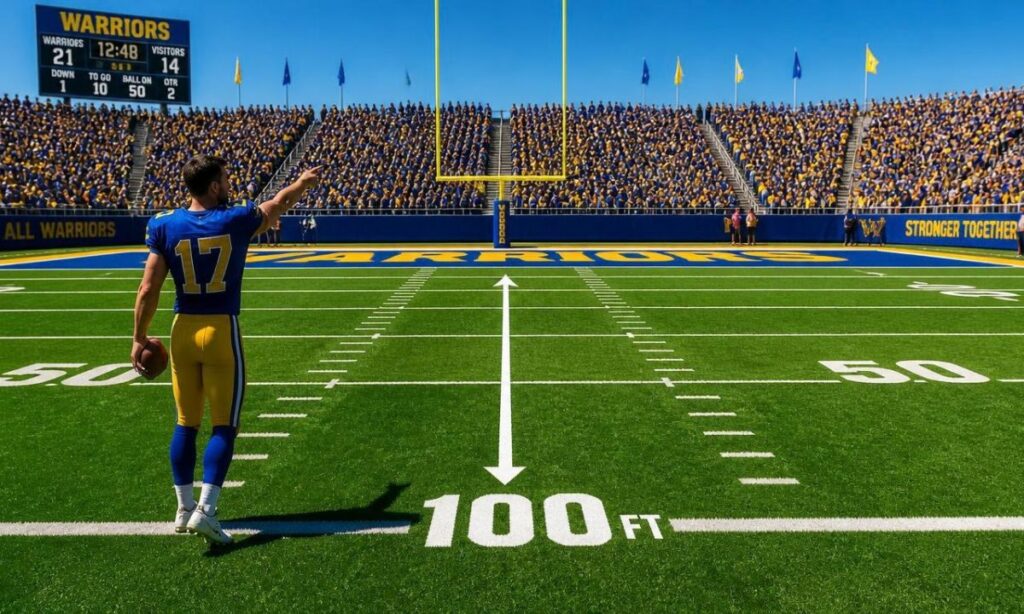
An American football field is 120 yards long when both end zones are included. The playing field between the goal lines is 100 yards, which equals 300 feet. Therefore, 100 feet on a football field represents exactly one-third of the distance between the two goal lines.
Since 100 feet equals 33.33 yards, you can picture the distance as reaching from around the goal line toward the 33-yard line. It is not one-third of the entire field including the end zones, but it is one-third of the 300-foot playing surface.
That makes a football field an excellent 100 feet reference. If you have watched a game, you already possess a mental picture of the space. You’re simply shrinking the familiar field into a smaller portion.
The end zone also helps with orientation. A 100-foot distance is substantial, but it doesn’t dominate the field. There would still be a lot of grass left in front of you.
How Far Is 100 Feet Compared With a Basketball Court?
A basketball court is almost exactly the size you need for a memorable 100 feet visual comparison.
An NBA court is 94 feet long. So if you walk from one end of an NBA court to the other, you’ve traveled just 6 feet less than 100 feet.
That difference is roughly the height of an average adult, give or take. So a basketball court length plus about one person’s height gives you a rough picture of 100 feet.
This is also why the blue whale comparison works so well. NOAA notes that a blue whale can reach about 100 feet, roughly the length of a basketball court.
For how to picture 100 feet, a basketball court may be one of the easiest references because the space is clearly marked and relatively familiar.
What Does 100 Feet Look Like Compared With a Blue Whale?
A blue whale is one of nature’s most impressive answers to what does 100 feet look like.
Blue whales are the largest animals on Earth, and NOAA reports that they can reach lengths around 100 feet, with some sources giving maximum lengths up to about 110 feet.
Picture one enormous blue whale lying in a straight line from nose to tail. At around 100 feet, its body would be about the length of a basketball court.
That is hard to appreciate because most people have never stood beside a whale, naturally. But the comparison creates a strong sense of physical scale. You’re no longer imagining an abstract distance; you’re imagining the length of the largest known animal.
It also shows why saying “100 feet is long” doesn’t really tell the full story. In the natural environment, 100 feet can represent an enormous living creature moving through the ocean.
How Many Car Lengths Is 100 Feet?
If you’re wondering how many cars is 100 feet, the answer depends on the cars.
A typical compact car may be around 14 to 15 feet long, while a larger sedan or SUV can be closer to 16 to 18 feet. Using a rough average of 15 feet, about six and two-thirds cars would span 100 feet.
So, for quick vehicle length comparison, picture six cars bumper-to-bumper and then imagine most of another car.
With larger vehicles, you may need only six cars. With smaller vehicles, perhaps seven. That’s why “seven cars end to end” is best treated as an estimation rather than an exact engineering measurement.
Still, for informal estimation, cars are extremely useful because nearly everyone understands the size of a car.
How Many Stories Is 100 Feet?

The question how many stories is 100 feet is slightly trickier because buildings don’t have one universal floor height.
A typical residential or office building floor might have around 9 to 12 feet from one floor to the next, depending on the structure, ceiling height, mechanical spaces, and structural thickness.
Using that rough range, 100 feet could correspond to approximately 8 to 11 floors. That’s why people often describe a 100-foot building as being around a 10-story building.
A 10-story structure is therefore a useful mental model for 100 feet tall, but it should not be treated as an exact rule. A commercial building with taller floors may reach 100 feet in fewer stories, while another structure with lower floor heights may need more.
This distinction matters when comparing 100-foot height with 100-foot length. A horizontal 100 feet is easy to walk, while a vertical 100 feet can look dramatically taller because of perspective.
100 Feet as a Vertical Height
When you turn the measurement upward, 100 feet vertical feels very different.
Imagine standing at ground level and looking toward the top of a roughly 10-story structure. The distance from the ground to the highest point could be around 100 feet, depending on the building design.
The human eye also changes how we experience vertical distance. A 100-foot line lying across an open field is easy to follow. A 100-foot tower rising overhead can feel much more imposing.
The Statue of Liberty provides an interesting reference, although the entire monument is much taller than 100 feet. The statue itself measures 151 feet 1 inch from the top of its base to the torch, while the pedestal is about 154 feet. The entire monument reaches 305 feet 1 inch.
So 100 feet is roughly two-thirds the height of the Statue of Liberty’s statue portion. That comparison helps establish building height comparison without pretending the landmark itself is 100 feet tall.
How Long Does It Take to Walk 100 Feet?
For most people, walking 100 feet doesn’t take very long.
At a normal walking pace, a person may cover the distance in roughly 30 to 40 seconds. Individual results vary because walking speed depends on age, fitness, terrain, footwear, and whether someone is strolling or moving briskly.
You can also think in terms of steps. Depending on a person’s stride length, 100 feet in steps might take somewhere around 33 to 40 steps.
A taller adult with a longer stride may use fewer steps, while a shorter person may take more. So if you’re trying to measure 100 feet by walking, counting your steps can provide a rough estimate but shouldn’t replace precise measurement when accuracy matters.
Try walking at your normal pace while counting. Once you know approximately how many steps you personally need for 100 feet, that becomes a surprisingly handy personal reference.
Can You Picture 100 Feet Using Adults?
Human bodies make excellent visual references because we see them every day.
An adult’s average height varies considerably, but suppose you use 5.5 to 6 feet as a rough reference. Around 17 to 18 adults standing head-to-toe could add up to approximately 100 feet.
A human chain lying straight on the ground would be an odd way to measure, admittedly, but it makes the concept memorable.
Standing adults are different because you’re comparing height rather than horizontal length. Eighteen people standing upright are not literally creating a 100-foot horizontal line. The comparison works only if you imagine their body heights placed end-to-end.
This distinction is useful because it teaches an important part of spatial awareness: the same measurement behaves differently depending on direction.
What Does 100 Feet Look Like Around an Airplane?
The Boeing 737-500 is another remarkably close reference. Boeing’s airport planning documentation lists the aircraft at approximately 101 feet 9 inches, or 31.01 meters, long.
That means a 100-foot line is just a little shorter than the full airplane length of a Boeing 737-500.
Picture the aircraft sitting on a runway. From the nose to the tail, its overall length is just beyond 100 feet. This gives you an excellent sense of aircraft scale without needing to imagine an abstract measurement.
It is also a nice reminder that 100 feet is not some tiny backyard measurement. In aviation, that distance can span nearly the entire length of a commercial aircraft.
How Much Is 100 Feet in Nature?

Nature offers some wonderfully strange ways to imagine the measurement.
A mature coconut palm tree can become quite tall, although exact heights vary significantly by variety and growing conditions. A 100-foot tree would be a substantial specimen, especially when you stand beneath it and look straight upward.
Trees also demonstrate why estimating height can be harder than estimating horizontal distance. A 100-foot tree may appear shorter or taller depending on your viewing position, surrounding trees, slope, and perspective.
The Eastern Cottonwood Tree, for example, can reach impressive heights, making tall trees useful when thinking about natural height. But unlike a ruler, nature rarely produces perfectly standardized dimensions, so these examples should be treated as visual references rather than exact measuring devices.
What Does 100 Feet Look Like With Shipping Containers?
Shipping containers provide a surprisingly practical 100-foot construction reference.
A standard 20-foot shipping container is approximately 20 feet long. Place five of them end-to-end and you get approximately 100 feet.
This makes five shipping containers one of the easiest industrial comparisons for visualizing the measurement.
At a cargo port, rail yard, or large construction site, containers are often arranged in rows, which can make long distances easier to appreciate. Five containers stretching continuously across the ground would give you a strong sense of the 100-foot distance.
A 40-foot container changes the picture, of course. Two 40-foot containers total 80 feet, leaving another 20 feet to reach 100.
How to Measure 100 Feet Accurately
If the measurement actually matters, don’t rely entirely on your imagination.
A 100-foot tape measure is one of the simplest options. These long tapes are commonly used for property work, construction, landscaping, sports layouts, and field measurements.
A laser distance finder can also measure distances quickly, particularly where the endpoints are visible and the device is suitable for the environment.
For larger professional jobs, surveying equipment provides much more precise measurements. Builders, engineers, surveyors, and contractors may use specialized instruments rather than informal estimation.
Your method should match your purpose. Estimating a distance for a casual game is very different from marking a property boundary or performing construction work.
How to Estimate 100 Feet Without a Tape Measure
Sometimes you don’t have measuring tools nearby, and you simply need a reasonable estimate.
One method is to use walking. Walk at your normal pace and count your steps. If you know your approximate stride length, you can estimate the distance covered.
Another method is to use cars. If you know the approximate length of the vehicles available, line up an imaginary series of them and calculate how many would make 100 feet.
A third approach is to use a familiar sports facility. If you are standing near a football field, remember that 100 feet equals 33.33 yards, or roughly one-third of the playing field from one goal line toward the other.
These methods are useful for informal estimation, but they are not substitutes for precise measurement when accuracy is important.
100 Feet vs. Other Familiar Distances
The human brain understands measurements through relationships, so comparisons are often more helpful than isolated numbers.
- 100 feet is about 30.48 meters.
- It is approximately the length of an NBA basketball court plus 6 feet.
- It is one-third of the 300-foot distance between the goal lines on an American football field.
- It is about the length of a blue whale reaching around 100 feet.
- It is just slightly shorter than a Boeing 737-500.
- It is roughly six or seven typical passenger cars lined up.
- It is approximately five 20-foot shipping containers placed end-to-end.
- It can represent around 17 to 18 adult body heights placed end-to-end.
Each comparison answers a slightly different question. A football field helps with distance, a building helps with vertical height, and cars help with everyday scale.
Why 100 Feet Feels Different Horizontally and Vertically
One of the most interesting things about 100 feet is that it doesn’t always feel like the same amount.
If you walk 100 feet across a flat parking lot, the distance may feel modest. You can see the destination, walk toward it, and arrive in less than a minute.
But imagine a 100-foot tower directly above you. Suddenly the same number feels much larger. That’s because our perception of physical scale depends heavily on direction and surroundings.
A clear open field gives you an easy reference. A vertical structure can hide its dimensions behind perspective, shadows, and nearby objects.
This is why 100 feet height comparison and 100 feet distance comparison should not be treated as exactly the same visual experience.
A Quick 100-Foot Mental Picture

If you need one simple answer to what does 100 feet look like, remember this:
Imagine an NBA basketball court. Walk from one baseline to the other. You’ve covered about 94 feet. Now imagine adding roughly 6 more feet.
That’s 100 feet.
Or imagine about six or seven average cars parked bumper-to-bumper.
Or picture a blue whale stretching almost the entire length of a basketball court.
Or imagine five 20-foot shipping containers lined up end-to-end.
These aren’t merely random comparisons. They’re 100-foot reference points that give your brain several different ways to understand the same measurement.
Read more : Dimensions of a Can of Soda
Frequently Asked Questions
How Long Is 100 Feet?
100 feet equals 30.48 meters or 1,200 inches, making it a substantial everyday distance.
What Does 100 Feet Look Like in Real Life?
100 feet is roughly the length of an NBA basketball court plus a few extra feet, making it easier to visualize.
How Many Car Lengths Is 100 Feet?
About six to seven average cars placed bumper-to-bumper can span approximately 100 feet.
How Many Steps Are in 100 Feet?
For many adults, walking 100 feet takes roughly 33 to 40 steps, depending on stride length.
Conclusion
So, what does 100 feet look like? It looks different depending on what you place beside it.
Horizontally, it is about the length of a basketball court. On an American football field, it covers one-third of the 100-yard playing area. In transportation, it is close to the length of a Boeing 737-500. In nature, it can match the impressive length of a blue whale. In construction, five 20-foot containers can provide a practical mental model.
The most useful lesson is that measuring 100 feet doesn’t always require immediately reaching for a calculator. Visual references build spatial awareness, and once you have a few dependable comparisons in your head, estimating distance becomes much easier.
For casual situations, walking, cars, courts, and buildings can help. For construction, surveying, property boundaries, or other situations where precision matters, use a tape measure, laser distance finder, or professional surveying equipment instead.
And perhaps that’s what makes an ordinary measurement like 100 feet interesting. A number on a page feels flat. Put that number beside a whale, an airplane, a basketball court, or a row of cars, and suddenly it has a shape you can actually see.