Choosing the right flag is about more than picking a piece of red, white, and blue fabric. The size determines how well the flag looks against your home, how clearly its stars and stripes can be seen, and whether it suits the flagpole you already have. A flag that looks perfect on a porch might seem tiny outside a public building, while an oversized flag can overwhelm a small yard.
This guide to standard flag sizes explains common American flag dimensions, measurements for residential and commercial displays, and how to match a flag to its pole. We’ll also look at the history and symbolism of the United States flag, along with practical tips for displaying and caring for it.
Whether you’re buying your first flag for your home or replacing an old one before a national holiday, a little knowledge makes the decision much easier.
What Are the Standard American Flag Sizes?
There isn’t just one standard American flag size for every situation. Flags are manufactured in several dimensions to suit homes, schools, businesses, government buildings, ceremonies, and large outdoor displays. The familiar 3 × 5-foot flag is a popular choice for residential use, but larger and smaller options are common too.
The United States flag has a prescribed design and proportion. Its official length-to-height ratio is 1.9:1, often expressed as 10:19 when comparing height with length. In other words, the flag’s length is 1.9 times its height. This proportion keeps the stars and stripes looking balanced, whether the flag is small enough to hang indoors or large enough to fly above a public building.
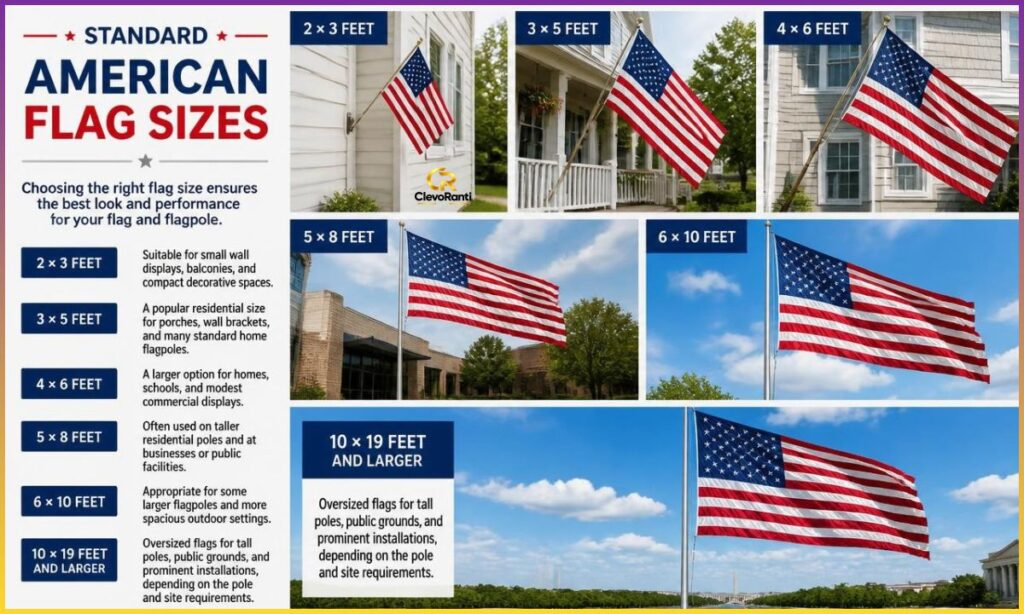
Common standard American flag sizes include:
- 2 × 3 feet: Suitable for small wall displays, balconies, and compact decorative spaces.
- 3 × 5 feet: A popular residential size for porches, wall brackets, and many standard home flagpoles.
- 4 × 6 feet: A larger option for homes, schools, and modest commercial displays.
- 5 × 8 feet: Often used on taller residential poles and at businesses or public facilities.
- 6 × 10 feet: Appropriate for some larger flagpoles and more spacious outdoor settings.
- 10 × 19 feet and larger: Oversized flags for tall poles, public grounds, and prominent installations, depending on the pole and site requirements.
These are common commercial sizes, not a universal list of mandatory dimensions for every flag display. The correct choice depends on your pole, mounting arrangement, surroundings, and the manufacturer’s specifications.
American Flag Size Chart: Common Dimensions
A quick flag size chart makes it easier to compare measurements before buying. The figures below show the nominal dimensions of popular rectangular flags, with the first number representing the flag’s height and the second representing its length.
| Flag size | Height in inches | Length in inches | Typical use |
|---|---|---|---|
| 2 × 3 feet | 24 in | 36 in | Small displays |
| 3 × 5 feet | 36 in | 60 in | Residential use |
| 4 × 6 feet | 48 in | 72 in | Homes and schools |
| 5 × 8 feet | 60 in | 96 in | Larger outdoor displays |
| 6 × 10 feet | 72 in | 120 in | Commercial or spacious residential settings |
| 10 × 19 feet | 120 in | 228 in | Large installations |
For example, a 3 × 5 American flag measures 36 inches high and 60 inches long. A 5 × 8-foot flag measures 60 inches high and 96 inches long. Both maintain the familiar 1:1.67 or 1:1.6-style proportions often seen in commercial products? Not quite: the precise U.S. flag design uses a 1:1.9 height-to-length ratio, so a flag sold as a standard commercial size may use rounded nominal dimensions rather than the exact official proportions.
That distinction is worth checking when buying a flag for a formal or government display. If exact specifications matter, verify the flag’s finished dimensions and construction with the manufacturer instead of relying on its product label alone.
What Is the Correct American Flag Length-to-Width Ratio?
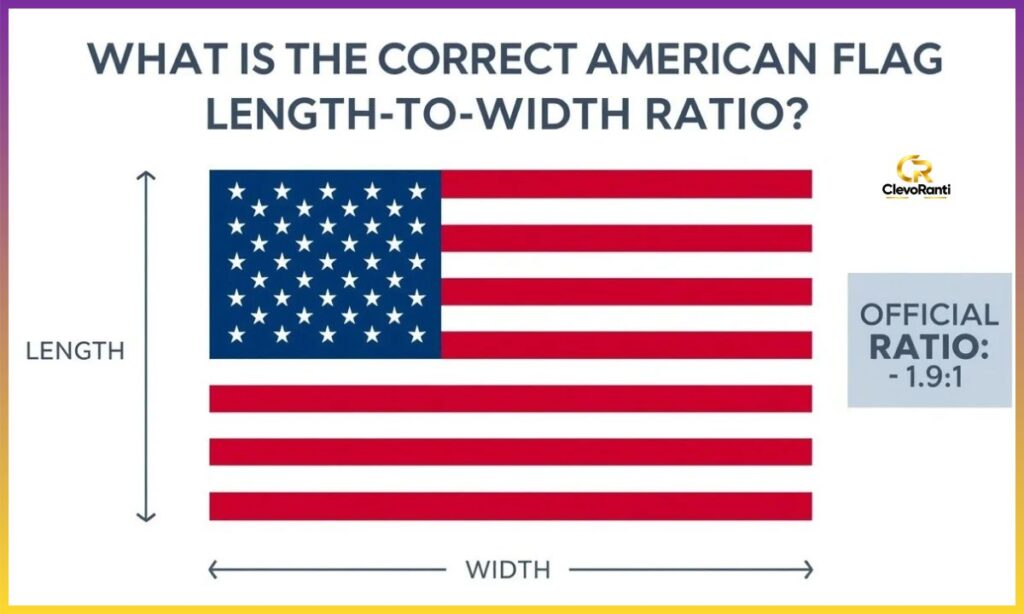
The official American flag dimensions follow a defined set of proportions, so the design stays consistent across different sizes. The flag is wider than it is tall, and its stars and stripes are arranged according to specifications rather than being stretched to fit any random rectangle.
The official flag’s length-to-height ratio is 1.9:1. For every 1 foot of height, the flag should be 1.9 feet long. A flag that measures 3 feet high, for example, would measure 5.7 feet long if made to that exact ratio.
Here’s a simple way to understand the measurement:
- Flag height: The measurement from the top edge to the bottom edge.
- Flag length: The measurement from the hoist edge, attached to the pole, to the outer edge that waves in the wind.
- Flag ratio: The relationship between the length and height.
- Flag proportions: The relative size and placement of the stripes, blue canton, and stars.
Not every commercially sold flag uses dimensions that match the official ratio exactly. The popular 3 × 5-foot flag, for instance, has a length-to-height ratio of 1.67:1. If exact proportions are required, consult the relevant specifications and choose a correctly manufactured flag rather than assuming every retail size follows the official design.
How to Choose the Right Flag Size for Your Flagpole
A flag should look balanced when it’s flying, not like a tiny decoration lost against a towering pole or a giant sheet straining against a small mount. Choosing the correct flag size by pole height helps the display look attractive while reducing unnecessary stress on the flag and its fittings.
The following table provides general shopping guidance for common residential and commercial setups. These are practical starting points, not universal legal requirements; wind exposure, pole construction, and manufacturer guidance also matter.
| Flagpole height | Possible flag size | Typical setting |
|---|---|---|
| 15–20 feet | 3 × 5 feet | Small homes and yards |
| 20–25 feet | 4 × 6 feet | Larger homes and residential lawns |
| 25–30 feet | 5 × 8 feet | Spacious properties and businesses |
| 30–35 feet | 6 × 10 feet | Commercial properties and institutions |
| 50 feet or more | Site-specific larger flag | Public grounds and large installations |
Before purchasing, check whether the pole manufacturer specifies a maximum flag area or weight. A taller pole doesn’t automatically mean it can handle every large flag, particularly in strong winds.
What Size Flag Is Best for a 20-Foot Flagpole?
For many residential installations, a 3 × 5-foot flag is a reasonable starting point for a 20-foot pole. A 4 × 6-foot flag may also suit some installations, depending on the pole’s strength, mounting system, and exposure to wind.
If your home sits in an open area where the wind rarely takes a break, a lighter flag or a smaller size may be more practical. Check the pole’s recommendations before choosing a larger flag, since wind puts extra force on the fabric and hardware.
What Size Flag Do You Need for a 25-Foot Flagpole?
A 4 × 6-foot flag is one option to consider for a 25-foot pole, while a 5 × 8-foot flag may be suitable for certain sturdier installations. The right size depends on whether the pole is designed for residential use or a more demanding commercial setting.
Consider the view from the street, too. A flag that’s visible without dominating the house generally creates a more balanced display. Sometimes, a modest flag positioned well looks much better than a larger one squeezed into a small space.
What Size Flag Fits a 30- or 35-Foot Flagpole?
For a 30-foot pole, a 5 × 8-foot flag is a common starting point. For a 35-foot pole, a 6 × 10-foot flag may be appropriate if the pole is rated to support it.
These recommendations are not fixed standards for every installation. A pole with a heavy-duty construction may support a different flag than a lightweight residential model of the same height. Always follow the pole manufacturer’s maximum flag dimensions and wind limitations.
Standard Flag Sizes for Homes, Businesses, and Government Buildings
The best standard flag dimensions depend on where the flag will be displayed. A front porch, a school entrance, and a large government building have very different visual and practical requirements.
Residential Flag Sizes
For homes, the 3 × 5-foot flag is a popular choice because it offers good visibility without taking over the entire front yard. Smaller flags, such as 2 × 3 feet, can work well on balconies, garden walls, and compact porch mounts.
When choosing a flag for home use, consider:
- The height of the mounting bracket or pole.
- The distance between the flag and nearby trees or walls.
- The amount of space available for the flag to move freely.
- The typical wind conditions in your neighborhood.
- The distance from which people will view the flag.
A flag mounted beside a front door has a different visual impact from one flying on a tall pole in the middle of a lawn. Think about the setting before deciding which dimensions to buy.
Commercial Flag Sizes
Businesses often use 4 × 6-foot, 5 × 8-foot, or 6 × 10-foot flags, depending on the height of the pole and the scale of the property. A hotel entrance, shopping center, or office campus may require a larger flag than a small storefront.
Commercial displays should also account for wind exposure, pedestrian traffic, nearby signs, and the distance from the road. A flag that is easy to see from a parking lot might be too large for a narrow entrance where fabric could strike a wall or obstruction.
Government Building Flag Sizes
Government buildings, courthouses, schools, and other public facilities may use larger flags to suit their grounds and architectural scale. Some official installations follow specific purchasing, design, or display requirements, so the appropriate dimensions should be confirmed with the relevant agency or site manager.
There is no single flag size that applies to every government building. The size may depend on the flagpole, the building’s design, the display location, and applicable specifications.
Large installations also require attention to maintenance. Replacing worn fabric, inspecting ropes and fittings, and checking the pole’s condition help keep the flag presentable and safe.
Indoor Flag Dimensions and Display Options

Indoor flags usually don’t need to withstand the same wind loads as outdoor flags, but their size still matters. A large flag can be an impressive feature in an auditorium, classroom, office, or community hall, while a smaller flag may be more suitable for a desk or personal display.
Common indoor options include:
- Small desk flags: Often used in offices, reception areas, and meeting rooms.
- 3 × 5-foot flags: Suitable for many wall displays and larger indoor spaces.
- Ceremonial flags: Often used with a staff for formal events, assemblies, and official functions.
- Oversized wall flags: Used in spacious halls or event venues where the display can be seen clearly from a distance.
When displaying the flag indoors, consider the height of the ceiling, the available wall space, and the audience’s viewing angle. For formal settings, follow applicable U.S. flag display guidance, including the rules for positioning the flag when displayed with other flags.
A simple tip: measure the wall or display area before buying. It saves you from discovering that your impressive new flag is wider than the space where you intended to hang it.
The History Behind the United States Flag
The United States flag represents a long and changing national history. Its design developed during the American Revolution, and its appearance has changed as the country grew from thirteen original colonies into a union of fifty states.
Early American flags included designs such as the Grand Union Flag, also known as the Continental Colors. It combined British flag elements with stripes representing the colonies, reflecting the complicated political circumstances before independence.
The familiar Stars and Stripes emerged in 1777, when the Continental Congress adopted a flag design featuring thirteen stripes and thirteen stars. As new states joined the Union, the number of stars increased. The number of stripes, however, was eventually set at thirteen to honor the original colonies.
Some historical figures associated with the flag’s development include George Washington, who served as commander in chief during the Revolution, and Francis Hopkinson, who is often associated with the flag’s early design history. The precise origins of individual design elements have been debated, so it’s best not to treat every popular flag-origin story as settled fact.
Today, the American flag is recognized around the world. Its design connects national history with the lives of people who display it at home, at school, and during public ceremonies.
What Do the 13 Stripes and 50 Stars Represent?
The American flag symbolism is closely connected to the country’s founding and its growth over time. Every stripe and star has a specific place in the design, making the flag much more than a colorful rectangle.
The Thirteen Stripes
The flag contains thirteen alternating red and white stripes. They represent the thirteen original colonies that declared independence from Great Britain and formed the foundation of the United States.
The stripes also remind many Americans of the difficult path toward independence. They are a visual connection to the founding era, when the future of the new nation was far from certain.
The Fifty Stars
The blue canton, located in the upper-left portion of the flag when viewed in its standard display orientation, contains fifty white stars. Each star represents one state in the Union.
The arrangement is carefully specified so that the stars remain consistent across flags of different sizes. Their presence represents the states as part of one country, even though those states have their own governments and local identities.
The Meaning of Red, White, and Blue
The colors of the American flag are widely associated with national ideals. Traditional explanations connect red with valor and bravery, white with purity and innocence, and blue with vigilance, perseverance, and justice.
These associations are familiar in American civic tradition, although they should be distinguished from the specific design specifications that determine the flag’s proportions and arrangement.
For many people, the red, white, and blue also represent sacrifice, liberty, patriotism, and national unity. Their meaning can be deeply personal, shaped by family history, military service, community involvement, and national celebrations.
How to Display the American Flag Properly
Choosing the correct US flag dimensions is only one part of creating a respectful display. Position, condition, lighting, and the way the flag is raised or lowered are also important.
The U.S. Flag Code provides guidance on the display and treatment of the national flag. Although the code sets out accepted practices, many of its provisions are advisory rather than criminally enforceable, and applicable federal, state, and local rules may vary by setting.
Outdoor Flag Display Guidelines
For a residential or commercial outdoor display, keep these practical points in mind:
- Mount the flag securely so it can fly without becoming tangled in nearby branches or fixtures.
- Choose a flagpole and hardware rated for the flag’s size and the expected wind conditions.
- Inspect the fabric, stitching, clips, ropes, and mounting brackets regularly.
- Follow applicable guidance for raising and lowering the flag, including customary sunrise and sunset display practices.
- If the flag is displayed at night, use suitable illumination in accordance with applicable guidance.
- Lower or remove the flag during severe weather when necessary to protect it from damage, particularly if it is not designed for all-weather use.
The right approach depends on the site and the flag’s material. A lightweight polyester flag on a sheltered porch may need different care from a large nylon flag exposed to strong winds on an open lawn.
Indoor Flag Display Etiquette
Indoor displays often appear in classrooms, government offices, meeting rooms, and ceremonial spaces. In these settings, the flag should be positioned so it is visible and treated respectfully.
When displayed on a wall behind a speaker, the flag’s position depends on the viewer’s perspective and the applicable display guidance. When displayed with other flags, placement should follow the relevant rules for the setting, including guidance on the position of honor.
For formal events, it’s a good idea to consult the official Flag Code rather than relying solely on informal diagrams found online. Small positioning details can matter in ceremonial displays.
Half-Staff Displays
The American flag may be displayed at half-staff to mark certain periods of mourning or other occasions designated by the appropriate authority. This practice has specific conventions, including the usual procedure of raising the flag to the top of the pole before lowering it to the half-staff position.
Don’t confuse half-staff with simply flying a flag lower than usual. Follow the applicable proclamation or official instructions for the occasion, and make sure the pole and flag can be handled safely.
Caring for Your American Flag
Even a well-made flag will eventually show signs of use, particularly if it flies outdoors throughout the year. Sunlight, rain, wind, dust, and pollution can gradually weaken fabric and fade its colors.
A little maintenance helps extend its useful life.
- Inspect the fabric: Look for frayed edges, torn stitching, fading, or damaged seams.
- Check the hardware: Examine clips, ropes, brackets, and fasteners for wear or corrosion.
- Clean it appropriately: Follow the manufacturer’s washing instructions to avoid damaging the fabric or printed design.
- Store it properly: Make sure the flag is clean and dry before storing it in a suitable location.
- Consider the weather: Remove or lower the flag when conditions could cause damage, unless the installation and flag are designed for those conditions.
When a flag becomes worn beyond repair, follow appropriate flag-disposal guidance. Organizations such as the American Legion and other veterans’ groups may provide information about respectful retirement ceremonies in your community.
Regular maintenance also helps you spot problems with the pole before they become dangerous. A loose bracket or damaged rope can be just as important as a tear in the fabric.
How to Measure a Flag Before You Buy One
If you’re comparing American flag measurements, it helps to know exactly which edges are being measured. Product listings sometimes use height and length in different orders, which can cause confusion when shopping online.
Use these steps to check the dimensions:
- Measure the height: Measure from the top edge to the bottom edge of the flag.
- Measure the length: Measure horizontally from the edge attached to the pole to the outer edge.
- Check the listed units: Confirm whether the dimensions are given in feet, inches, or another measurement system.
- Review the product specifications: Look for the finished dimensions, fabric type, and recommended pole size.
- Check the design proportions: If you need a flag that follows official U.S. specifications, verify that the design matches the required proportions.
For reference, a 3 × 5-foot flag has nominal dimensions of 36 × 60 inches. A 4 × 6-foot flag measures 48 × 72 inches, while a 5 × 8-foot flag measures 60 × 96 inches.
Remember that these are nominal commercial sizes. If your project requires exact official dimensions, check the relevant specification rather than relying on a size label alone.
Explore More Blog : Size of Dessert Plate
Frequently Asked Questions
What is the standard size of a US flag?
A 3 × 5-foot flag is one of the most common sizes for residential use. However, there is no single size that suits every flagpole or setting. Homes, schools, businesses, and government facilities may use different dimensions depending on their needs.
What are the dimensions of a 3 × 5 American flag?
A commercially labeled 3 × 5-foot flag measures approximately 36 inches high and 60 inches long. Its exact proportions may differ from the official U.S. flag ratio, so check the manufacturer’s specifications if precise proportions are important.
What is the largest standard American flag size?
There is no single largest size across all manufacturers and installations. Oversized flags are made for large flagpoles, public grounds, and special installations. A 10 × 19-foot flag is one possible large format, while some displays use flags that are considerably larger.
How do you calculate flag size based on flagpole height?
Start by checking the flagpole manufacturer’s recommendations for maximum flag dimensions and weight. Then consider wind exposure, pole construction, and the surrounding space. General residential sizing charts can help narrow the choices, but they shouldn’t replace the manufacturer’s specifications.
Are indoor and outdoor flag sizes different?
They can be, although the same nominal dimensions may be used in either setting. Indoor flags are often selected for wall displays or ceremonial staffs, while outdoor flags must also suit the pole, wind conditions, and weather exposure.
What do the stars and stripes on the American flag mean?
The thirteen stripes represent the original thirteen colonies, while the fifty stars represent the fifty states. The red, white, and blue are traditionally associated with valor, purity, vigilance, perseverance, and justice.
Can I fly the American flag at night?
Yes, the U.S. Flag Code provides guidance on displaying the flag after sunset, including illumination practices. If you intend to fly it overnight, review the applicable guidance and make sure the mounting arrangement is safe and suitable for the conditions.
Conclusion
Choosing the right standard flag sizes becomes much easier when you understand the relationship between flag dimensions, flagpole height, and the location where the flag will be displayed. A 3 × 5-foot flag may be ideal for a front porch, while a larger 5 × 8-foot or 6 × 10-foot option could work better on a spacious property or commercial site.
Beyond measurements, the American flag carries a history and symbolism that make it meaningful to many people. Its thirteen stripes, fifty stars, and familiar red, white, and blue design connect generations through shared national traditions.
Before making a purchase, measure your available space, check the pole manufacturer’s recommendations, consider local weather, and confirm any official display requirements that apply. A thoughtfully chosen flag will look balanced, remain easier to maintain, and serve its purpose for longer.
Whether you’re displaying the flag at home, outside a business, or at a public gathering, the best choice is one that combines suitable dimensions with careful, respectful display.