Walk into a boxing gym and you’ll notice something almost funny about heavy bags: they look like simple cylinders hanging from the ceiling, yet they can weigh as much as a large piece of furniture. A new boxer may throw a few punches at one and suddenly wonder, how much does a heavy bag weigh, anyway? The answer is not one single number, because heavy bags come in different weights, sizes, shapes, and materials.
A typical heavy bag used for boxing, kickboxing, or martial arts commonly weighs between 60 and 100 pounds (27 and 45 kg). Smaller bags may weigh around 40 pounds, while professional or extra-heavy models can reach 120 pounds or more. So yes, that innocent-looking bag can be seriously heavy.
The right punching bag weight depends on several things, including your body weight, training experience, workout style, available space, and the kind of strikes you plan to practice. A beginner doing light boxing combinations has different needs from an experienced athlete practicing powerful kicks. Choosing a bag is a little like choosing shoes; the biggest one isn’t automatically the right one.
How Much Does a Heavy Bag Weigh on Average?
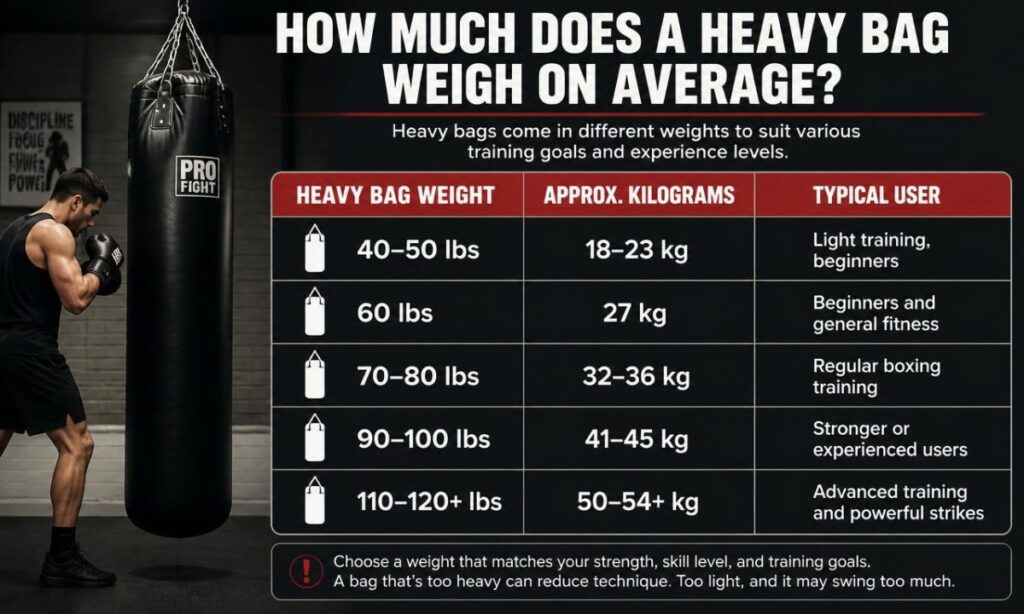
The average punching bag weight is usually somewhere around 70 to 100 pounds for a traditional adult heavy bag. Many home-gym models are sold in the 60-pound, 80-pound, and 100-pound ranges because these sizes provide a useful balance between stability and movement.
A 60-pound heavy bag is a common starting point for many recreational users. An 80-pound bag provides more resistance and tends to swing less when struck hard, while a 100-pound model feels substantially more solid. Of course, manufacturers don’t all fill bags the same way, so two bags with identical dimensions can feel quite different.
Here is a simple punching bag weight chart to make the basic ranges easier to understand:
| Heavy Bag Weight | Approx. Kilograms | Typical User |
|---|---|---|
| 40–50 lbs | 18–23 kg | Light training, beginners |
| 60 lbs | 27 kg | Beginners and general fitness |
| 70–80 lbs | 32–36 kg | Regular boxing training |
| 90–100 lbs | 41–45 kg | Stronger or experienced users |
| 110–120+ lbs | 50–54+ kg | Advanced training and powerful strikes |
These ranges are guidelines rather than strict rules. Your fitness level, body weight, and training goals matter more than simply picking the heaviest bag available, which is something people sometimes learn after buying a bag that feels like a small refrigerator.
How Heavy Is a Punching Bag Compared With Your Body Weight?
One commonly repeated rule says a heavy bag should weigh roughly 50 percent of your body weight. This can be a useful starting point, but it shouldn’t be treated like a law carved into a boxing gym wall.
For example, someone weighing 160 pounds might consider a bag around 80 pounds. Someone weighing 200 pounds could look at a 100-pound model. But experienced boxers may intentionally choose heavier or lighter bags depending on what they want from their training.
The idea behind punching bag weight by body weight is fairly simple. A heavier bag generally moves less when struck, creating a more stable target. A lighter bag can move around more, making footwork, timing, and movement important. Neither is automatically superior; they simply create different training experiences.
A Basic Body-Weight Guide
| Body Weight | Possible Heavy Bag Range |
|---|---|
| Under 120 lbs | 40–60 lbs |
| 120–150 lbs | 50–70 lbs |
| 150–180 lbs | 60–90 lbs |
| 180–220 lbs | 80–110 lbs |
| Over 220 lbs | 90–120+ lbs |
This punching bag weight based on body weight table is only a starting reference. Your striking power, experience, and whether you are punching or kicking should also be considered. A smaller martial artist with strong kicking technique may need something different from a similarly sized beginner.
How Heavy Should a Punching Bag Be for Beginners?
For most beginners, a 60 lb punching bag is a practical place to start. It offers enough resistance for ordinary punches without becoming unnecessarily difficult to install or move.
A beginner who weighs more or intends to practice powerful kicks may prefer an 80-pound bag. On the other hand, someone mainly interested in light cardio exercise or basic fitness training may be perfectly comfortable with a lighter model.
The goal isn’t to find the bag that refuses to move. The goal is finding a bag that gives you useful resistance while still allowing you to develop good technique. If the bag swings wildly after every punch, it may be too light for your training style; if it barely reacts and makes every strike feel awkward, it may be too heavy.
How Much Does a 60-Pound Heavy Bag Weigh?
A 60-pound heavy bag weighs approximately 27.2 kilograms. This is one of the more popular sizes for home users because it provides reasonable resistance without requiring an enormous support structure.
A 60-pound model can work well for boxing training, general conditioning, and moderate resistance training. It may also be suitable for teenagers or lighter adults, depending on their experience and the manufacturer’s recommendations.
The important detail is that the advertised weight usually refers to the filled bag itself. Chains, mounting hardware, brackets, and other equipment add additional weight to the installation, so your ceiling isn’t technically supporting only 60 pounds. There is always a little extra baggage, literally.
What Is the Difference Between an 80-Pound and 100-Pound Heavy Bag?
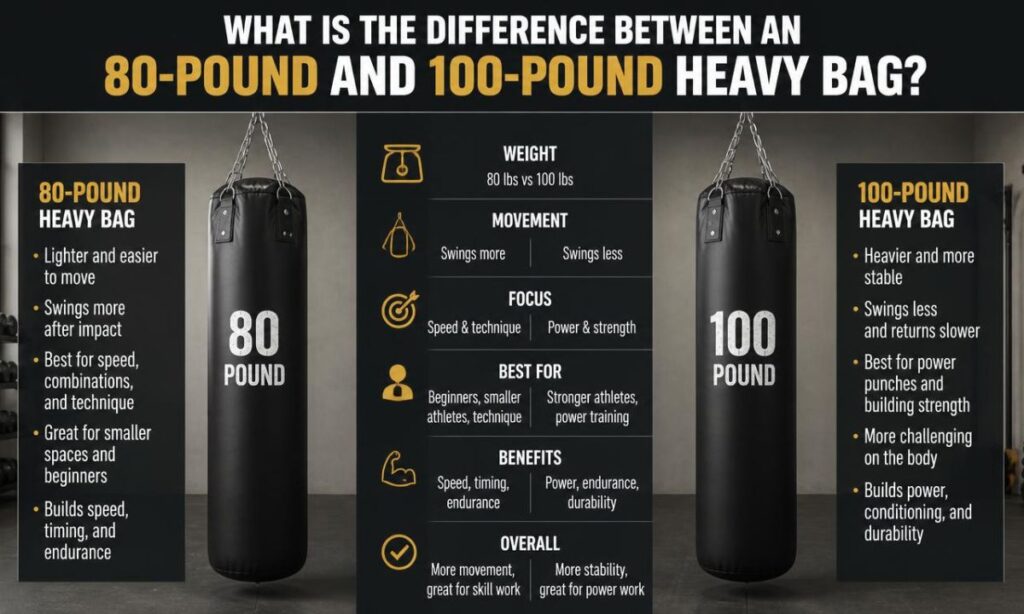
An 80-pound punching bag and a 100-pound punching bag can both be excellent training tools, but they don’t behave exactly the same.
An 80-pound bag generally provides substantial resistance while still allowing some movement. It can be useful for a home gym user who wants to practice combinations, conditioning, and moderate power.
A 100-pound bag is more stable and better suited to people who want a firm target for powerful straight punches, hooks, uppercuts, and kicks. It can be especially useful for an experienced athlete who generates considerable force.
The difference isn’t merely those extra 20 pounds. Bag construction, filling density, hanging height, and dimensions all influence how the bag reacts. Two 100-pound bags can feel surprisingly different, which is one reason product specifications deserve more attention than the number printed on the box.
Punching Bag Size and Weight Are Connected
When you’re looking at punching bag size and weight, don’t focus on weight alone. The punching bag dimensions can dramatically change the way a bag feels and moves.
A longer bag gives you more usable hitting surface. A traditional 5-foot punching bag, for instance, can provide room for both punches and body kicks. A shorter 3-foot bag may be more focused on boxing combinations.
Common dimensions vary by manufacturer, but you may encounter bags around 2.5 feet, 3 feet, 5 feet, or 6 feet long. Some specialty bags have measurements such as 30 × 25 inches or 32 × 16 inches, while smaller training targets may use dimensions closer to 5 × 8 inches or 6 × 9 inches.
A simple heavy bag size chart might look like this:
| Bag Length | General Training Use |
|---|---|
| 2.5–3 feet | Boxing and compact home workouts |
| 4–5 feet | Boxing and mixed striking |
| 5–6 feet | Boxing, kickboxing, and kick training |
| 6+ feet | Larger striking surfaces and specialized training |
Again, these are broad categories. A bag’s diameter, filling, density, and suspension system all matter, so length alone can’t tell the whole story.
Different Types of Punching Bags Have Different Weights
Not every bag in a boxing gym is a traditional heavy bag. The phrase punching bag covers several types of equipment, each designed for a different purpose.
Standard Hanging Heavy Bag
The standard hanging heavy bag is the classic cylindrical bag suspended from a ceiling mount, heavy chain, or reinforced straps. It is commonly used for boxing, kickboxing, and general striking practice.
These bags commonly range from about 40 to 120 pounds, with 60–100 pounds being especially common for adult training. Their sturdy exterior may be made from synthetic materials, canvas, or leather construction, depending on the model.
Free-Standing Punching Bag
A free-standing punching bag sits on a large base rather than hanging from the ceiling. The base is often filled with water or sand to keep the unit stable.
This type can be convenient for a home gym because it avoids ceiling installation. It is also easier to reposition, although moving a filled base isn’t exactly a delightful afternoon activity.
Wrecking Ball Heavy Bag
The wrecking ball heavy bag has a rounded shape designed particularly well for practicing hooks, uppercuts, and body shots. Its shape can make close-range combinations feel more natural.
These bags are often used alongside traditional heavy bags in boxing and martial arts training, especially when athletes want to practice angles and curved strikes.
Speed Bag
A speed bag or speed punching bag is much lighter than a heavy bag. It is designed for rhythm, hand-eye coordination, timing, and rapid punching rather than developing maximum punching power.
Speed bags may have relatively small dimensions, sometimes around 7–9 inches across, although sizes differ by manufacturer.
Uppercut Punching Bag
An uppercut punching bag is shaped to create useful targets for uppercuts, hooks, and angled strikes. It can be mounted horizontally or designed as a specialized hanging unit.
It is particularly useful for boxers who want to practice close-range combinations that aren’t as natural on a standard cylindrical bag.
Wall-Mounted Punching Bag
A wall punching bag or wall-mounted punching bag attaches to a reinforced wall structure using wall brackets or a dedicated wall mount.
These bags can save floor space, which makes them attractive for smaller training rooms. However, the wall must be capable of handling repeated impact. Mounting a powerful bag to a weak wall is a recipe for an unpleasant surprise.
Double-End Bag
A traditional double-end bag attaches at both the top and bottom, creating a rapidly moving target. The Mexican double-end bag is another variation used for rhythm, timing, accuracy, and defensive movement.
Unlike a conventional heavy bag, the double-end bag isn’t mainly about weight. Its value comes from movement and reaction.
Inflatable Punching Bag
An inflatable punching bag is generally designed for lighter recreational workouts, beginners, or children. It uses an air-filled construction and typically offers much less resistance than a genuine heavy punching bag.
It’s useful when portability and simplicity matter, but it shouldn’t be confused with a heavyweight striking bag.
Choosing a Punching Bag for Boxing
For boxing, the right bag should let you practice combinations without constantly fighting the equipment itself. A 60–100 pound hanging bag is common for adult boxing workouts, though the appropriate choice varies with body weight and experience.
A boxer should consider whether they want the bag to swing. A moderate amount of movement can encourage footwork and distance management, while a heavier bag provides a steadier target for power development.
The punching bag for boxing should also have enough height to provide useful targets at head and body level. A 5-foot bag can be particularly versatile because it gives the boxer a long vertical striking area.
Choosing a Bag for Kickboxing and Martial Arts
A person practicing kickboxing, MMA, or broader martial arts may benefit from a longer bag than someone doing only boxing.
Why? Legs take up more space than fists, and kicking techniques need room. A 5-foot or 6-foot bag can provide useful areas for low kicks, body kicks, and higher strikes.
For punching bag for kicks training, weight is also important. A very light bag may swing dramatically after a hard kick, which can be useful for movement drills but frustrating when you’re trying to repeat combinations accurately.
A heavier bag, perhaps 80–100 pounds or more, can provide a more stable target for powerful martial arts combinations.
What Weight Heavy Bag Should I Get for a Home Gym?
Choosing a punching bag for home gym use requires more thought than simply checking the price and weight.
First, measure your available space. You need room not just for the bag but also for your body to move around it. A bag pressed against a wall isn’t much use for practicing footwork.
Second, check the installation point. A 100-pound bag swinging under repeated impact creates much greater forces than its static weight suggests. A proper ceiling mount, reinforced beam, or suitable wall-mounted brackets may be required.
Third, think about noise. A heavy bag can create considerable vibration, especially in apartments or rooms located above other living spaces.
Finally, think about portability. If you’re renting or don’t want permanent installation, a free standing heavy bag may make more sense.
Heavy Bag Weight for Beginners vs Experienced Athletes
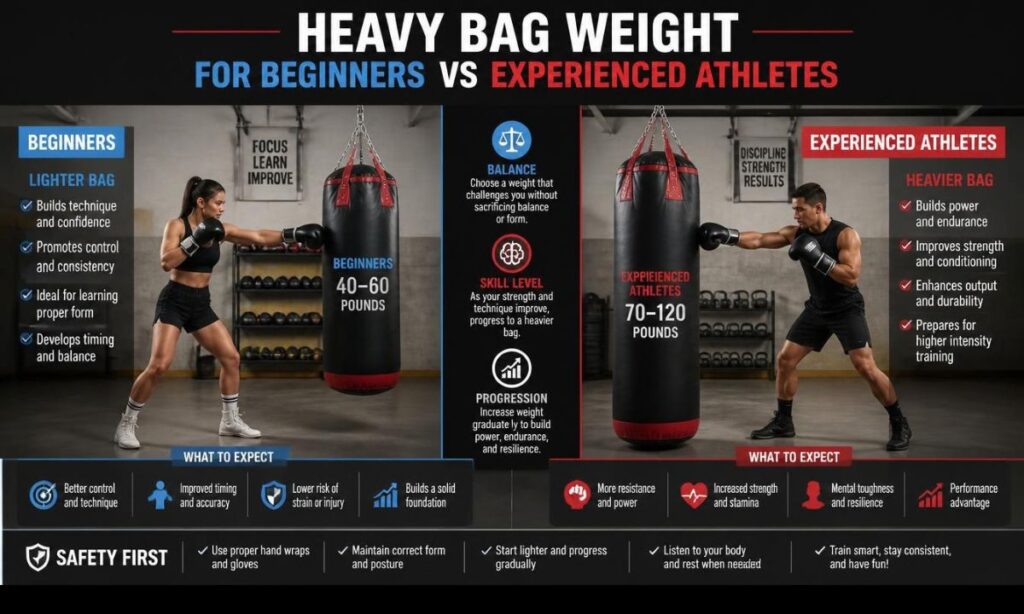
A punching bag for beginners doesn’t need to be extremely heavy. Beginners are usually still learning stance, distance, balance, breathing, and proper striking mechanics.
A moderate-weight bag can allow the user to make mistakes safely while learning. As technique improves, a heavier bag can become useful for developing power and resistance.
An experienced athlete may intentionally use several bags rather than relying on one. A boxer might use a heavy bag for power, a speed bag for rhythm, and a double-end bag for timing and reflexes.
That’s a more complete training setup because different pieces of boxing equipment develop different abilities.
Heavy Bag Weight for Children
Children generally shouldn’t be given an adult-sized heavyweight bag simply because it looks impressive. A punching bag weight for children should be appropriate for their size, age, skill level, and the manufacturer’s intended use.
Lighter bags or child-specific equipment can make training more manageable. For young users, supervision and proper technique matter enormously.
A bag that is too heavy may not move at all, while one that is too light could move excessively. Neither situation automatically creates better training. The equipment should match the person using it, pretty straightforward really.
How Bag Construction Affects Weight
The weight of a bag isn’t determined only by its size. Construction materials matter too.
Some bags use textile or synthetic filling, while others contain dense fabric, foam, rubber materials, or specialized combinations. A rubber bladder may be found in certain equipment designs, particularly specialized or air-filled products.
The outer shell can also affect durability and weight. Leather construction is traditionally valued for its durability and feel, while modern synthetic materials can offer easier maintenance at a lower price.
Chains, straps, hooks, and internal components add additional weight as well. This is why looking at both the advertised weight and construction specifications is useful when buying a punching bag.
How to Choose the Right Punching Bag Weight
If you’re wondering how to choose the right punching bag weight, start with five questions.
What is your body weight? A rough starting point is around half your body weight, but don’t treat this as a mandatory formula.
What is your fitness level? Beginners may prefer lighter or medium-weight equipment, while experienced users may want heavier resistance.
What are your training goals? Boxing combinations, cardio, power development, kicking, reflex work, and technique practice can all point toward different bag types.
How much space do you have? A huge hanging bag isn’t practical if your training area is tiny.
How will you install it? A heavy bag needs a genuinely secure support system. Never assume a normal ceiling hook can handle repeated striking forces.
These questions make the punching bag buying guide much more useful than simply asking, “What is the heaviest bag available?”
Punching Bag Weight and Training Goals
Different weights can change the feel of a workout.
For cardio exercise, a lighter or medium bag may encourage continuous movement and longer combinations.
For strength training, a heavier bag can provide a more stable resistance target, particularly when combined with controlled powerful strikes.
For speed training, a lighter moving target or dedicated speed bag may be more appropriate.
For timing skills and reflex training, a double-end bag can be more useful than a 100-pound heavy bag.
For stamina, almost any appropriate striking bag can become part of interval workouts, especially when rounds are combined with footwork and bodyweight exercises.
In other words, the bag is only one piece of the workout. The way you use it matters enormously.
Does a Heavier Punching Bag Mean a Better Workout?
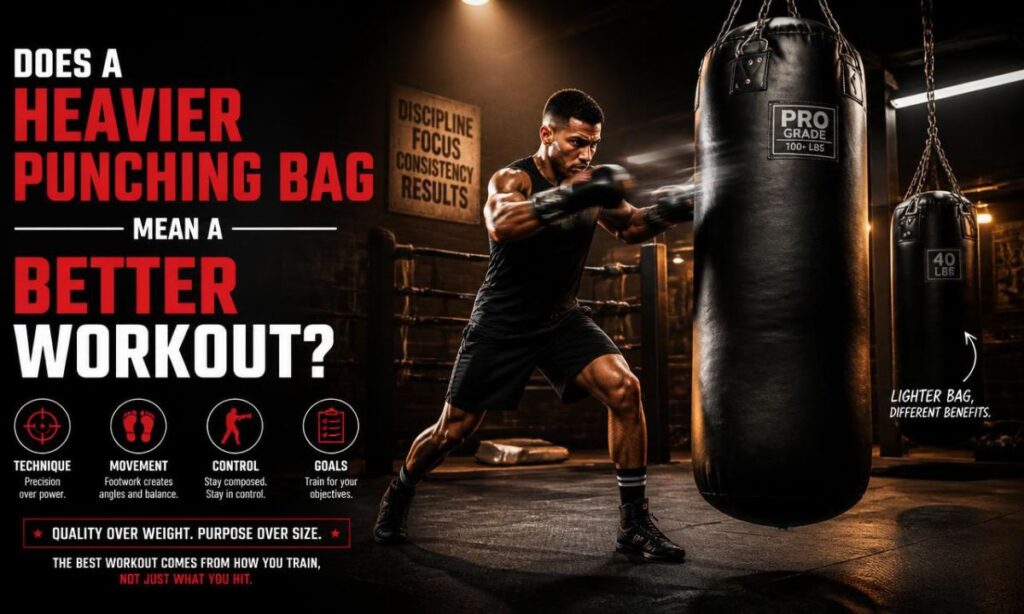
Not necessarily. A heavier bag isn’t automatically better, and a lighter bag isn’t automatically easier in every training situation.
A heavy bag can provide stability and resistance, but the athlete still needs good technique. If someone spends an entire session throwing sloppy punches at a 120-pound bag, the extra weight doesn’t magically turn poor technique into good technique.
Likewise, a lighter bag can create more movement, forcing the user to adjust distance, timing, and footwork. Sometimes the bag moving away is exactly what makes the workout interesting.
The ideal punching bag weight is therefore the one that supports your particular training objective rather than the one with the largest number printed on the label.
Practical Punching Bag Weight and Size Chart
Here is a broader reference you can use when comparing options:
| User / Goal | Approx. Weight | Suggested Bag Type |
|---|---|---|
| Young beginner | 20–40 lbs | Lightweight or child-specific bag |
| Adult beginner | 40–60 lbs | Lightweight/medium heavy bag |
| General fitness | 50–70 lbs | Standard heavy bag |
| Recreational boxer | 60–80 lbs | Hanging heavy bag |
| Regular boxer | 70–100 lbs | Heavy punching bag |
| Kickboxer | 80–120 lbs | Long heavy bag |
| Experienced striker | 90–120+ lbs | Heavy-duty bag |
| Speed/timing work | Much lighter | Speed or double-end bag |
These aren’t universal prescriptions. Manufacturers may recommend different weights, and the user’s height, technique, training frequency, and installation setup should all be considered.
How Much Space Does a Heavy Bag Need?
A heavy bag needs more space than its physical dimensions suggest because it moves.
Suppose you install a 5-foot bag in a narrow room with only a few inches around it. You technically have a punching bag, but you don’t really have a training area.
Allow enough room for your stance, punches, kicks, lateral movement, and the natural swing of the bag. A punching bag for small spaces can work, but planning becomes much more important.
Also consider the height. A hanging bag should be positioned so that its useful striking zones line up with your training needs. The exact bag height depends on the bag’s length and your intended techniques.
Safety and Installation Matter More Than the Number on the Scale
A heavy bag is a piece of fitness equipment, but it can create substantial forces during training. Secure installation is therefore essential.
A ceiling mount should be attached to an appropriate structural point, not merely a decorative ceiling surface. Wall-mounted systems need suitable wall brackets and proper structural support.
Use a strong chain or manufacturer-approved tie-down straps where appropriate. Inspect the mounting hardware regularly for wear, loose bolts, cracks, or deformation.
The same goes for the bag itself. Check the hitting surface, stitching, suspension straps, and attachment points. A small problem noticed early is much easier to deal with than a heavy bag falling in the middle of your workout.
What Should You Look for When Buying a Heavy Bag?
When choosing a punching bag, consider these factors together:
- Bag weight: Match it to your body weight and training goals.
- Bag size: Choose enough length for the techniques you practice.
- Material: Look at leather, synthetic leather, canvas, or other construction.
- Mounting: Make sure your ceiling or wall can support the equipment.
- Filling: Different fillings create different levels of firmness.
- Training purpose: Boxing, kicks, cardio, speed, or martial arts may require different designs.
- Available space: Leave room for movement around the bag.
- Budget: More expensive doesn’t always mean more suitable.
- Portability: Consider a standing model if permanent installation isn’t practical.
- Maintenance: Inspect the bag and hardware regularly.
This approach makes choosing heavy bag weight much less confusing. You’re not really choosing a number; you’re choosing a complete training setup.
Read more : What Is the Standard Size of a Bedroom?
Frequently Asked Questions
How Much Does a Standard Heavy Bag Weigh?
A standard heavy bag usually weighs between 60 and 100 pounds, depending on its size, filling, and construction.
What Weight Heavy Bag Should I Get?
For most beginners, a 60–80 pound bag is a practical choice, while experienced athletes may prefer a 100-pound or heavier bag.
How Heavy Should a Punching Bag Be for Boxing?
A boxing heavy bag should generally weigh around half of the user’s body weight, although training goals and experience also matter.
Does Heavy Bag Weight Affect Training?
Yes, heavier bags move less and provide more resistance, while lighter bags swing more and can help develop movement, timing, and speed.
Conclusion
So, how much does a heavy bag weigh? For most traditional adult models, somewhere around 60 to 100 pounds is a useful general range, with lighter bags available for beginners and heavier models available for experienced athletes.
A 60-pound heavy bag weighs about 27 kg, an 80-pound bag weighs about 36 kg, and a 100-pound bag weighs about 45 kg. Larger specialty models can reach 120 pounds or more. The actual heavy bag weight varies according to the manufacturer, dimensions, filling, and construction.
The important thing is not to chase the biggest number. Think about your body weight, fitness level, training goals, available space, installation options, and whether you’re practicing boxing, kickboxing, MMA, or general fitness.
A well-chosen punching bag should challenge you without turning every workout into a battle against the equipment itself. Start with a sensible weight, learn your technique, and increase the challenge as your training develops. And remember, the bag doesn’t need to be enormous to make your workout feel very real indeed.
If you’re still unsure, compare the manufacturer’s weight recommendations with your body weight and experience, then consider how much movement you want from the bag. That’s usually a much smarter way to select your equipment than simply picking the heaviest bag you can find.
Explore More Blogs