Five inches sounds like a tiny measurement until you try to picture it without a ruler. Then suddenly, your brain starts doing that funny little guessing game: Is it about the length of my hand? A phone? A pen? Maybe a soda can? The answer is surprisingly close to several ordinary things sitting around your home right now.
If you’re wondering what does 5 inches look like, the easiest answer is to connect the measurement to familiar objects. 5 inches equals 12.7 centimeters, so it is noticeable but still fairly compact. It is about the length of a small smartphone, a little shorter than a standard soda can, and roughly the length of several everyday stationery or personal-care items.
This guide explores five inches from different angles, including conversions, rulers, phones, coins, household objects, sports equipment, and simple ways to estimate the length when no measuring tool is nearby. The goal isn’t just to give you a number. It is to help you actually see the size in your mind.
How Long Is 5 Inches?
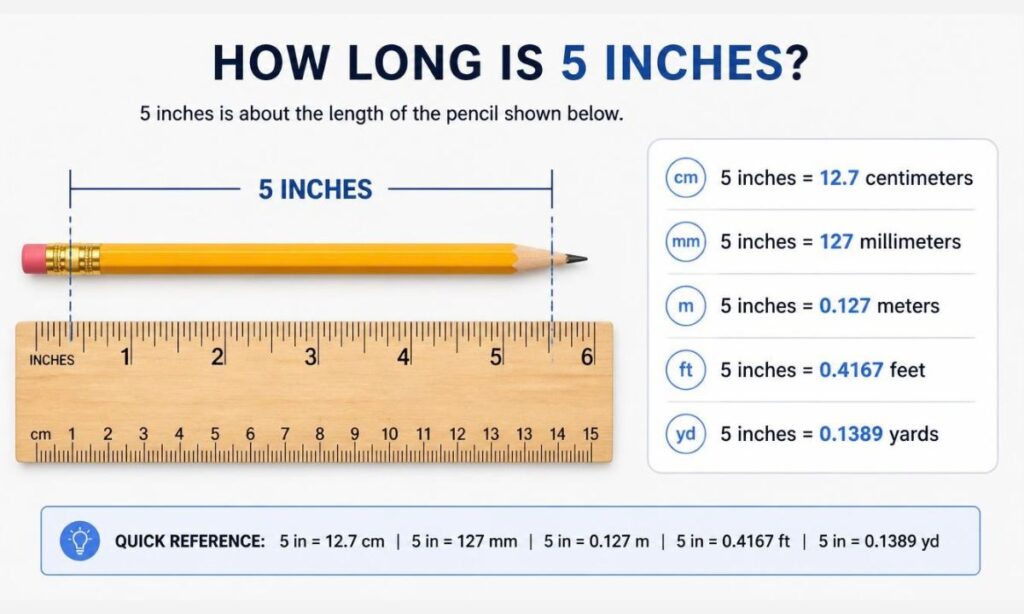
So, how long is 5 inches exactly? One inch equals 2.54 centimeters, which means:
- 5 inches = 12.7 centimeters
- 5 inches = 127 millimeters
- 5 inches = 0.127 meters
- 5 inches = 0.4167 feet
- 5 inches = 0.1389 yards
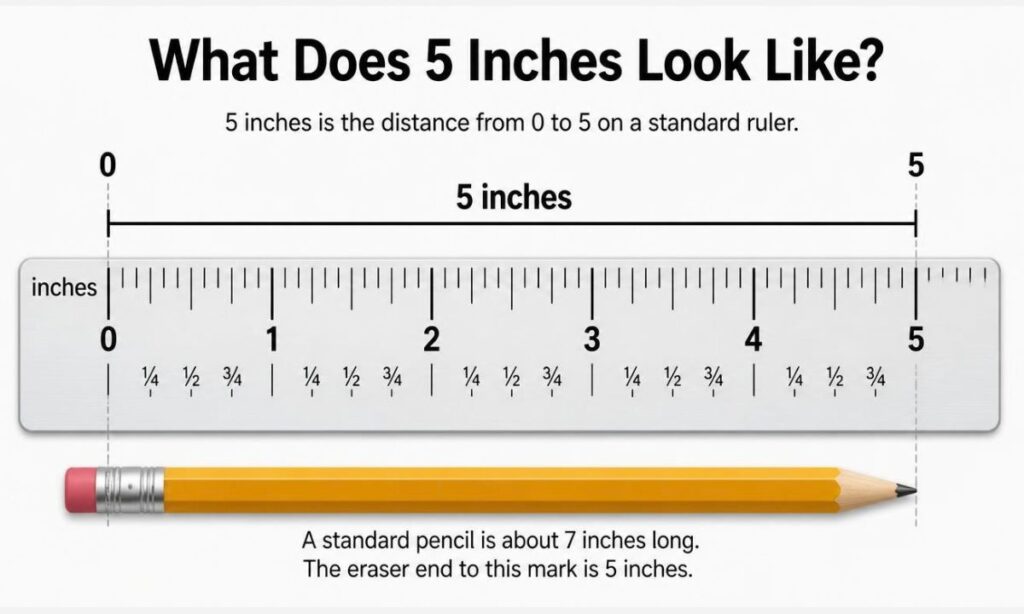
In other words, five inches is a 5-inch length measuring exactly 12.7 cm from one end to the other. If you place an object beside a ruler, its endpoint would land right on the 5-inch mark.
That makes 5 inches a useful reference when you’re trying to judge the length, height, or width of something. Just remember that an object’s overall size can have three different dimensions. A box might be 5 inches long but only 2 inches wide, for example.
For quick measurement conversion, the most useful formula is simple:
Inches × 2.54 = centimeters
So, 5 × 2.54 gives you 12.7 centimeters. For inch to mm conversion, multiply by 25.4 instead, giving 127 millimeters. No complicated calculator gymnastics required.
What Does 5 Inches Look Like in Real Life?
The phrase what does 5 inches look like in real life is easier to answer with familiar objects than with numbers. Imagine holding a ruler and placing your finger at zero. Move along to the 5-inch mark. That’s the entire distance we’re talking about.
Several common objects come surprisingly close to this size, although not every example will be exactly 5 inches.
A small smartphone, for instance, can give you a strong visual reference. The iPhone 13 mini is about 5.18 inches tall, making it extremely close to five inches. The iPhone 7, at about 5.44 inches tall, is slightly longer.
Other useful references include:
- A 12-oz soda can is roughly 4.83 inches tall.
- A Bic Cristal pen is around the five-to-six-inch range, depending on the model.
- Several poker cards placed end to end can quickly exceed five inches.
- A group of pennies lined up by diameter comes surprisingly close.
- Some pocket combs and nail files are made around this general length.
- Two small objects placed end to end can create an easy visual approximation.
These examples show why 5 inches comparison is useful. Rather than memorizing an abstract number, you attach the measurement to something you’ve already seen hundreds of times.
15 Things That Are About 5 Inches Long
If you’re searching for things that are 5 inches long, there are plenty of everyday references. Some are very close to exactly five inches, while others are useful because their dimensions make the comparison easy.
1. iPhone 13 Mini
The iPhone 13 mini measures approximately 5.18 inches in height. That makes it one of the easiest modern references for understanding a 5-inch size.
Place a ruler beside the phone and you’ll see that five inches ends just a little below its top edge. It’s almost a perfect real-world visual guide.
2. iPhone 7
The iPhone 7 is approximately 5.44 inches tall. It is therefore slightly longer than five inches, but not by much.
If you don’t have a ruler nearby, imagining the length of an iPhone 7 gives you a useful approximation of how big is 5 inches.
3. A 12-Ounce Soda Can
A standard 12-oz soda can is around 4.8 inches tall. That’s just a fraction shorter than five inches.
So if you’re holding a regular aluminum can, you are looking at something remarkably close to the target measurement. It’s one of the best household references for 5 inches in real life.
4. Several Pennies in a Row
A U.S. penny has a diameter of about 0.75 inches. Seven pennies lined up edge to edge would measure about 5.25 inches.
That means 7 pennies provide a rough but memorable way to visualize five inches. They aren’t exact, but they’re close enough for everyday size estimation.
5. A Bic Cristal Pen
A standard Bic Cristal ballpoint pen is longer than five inches, but its familiar slim shape makes it useful for judging approximate length.
If you imagine removing roughly an inch from the pen’s overall length, you’re getting closer to five inches. Not laboratory precision, obviously, but handy when you’re estimating.
6. A Pocket Comb
Many compact hair combs measure around five inches. Their dimensions vary, but the typical pocket-sized design can make a good visual reference.
A five-inch comb is small enough to fit easily inside a purse or pocket while still being long enough for practical styling.
7. A Nail File
Some nail files are manufactured around five inches long. They’re another useful personal-care reference.
Imagine placing one beside a ruler: the distance from the end of the file to the other end can fall very close to the 5-inch mark.
8. Two Golf Tees
Depending on the model, two standard golf tees placed end to end can approach five inches. Individual golf tees vary in length, so this is best treated as an approximation.
Still, it’s a fun way to understand the measurement if you’re around a golf bag or golf course.
9. Tea Light Candles
A single tea light candle isn’t five inches long, but several placed in a line quickly demonstrate how short five inches actually is.
Their small circular shape also helps distinguish length from diameter, which people sometimes mix up when looking at household objects.
10. A Teaspoon Handle
The handle of a kitchen teaspoon can approach several inches, depending on the spoon design. Some are close enough to provide a rough reference.
It’s particularly useful when thinking about measurements in cooking, where visual estimates are common.
11. Poker Cards
A standard poker card is about 3.5 inches long. One card alone is therefore shorter than five inches.
Place a second card beside it with some overlap, however, and you can easily visualize the difference between three-and-a-half inches and five inches.
12. Ping Pong Balls
A standard ping pong ball, or table tennis ball, has a diameter of about 1.57 inches. Three balls lined up would total roughly 4.7 inches.
That’s remarkably close to five inches and creates a surprisingly intuitive 5 inch comparison.
13. Paper Clips
Standard paper clips are generally much shorter than five inches, but placing several end to end provides a familiar stationery size comparison.
For example, if a paper clip is roughly one inch long, five of them lined up would illustrate the measurement quite neatly.
14. A Small Pocket Comb
Compact combs are often manufactured in sizes around five inches. They are especially useful because their long, narrow shape makes the measurement easy to visualize.
A five-inch pocket comb is basically the kind of object you could slip into a purse or small toiletry pouch without thinking twice.
15. A Garden Snail’s Shell
A typical garden snail, scientifically known as Cornu aspersum, is generally much smaller than five inches. But the example is useful because it reminds us that biological objects vary considerably.
A snail’s shell diameter is normally measured in centimeters, not inches, and comparing it with five inches helps demonstrate just how large five inches would be for such a creature.
How Big Is 5 Inches Compared to a Hand?
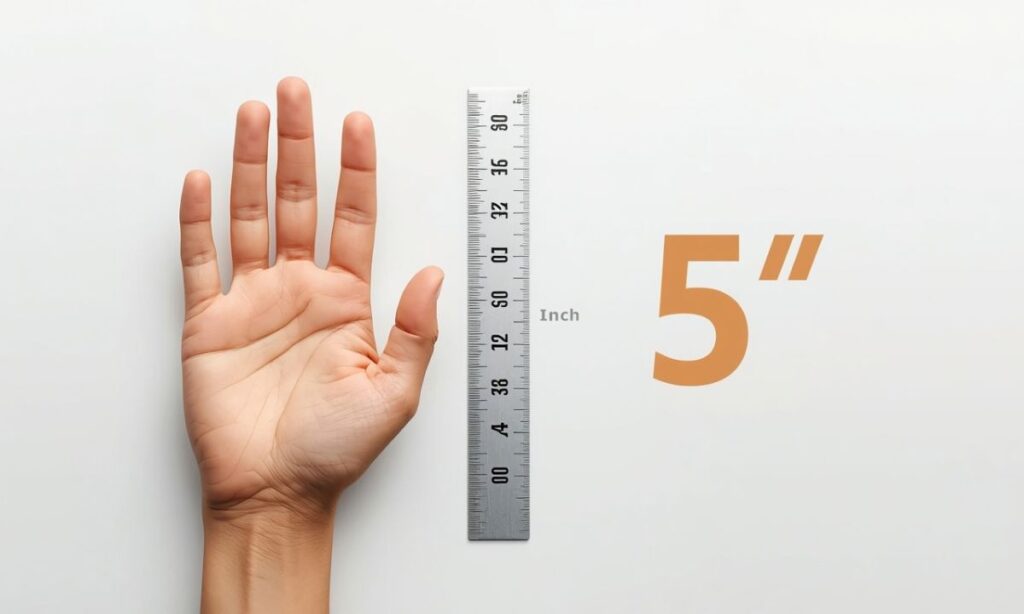
Another common question is what does 5 inches look like compared to a hand?
The answer depends heavily on the person. Hand sizes aren’t standardized, so your thumb, palm, or finger cannot provide an exact measurement. Still, the distance across certain parts of an adult hand can offer a rough visual reference.
For many adults, five inches is somewhere around the width or length of a portion of the hand rather than the entire hand. Your thumb itself will usually be much shorter than five inches, while the distance from the base of the palm toward the fingertips is considerably longer.
This is why using adult thumbs or fingers for exact measurement isn’t recommended. Hands are excellent for quick estimates, but a ruler is the better choice when accuracy matters.
If you’re simply asking how to visualize 5 inches, hold your hand flat and imagine a ruler extending from zero to the five-inch point. Your hand becomes a reference object rather than a measuring instrument.
What Does 5 Inches Look Like Compared to a Phone?
Phones are among the easiest objects to use for visual measurement because their dimensions are fairly consistent and familiar.
The iPhone 13 mini is about 5.18 inches tall, which makes it almost the same as five inches. If someone asks you what does 5 inches look like compared to a phone, this is a particularly strong reference.
The iPhone 7 is approximately 5.44 inches tall, so it is slightly longer. The difference between the two phones is enough to show that even half an inch can become visible when objects are placed side by side.
One important detail, though: when people say a phone is a “5-inch phone,” they may actually be referring to the screen size, measured diagonally. That’s different from the phone’s physical height.
So don’t confuse:
- Screen size: measured diagonally across the display.
- Phone length: measured from the top edge to the bottom edge.
- Phone width: measured from one side to the other.
Those are three separate measurements, and yeah, the wording can be a little sneaky.
What Does 5 Inches Look Like Compared to a Dollar Bill?
A U.S. $1 bill is approximately 6.14 inches long and 2.61 inches wide. Therefore, five inches is shorter than the long edge of a dollar bill.
Imagine placing a ruler along the length of a US dollar bill. The five-inch point would appear a little more than one inch before the far edge.
That makes the bill a useful reference when you’re trying to estimate 5 inches without a ruler. You don’t need to carry measuring equipment everywhere; remembering that five inches is noticeably shorter than a dollar bill’s longest side can be enough for casual comparisons.
The same basic dimensions apply to other denominations of modern United States currency, so the familiar rectangular shape works as a convenient everyday reference.
What Does 5 Inches Look Like Compared to a Penny?
Coins are especially useful for visual comparisons because their dimensions are standardized.
A U.S. penny has a diameter of approximately 0.75 inches. Seven pennies placed edge to edge measure around 5.25 inches.
So, if you have seven pennies sitting on a table, line them up carefully from edge to edge. Their total span will be just a quarter inch longer than five inches.
This isn’t a substitute for precise coin measurement, but it’s an easy trick for rough length estimation. You can even remember it as “seven pennies is about five inches,” which is much easier to recall than a decimal.
How to Measure 5 Inches Without a Ruler
What if you’re somewhere without a ruler and need to measure 5 inches?
There are several ways to make a reasonable estimate.
Use a Smartphone
If you have a phone whose physical dimensions you know, it can serve as a reference object. A device close to five inches tall can provide a strong comparison.
Just remember that phone cases add extra size, and different models have different dimensions.
Use a Dollar Bill
A standard U.S. dollar bill is 6.14 inches long. Five inches is therefore about 81% of its long edge.
You can mentally estimate that distance along the bill when a rough measurement is good enough.
Use Seven Pennies
As mentioned earlier, seven pennies span about 5.25 inches when placed edge to edge.
For casual ruler-free measurement, that’s surprisingly useful.
Use Your Hand
Your hand can provide a rough visual reference, but it shouldn’t be treated as an exact measurement tool. If you’re measuring something for construction, tailoring, crafting, or another task where precision matters, use an actual ruler or measuring tape.
Use a Credit Card or Similar Reference
A standard payment card is about 3.37 inches wide. Two cards placed end to end would be considerably longer than five inches, but one card plus roughly half its width can help you visualize the distance.
It’s not exact, but real-world references like these are often easier to remember than numbers.
How Long Is 5 Inches on a Ruler?
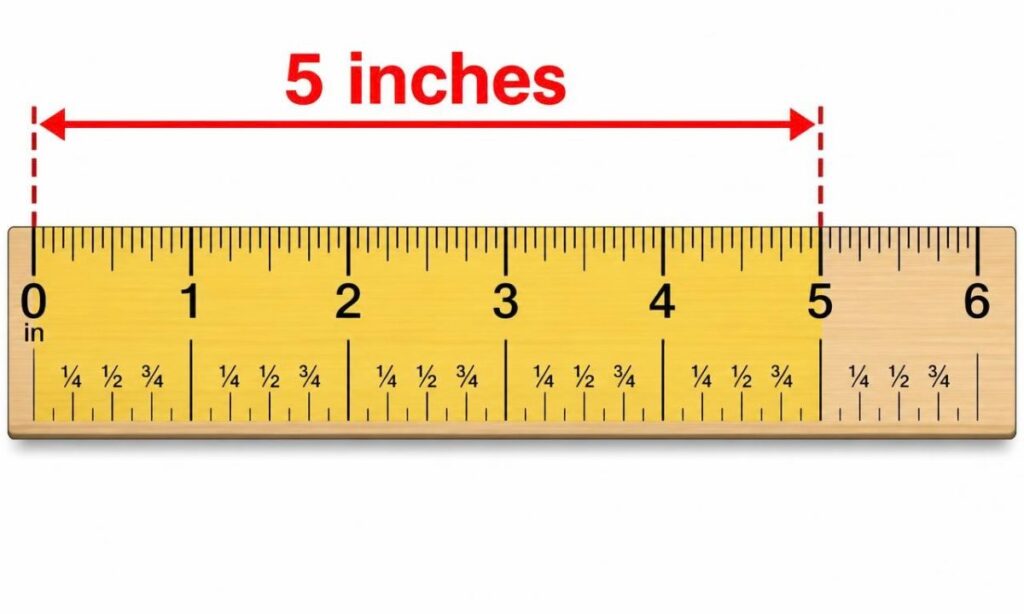
On a standard ruler, finding five inches is straightforward.
Start at zero and move along the ruler until you reach the number 5. That line represents exactly 5.0 inches.
Depending on the ruler, you may see smaller divisions between each inch. These divisions commonly represent fractions such as halves, quarters, eighths, or sixteenths.
The 5-inch mark on ruler is therefore the main reference point. If an object reaches from zero to that mark, its measured length is five inches.
For precise work, make sure the object’s starting edge is aligned with zero rather than the physical end of the ruler. Some rulers have a small blank border before the first measurement line, and that can throw off your result.
5 Inches in Centimeters, Millimeters, Feet, and Yards
For anyone dealing with international measurements, 5 inches to cm is probably the most useful conversion.
| Measurement | Equivalent |
|---|---|
| 5 inches | 12.7 centimeters |
| 5 inches | 127 millimeters |
| 5 inches | 0.127 meters |
| 5 inches | 0.4167 feet |
| 5 inches | 0.1389 yards |
So when someone asks how many centimeters is 5 inches, the exact answer is 12.7 centimeters.
For 5 inches to millimeters, the answer is 127 mm.
For 5 inches to feet, it is approximately 0.4167 feet.
And for 5 inches to yards, it is approximately 0.1389 yards.
These conversions are especially handy when product dimensions are listed in one measurement system but your ruler uses another. It happens more often than you’d expect, particularly with imported products and online shopping.
5 Inches Compared to Everyday Objects
A measurement becomes much easier to understand when you stop treating it like a number and start treating it like an object.
Think about a little line stretching across your desk. Five inches is longer than a typical paper clip, shorter than a dollar bill, nearly the height of an iPhone 13 mini, and just slightly taller than a standard 12-ounce soda can.
That’s why 5 inches compared to everyday objects works so well as a visual reference.
Here are some quick mental comparisons:
- iPhone 13 mini: about 5.18 inches tall.
- iPhone 7: about 5.44 inches tall.
- 12-oz soda can: about 4.83 inches tall.
- Seven pennies: about 5.25 inches across when lined up.
- Three ping pong balls: about 4.7 inches across when arranged end to end.
- $1 bill: 6.14 inches long, so noticeably longer.
- Poker card: about 3.5 inches long, so shorter.
- Small pocket comb: often close to five inches, depending on design.
These comparisons aren’t meant to replace measuring. They’re visual shortcuts, basically little mental rulers you can carry around without actually carrying a ruler.
Why 5 Inches Can Look Different on Different Objects
An interesting thing about measurement is that the same length can look completely different depending on an object’s shape.
A five-inch-long pencil appears long and narrow. A five-inch-wide square looks broad. A five-inch-tall cylinder looks completely different again.
This is because our eyes don’t perceive length in isolation. We also notice width, height, diameter, thickness, color, and surrounding objects.
For example, a five-inch ruler and a five-inch-diameter circular object have exactly the same numerical measurement in one direction, but they don’t look remotely alike.
That’s why object size comparison should always identify which dimension is being compared.
Is 5 Inches Considered Long?
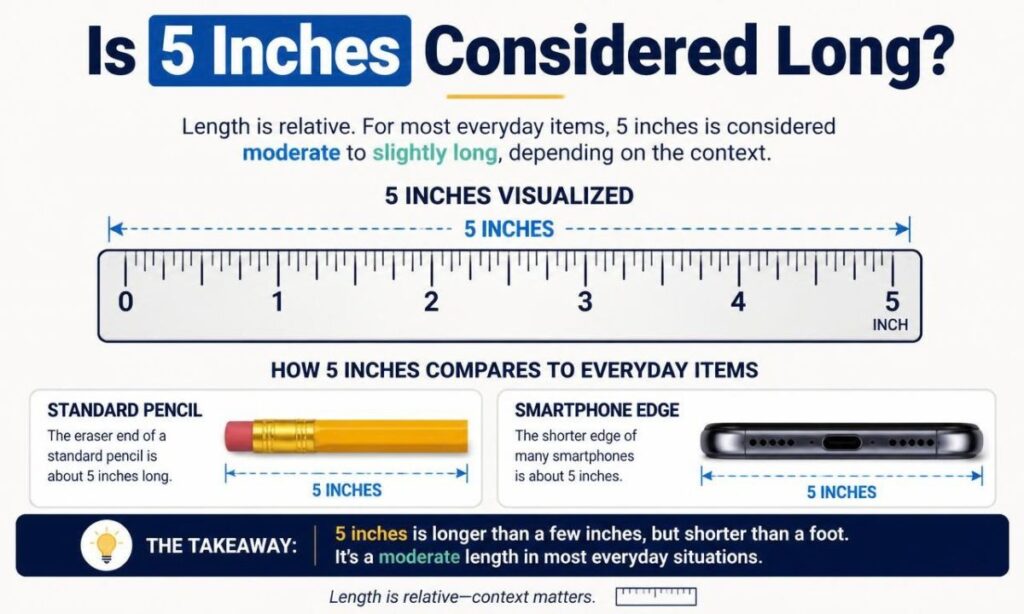
Whether five inches is “long” depends entirely on the object.
For a pencil, five inches is relatively short. For a garden snail, five inches would be enormous. For a phone, five inches is close to the total height of a compact smartphone. For a ruler, five inches is only part of its overall length.
So there isn’t one universal answer to how big is 5 inches.
The better question is: five inches of what?
When you understand that distinction, measurements become much less confusing. A number describes a dimension, while the object gives that dimension its visual meaning.
Easy Ways to Visualize 5 Inches
If you’re trying to memorize the measurement, don’t memorize the conversion table first. Build a little mental picture instead.
Think of a compact smartphone almost five inches tall. Then imagine a standard soda can, which is just under five inches tall. Then picture seven pennies lined up in a row.
Those three references give you different shapes but nearly the same overall scale.
You can also remember:
5 inches ≈ 12.7 cm ≈ the height of a small phone ≈ the height of a soda can.
That mental shortcut is much more useful in daily life than endlessly thinking, “Wait, how many millimeters was that again?”
Frequently Asked Questions
How Do I Choose the Right Dress Size?
Check your bust, waist, and hip measurements against the brand’s size chart to find the closest match and ensure a comfortable fit.
What Are the Standard US Dress Sizes?
US dress sizes generally range from 0 to 24+, but sizing can vary between brands, styles, and designers.
How Should a Dress Fit?
A well-fitting dress should feel comfortable around the bust, waist, and hips without pulling, gaping, or restricting movement.
How Do I Measure Myself for a Dress?
Use a soft measuring tape to measure your bust, natural waist, and fullest hip area while keeping the tape level and comfortably snug.
Conclusion
So, what does 5 inches look like?
It looks like a small but very noticeable everyday length—roughly 12.7 centimeters. It is close to the height of an iPhone 13 mini, slightly taller than a typical 12-oz soda can, around the span of seven lined-up pennies, and shorter than the long edge of a U.S. dollar bill.
The best way to understand five inches is through several familiar reference points rather than one supposedly perfect object. Use a ruler when you need accuracy, but use everyday objects when you simply need your brain to recognize the size.
Once you’ve compared 5 inches with a phone, coins, stationery, kitchen items, and household objects a few times, the measurement starts to feel much less abstract. Five inches becomes a real distance you can almost see.
And that’s really the trick with measurement: numbers tell you how much, but familiar objects tell you what it feels like.