Finding the right T-shirt should feel simple, but sometimes a small letter on a clothing label can create a surprisingly big question. Should you choose a medium or large? Will a unisex shirt fit the same way as a men’s T-shirt? And if you usually wear women’s clothing, which unisex size should you pick?
That’s where understanding Unisex T Shirt Sizes becomes helpful. Unisex T-shirts are designed to suit people of different genders, offering a versatile option for everyday outfits, work uniforms, team events, and personalized merchandise. They are popular because of their relaxed designs, practical comfort, and ability to fit into almost any wardrobe.
Still, unisex sizing isn’t identical across every brand. A medium from one manufacturer might feel roomy, while another medium could fit closer to the body. The trick is knowing how to read a size chart, measure yourself correctly, and choose a fit that feels right for you.
In this guide, we’ll explore unisex T-shirt measurements, size conversions, men’s and women’s equivalents, international sizing differences, and practical tips for choosing the perfect shirt. Whether you’re shopping online or ordering custom T-shirts for a group, you’ll have a clearer idea of what to look for.
What Does Unisex T-Shirt Sizing Mean?
A unisex T-shirt is designed for people of different genders rather than being made exclusively for men or women. Many unisex styles use a straight body shape, relatively broad shoulders, and a comfortable fit that works for a variety of body types.
In everyday clothing, unisex sizing often resembles standard men’s sizing. However, this is not a universal rule. Some brands create their own gender-neutral patterns, while others adapt an existing T-shirt design to accommodate different preferences.
Gender-neutral clothing also reflects a wider movement toward inclusive fashion. People can select garments based on comfort, personal style, and measurements instead of feeling restricted by traditional men’s and women’s clothing sections.
A unisex shirt might be worn as a regular everyday top, an oversized streetwear piece, a work uniform, or a customized graphic T-shirt. Its versatility is part of the appeal.
Unisex T-Shirt Size Chart
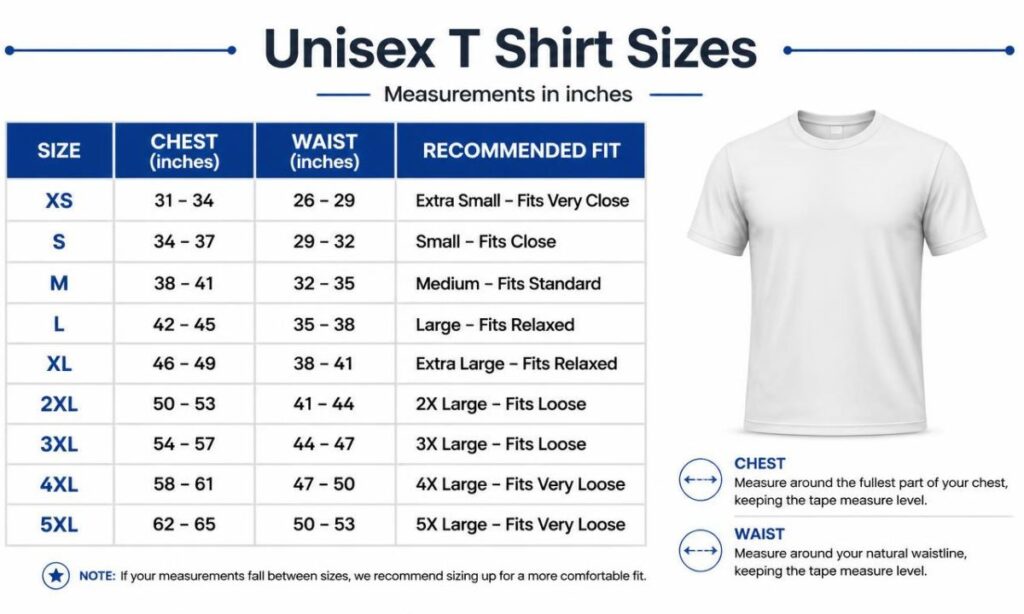
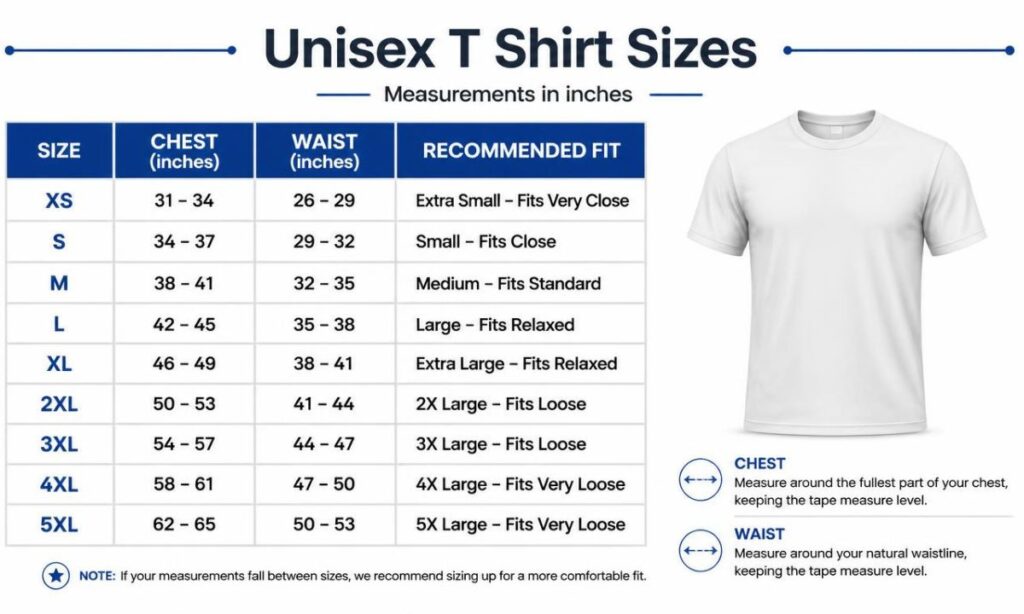
The easiest way to understand Unisex T-shirt sizing is to begin with a general size chart. The following table provides illustrative chest measurement ranges for adults. These ranges are a starting point rather than a universal industry standard, so always check the specific brand’s chart before ordering.
| Size | Approximate chest measurement | Chest in centimeters |
|---|---|---|
| XXS | 30–32 inches | 76–81 cm |
| XS | 32–34 inches | 81–86 cm |
| S | 34–36 inches | 86–91 cm |
| M | 36–40 inches | 91–102 cm |
| L | 40–44 inches | 102–112 cm |
| XL | 44–48 inches | 112–122 cm |
| 2XL | 48–52 inches | 122–132 cm |
| 3XL | 52–56 inches | 132–142 cm |
| 4XL | 56–60 inches | 142–152 cm |
These measurements refer to approximate body chest circumference, not necessarily the actual circumference of the finished garment. A T-shirt needs extra room beyond the body measurement to allow comfortable movement.
For example, someone with a 38-inch chest might fit a medium in one brand and a large in another. The difference could come from the shirt’s cut, fabric stretch, intended fit, or manufacturer’s sizing standards.
When shopping, look for a note explaining whether the chart lists body measurements or garment measurements. That little detail can prevent a lot of sizing confusion.
Understanding Standard Unisex T-Shirt Sizes
Every size has its own general purpose, but the right choice depends on your body measurements and preferred appearance. Here’s how the most common standard unisex T-shirt sizes generally work.
XXS and XS: Extra Small Options
XXS and XS are useful for people who prefer a closer fit or have smaller body measurements. These sizes may also suit anyone looking for a less bulky shirt to wear beneath a jacket or cardigan.
An XS doesn’t automatically mean the shirt will be short or tight. Its actual length and width depend on the manufacturer.
Small: A Comfortable Everyday Choice
Small is often selected by people who want a relatively neat silhouette without wearing a tight-fitting shirt. It can work well for casual outfits, lightweight layering, and customized T-shirts.
If you’re between XS and S, compare the chest width and body length rather than assuming that the smaller size will always look better.
Medium: A Popular Middle Ground
Medium is a common option for people who prefer a balanced fit. It can provide enough room for movement without creating an especially oversized appearance.
However, the word medium doesn’t describe one fixed set of measurements. If you normally wear a medium in women’s clothing, you should still compare your measurements against the unisex chart.
Large and XL: More Room to Move
Large and XL offer additional width and, in many designs, extra length. These sizes may suit broader shoulders, larger chest measurements, or people who simply enjoy a relaxed style.
Some people intentionally choose these sizes for an oversized look. Others need the extra room for a comfortable everyday fit. Neither choice is wrong; the important thing is knowing what the garment will look like when worn.
2XL, 3XL, and 4XL: Extended Sizes
Extended sizes provide additional options for people who need or prefer more room. They can be particularly useful when ordering company uniforms, family reunion shirts, or event merchandise for a diverse group.
Check the actual measurements carefully because extended-size garments don’t always increase in length and width at the same rate. A shirt might become wider without gaining much additional length, depending on the design.
How to Read a Unisex T-Shirt Size Chart
A Unisex T-shirt size chart is most useful when you know which measurements matter. Most charts include some combination of chest width, body length, shoulder width, and sleeve length.
Here’s what those terms usually mean:
- Chest: The measurement around the fullest part of your chest.
- Shoulder width: The distance across the shoulders, commonly measured from one shoulder seam to the other on a garment.
- Body length: The distance from the highest shoulder point near the collar to the bottom hem.
- Sleeve length: The length of the sleeve, measured according to the manufacturer’s method.
- Garment width: The flat measurement from one side of the shirt to the other, usually across the chest.
One important detail is that a flat garment measurement is not the same as a body circumference. If a shirt measures 20 inches across the chest while lying flat, its approximate circumference at that point is 40 inches, assuming the garment is measured straight across without stretching.
Don’t overlook body length either. A shirt can fit comfortably around your chest and still feel too short or too long. Checking both width and length gives you a much better idea of how it will fit.
How to Measure Unisex T-Shirt Size
You don’t need professional tailoring equipment to determine your size. A flexible measuring tape and a few minutes are usually enough.
Measure Your Chest
Wrap a measuring tape around the fullest part of your chest, keeping it level beneath your arms. Stand naturally and avoid pulling the tape so tightly that it compresses your body.
Record the measurement in inches or centimeters. If your chest measures 96 cm, for example, that’s approximately 37.8 inches.
Compare this number with the body measurement range in the brand’s size chart. If you’re between sizes, consider whether you prefer a regular, fitted, or relaxed appearance.
Measure Your Shoulders
Shoulder measurements can be helpful when you have broad shoulders or prefer a more structured T-shirt.
For the simplest method, use a T-shirt that already fits well. Lay it on a flat surface and measure across the back from one shoulder seam to the other.
Compare that measurement with the garment measurements of the shirt you want to purchase. Keep in mind that dropped-shoulder and oversized designs are intended to sit differently from traditional shirts.
Measure Your Preferred T-Shirt Length
Take a shirt you like wearing and lay it flat. Measure from the highest point near the shoulder and collar down to the bottom hem.
This measurement can help you avoid shirts that sit too high or extend farther down your body than you prefer.
The right length depends on your proportions and style. Someone who likes a cropped appearance will want a different measurement from someone who prefers a longer streetwear fit.
Check the Sleeve Length
Sleeves influence the overall appearance of a T-shirt. Shorter sleeves can create a more fitted look, while longer or wider sleeves often give a relaxed, contemporary feel.
Measure a favorite shirt’s sleeve and compare it with the product chart if the manufacturer provides this information. Not every brand lists sleeve measurements, but they can be useful when available.
Unisex T-Shirt Sizes for Men and Women
One of the most common questions about Unisex T-shirt sizes for men and women is whether everyone should choose the same size. The answer depends on body measurements, garment construction, and personal preference.
Unisex T-shirts are often based on a straighter silhouette than traditionally fitted women’s shirts. That can mean a wider waist, a different shoulder shape, and a less tapered body.
For some people, this design feels more comfortable. Others may prefer a more shaped garment or a smaller size for a closer fit.
Unisex T-Shirt Size for Women
Women who are accustomed to fitted women’s T-shirts may find unisex styles wider through the body and shoulders. Some choose a smaller size for a neater appearance, while others select their usual size for a relaxed fit.
For example, someone who wears a women’s medium might try a unisex small if the brand’s chart suggests it. But another person’s women’s medium could match a unisex medium more closely.
There is no dependable one-size-fits-all conversion because women’s clothing sizes vary considerably between brands.
Unisex T-Shirt Size for Men
Men who typically wear men’s T-shirts may find unisex sizing familiar, especially when a brand uses a standard straight-cut pattern.
Even so, don’t assume the sizes are identical. A unisex large may have different shoulder proportions, body length, or overall width from a men’s large produced by another manufacturer.
If your current shirt fits well, measuring it flat and comparing those numbers with the new product is often more reliable than comparing labels.
Unisex T-Shirt Size Comparison
The table below provides a general starting point for comparing traditional women’s labels with unisex letter sizes. These are approximate shopping suggestions, not guaranteed equivalents.
| Traditional women’s size | Possible unisex size to try |
|---|---|
| Women’s XS | Unisex XS or XXS |
| Women’s S | Unisex XS or S |
| Women’s M | Unisex S or M |
| Women’s L | Unisex M or L |
| Women’s XL | Unisex L or XL |
| Women’s 2XL | Unisex XL or 2XL |
Use your measurements to make the final decision. The table cannot account for every brand’s pattern, fabric, or fit preference.
For a closer look, compare the shirt’s chest and shoulder measurements. For a relaxed appearance, you might prefer the larger of two suitable sizes.
Unisex vs. Men’s T-Shirt Sizes
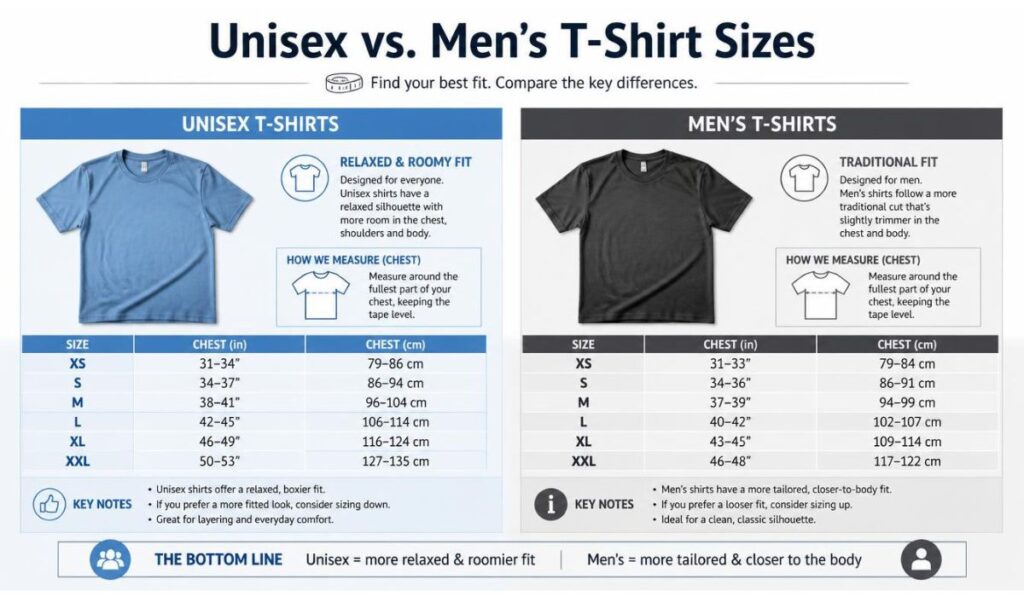
Unisex and men’s T-shirts often look similar, but there are some differences worth understanding.
A men’s T-shirt may be designed around a conventional men’s fit, while a unisex version aims to accommodate a wider range of people. Depending on the brand, the unisex shirt may have similar measurements to its men’s equivalent or a slightly different cut.
Consider these factors:
- Shoulders: Some men’s styles use broader shoulder proportions, while some unisex designs use a more general shape.
- Body shape: Unisex shirts often have a relatively straight cut through the waist.
- Length: Body length varies by style and brand rather than being determined by the unisex label alone.
- Available sizes: Both categories may offer sizes from XS through extended sizes, but availability differs between manufacturers.
- Intended fit: A men’s shirt might be tailored, regular, or relaxed, just like a unisex shirt.
So, are unisex sizes the same as men’s? Sometimes they are similar, but the label alone isn’t enough to guarantee an exact match.
Unisex vs. Women’s T-Shirts
Traditional women’s T-shirts may feature a narrower waist, shaped side seams, a different neckline, or sleeves designed around a particular silhouette. Unisex styles often prioritize a straighter and more relaxed cut.
Neither design is inherently better. It comes down to the style you enjoy and the shape that feels comfortable.
A unisex graphic T-shirt can work well with jeans, shorts, leggings, or layered outfits. A fitted women’s T-shirt might suit someone who wants a more defined silhouette.
If you’re ordering a shirt featuring a favorite band, pop singer, or event design, consider the garment cut as well as the printed artwork. A great graphic won’t make a shirt comfortable if the shoulders or length are wrong for you.
Unisex T-Shirt Fit Guide: Regular, Relaxed, and Oversized
Size is only part of the story. Two shirts marked large can look completely different because they use different cuts.
Regular Fit
A regular-fit T-shirt offers a balanced silhouette. It usually provides enough room to move without appearing especially loose.
This is a practical choice for everyday wear, corporate T-shirts, and team uniforms. It can also be a good starting point if you’re unsure which style you prefer.
Relaxed Fit
Relaxed-fit shirts have additional room through the chest, shoulders, or body. They can feel less restrictive and work nicely for casual outfits.
If a shirt is already designed as relaxed fit, you might not need to size up to achieve a roomy appearance. Check the measurements first.
Oversized Fit
Oversized T-shirts are intentionally wider or longer than conventional styles. They may feature dropped shoulders, broad sleeves, and a loose body.
If you want this look, check the product’s intended fit before ordering a larger size. Buying two sizes up in an already oversized design can create more length and width than expected.
Slim or Fitted Styles
Some gender-neutral brands also produce fitted T-shirts. These usually sit closer to the body and may use a more shaped pattern or stretch fabric.
For a fitted appearance, follow the manufacturer’s chart closely rather than automatically sizing down. A shirt that’s too small can pull across the chest, twist at the seams, or restrict movement.
International Unisex T-Shirt Sizing
Shopping across countries can introduce another layer of confusion. A size labeled medium in the United States may not match a medium from a Japanese, Korean, European, Australian, or British brand.
International sizing isn’t governed by one universal letter-to-letter conversion. Manufacturers use different patterns, target measurements, and grading methods.
Here’s what to keep in mind when comparing international clothing sizes:
- US T-shirt sizes: Many brands use letter sizing such as XS, S, M, L, and XL.
- UK T-shirt sizes: Letter sizing is common, but measurements and fit can vary from US products.
- European T-shirt sizes: Some manufacturers use numeric clothing sizes alongside or instead of letters.
- Australian clothing sizes: Women’s numeric sizing may differ from men’s or unisex letter sizing.
- Japanese clothing sizes: Some products may have a smaller or narrower fit than what a shopper expects from their usual size.
- Korean clothing sizes: Fit and garment proportions vary, and some brands offer fewer size options than others.
A country’s sizing convention is not a substitute for actual measurements. If a product is manufactured overseas, look for the brand’s own chart and note whether the figures are in centimeters or inches.
When necessary, use an online measurement converter to change inches to centimeters. One inch equals 2.54 centimeters, so a 40-inch measurement is 101.6 cm.
How to Choose a Unisex T-Shirt Size Online
Buying clothing online is convenient, but you cannot try on the shirt before placing your order. A little preparation makes the decision easier.
Start with your measurements. Record your chest circumference and compare it with the product’s sizing guide. If length matters to you, measure a shirt you already like.
Check the fit description. Regular, relaxed, oversized, and fitted shirts are designed to look different. Read the description rather than relying only on the size letter.
Review the product photographs. Images can help you understand sleeve length, shoulder placement, and the overall silhouette. Remember that the model’s proportions may differ from yours.
Read customer feedback carefully. Reviews can sometimes indicate whether a particular item runs small, large, short, or long. Look for comments about the exact product rather than assuming every item from the same brand fits identically.
Check the return policy. If you are between sizes, knowing whether exchanges are allowed can make the purchase less stressful.
Consider fabric and shrinkage. Cotton shirts may shrink depending on the fabric construction and washing conditions. Pre-shrunk fabric may reduce the risk, but it does not guarantee zero shrinkage.
For a large group order, collect measurements or ask everyone to consult the same chart before choosing sizes. This is particularly helpful for company merchandise, family gatherings, sports groups, and special events.
Common Mistakes When Buying Unisex Shirts
Even experienced shoppers sometimes choose the wrong size. A few simple habits can help prevent that.
- Assuming unisex means oversized: Some unisex shirts are relaxed, but others have a regular or fitted cut.
- Choosing only by gender: Body measurements are more useful than assuming a particular size belongs to one gender.
- Ignoring garment length: Chest width may be perfect while the hem falls too high or too low.
- Mixing body and garment measurements: A 40-inch chest circumference is not the same as a shirt measuring 20 inches flat across.
- Expecting international sizes to match: Letter labels do not guarantee identical measurements between countries.
- Sizing down automatically: A smaller shirt may become tight across the shoulders or chest rather than simply looking neater.
- Ignoring the fabric: Stretch, thickness, and shrinkage can all affect the way a garment feels after washing.
A size chart is useful, but it works best when you understand what its measurements actually describe.
How to Make Your T-Shirt Choice More Personal
Choosing a T-shirt isn’t only about finding a letter that matches your measurements. It’s also about deciding how you want to feel when you wear it.
Perhaps you want a comfortable shirt for long days at work. Maybe you’re ordering matching tops for a family celebration, preparing customized merchandise for a small business, or looking for a graphic T-shirt that reflects your personality.
Start by identifying the purpose. Everyday wear may call for a regular fit, while a relaxed weekend outfit might feel better in a looser design. Team uniforms may require consistency in both fit and fabric, so using one shared size chart is especially important.
If you’re buying a gift, compare the recipient’s favorite T-shirt with the manufacturer’s measurements when possible. It is usually more reliable than guessing based on their usual size label.
You can also keep a simple record of your preferred chest width, shirt length, and fit. The next time you shop, those measurements will give you a useful reference point.
Explore More Blog : What Is a Normal Size Bedroom?
Frequently Asked Questions
What Size Unisex T-Shirt Should I Buy?
Choose the size that best matches your body measurements on the manufacturer’s chart. Then consider the cut and your preferred fit. If you’re between sizes, compare garment width and length before deciding.
Do Unisex T-Shirts Run Bigger Than Regular Shirts?
Some unisex T-shirts feel roomier than fitted women’s styles, but not every unisex shirt runs large. The design, fabric, and manufacturer determine the actual fit.
Is Unisex Sizing the Same as Men’s Sizing?
Unisex sizing often resembles conventional men’s sizing, especially in straight-cut T-shirts. However, the measurements are not always identical, so compare the brand’s chart before ordering.
Should Women Size Down in Unisex T-Shirts?
Not necessarily. Sizing down can create a closer fit, but it may also make the shirt too short or tight across the shoulders. Compare your measurements and choose according to your preferred style.
What Chest Measurement Fits a Medium Unisex T-Shirt?
In the illustrative chart above, medium corresponds to an approximate body chest circumference of 36–40 inches, or 91–102 cm. Individual brands may use different ranges.
What Is the Difference Between a Unisex Large and a Women’s Large?
A unisex large may have a straighter body, broader shoulders, or different sleeve proportions than a women’s large. The precise difference depends on the two garments being compared.
How Do I Convert T-Shirt Measurements From Inches to Centimeters?
Multiply inches by 2.54 to convert to centimeters. For example, 38 inches equals 96.52 cm. To convert centimeters to inches, divide the centimeter value by 2.54.
Is Unisex Sizing Suitable for All Body Types?
Unisex styles can suit a wide range of body types, but no single pattern will fit every person in exactly the same way. Extended sizes, different cuts, and careful measurement comparisons can help shoppers find comfortable options.
Conclusion
Understanding Unisex T Shirt Sizes makes clothing shopping more straightforward, whether you’re buying one shirt or ordering a hundred for an event. The most reliable approach is to measure your body, read the brand’s size chart, and consider the intended fit instead of depending on a label alone.
Remember that unisex, men’s, and women’s sizing systems can overlap without being identical. A medium might be ideal for one person and too loose or tight for another. That’s perfectly normal because bodies, garment patterns, and personal preferences are different.
Take a moment to compare chest measurements, shoulder width, body length, and sleeve style before making your choice. If you’re shopping internationally, pay extra attention to the manufacturer’s measurement units and conversion guide.
Ultimately, the best T-shirt is one that fits comfortably and feels like your own style. Whether you prefer a classic regular fit, a roomy oversized design, or something in between, understanding the measurements gives you more confidence in every purchase.