Buying shoes from Mexico can feel surprisingly confusing when the number on the box does not look anything like the size you normally wear. A pair that seems to say “31” or “24” may look mysterious if you are used to seeing US, UK, or European numbers. It’s not that the shoes are speaking in riddles, though; Mexico simply uses a different Mexican shoe sizing system.
If you are shopping for Mexican shoes, ordering footwear online, visiting Mexico, or trying traditional styles such as huaraches and leather boots, understanding the sizing scale can save you from an uncomfortable pair of shoes that looked perfect on the screen. The useful trick is to focus on your foot length, especially when a seller provides measurements in centimeters.
The Mexican shoe size system is commonly associated with foot length in centimeters, although actual labeling and conversion can vary among manufacturers. That small detail matters a lot. A size number should never be treated as a magical international code that means exactly the same thing everywhere.
This guide explains the Mexican shoe size chart, how Mexican shoe size conversion works, how to compare Mexican sizes with the US shoe size, and how to measure your feet before ordering. We’ll also look at men’s, women’s, and children’s footwear, because sizing can shift depending on the type of shoe and the brand.
What Is a Mexican Shoe Size?
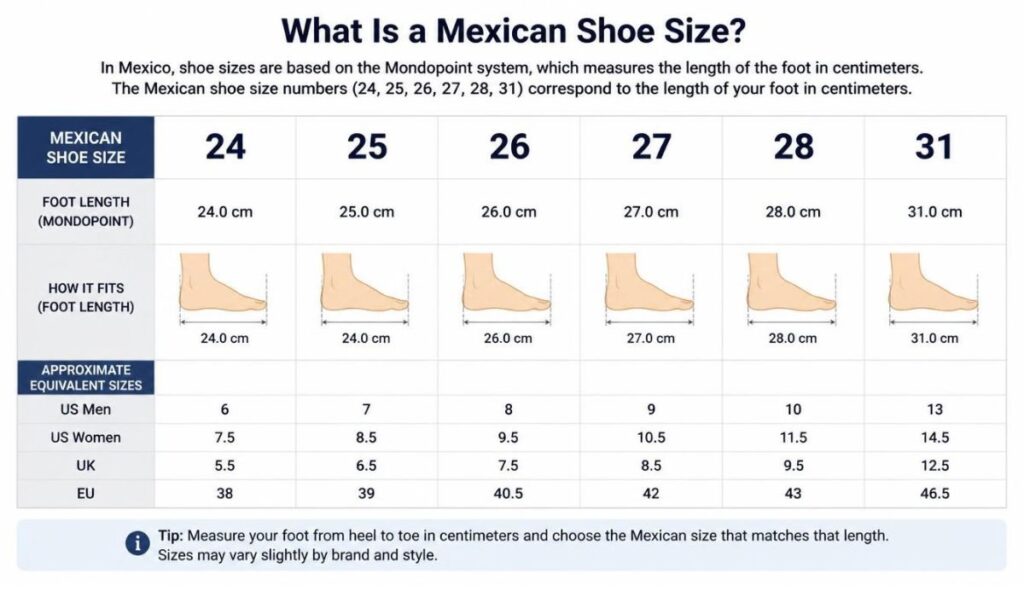
A Mexican shoe size generally relates closely to the length of the foot in centimeters, making the system somewhat easier to understand than some other sizing scales. In many Mexican footwear charts, the number is based on the approximate length of the foot rather than following the same scale used by the American or British systems.
For example, Mexican sizes such as 24, 25, 26, 27, 28, and 31 are commonly encountered when shopping for adult footwear. A Mexican size 24 is therefore associated with a much shorter foot than a Mexican size 31. Simple enough, right? Well, mostly.
The confusing part appears when you try to translate that number directly into a US shoe size. The American sizing system uses a different numerical scale for men, women, and children, so there isn’t always one universal formula for converting Mexican sizes into US sizes.
That is why a reliable shoe size guide should consider the actual measurement of the foot. If a seller gives you a measurement in centimeters, that information can be more useful than simply knowing the size number printed on the shoe.
How Does the Mexican Shoe Sizing System Work?
The Mexican sizing system is commonly based on centimeters, particularly the approximate length of the foot. This means that someone with a foot measuring around 26 cm may look for a Mexican shoe size around 26, depending on the brand and style.
However, this doesn’t mean that every Mexican size 26 has an internal length of exactly 26.00 cm. Shoes need room for movement, and manufacturers can use slightly different lasts, materials, and fitting standards. A leather boot and a flexible casual sneaker might have the same printed size while feeling quite different on the foot.
The same issue exists with international shoe sizing. A size in Mexico is not automatically identical to the equivalent-looking size in the US, UK, or Europe. In other words, size labels travel badly without their measuring system attached.
When comparing footwear, think of the size number as a starting point and foot length as the reality check.
Mexican Shoe Size Chart
A Mexican shoe size chart can help you quickly understand the approximate relationship between Mexican sizing and foot length. The following examples are useful as a general reference rather than an absolute rule for every manufacturer.
| Mexican Size | Approx. Foot Length | Approx. Inches |
|---|---|---|
| 18 | 18 cm | 7.09 in |
| 19 | 19 cm | 7.48 in |
| 21 | 21 cm | 8.27 in |
| 24 | 24 cm | 9.45 in |
| 25 | 25 cm | 9.84 in |
| 26 | 26 cm | 10.24 in |
| 27 | 27 cm | 10.63 in |
| 28 | 28 cm | 11.02 in |
| 31 | 31 cm | 12.20 in |
| 34 | 34 cm | 13.39 in |
These values are based on centimeter measurements, not a promise that every shoe manufacturer will fit exactly this way. A shoe size comparison should therefore be treated as a guide, especially when buying handmade footwear.
Some charts online may show values such as 18 cm, 19 cm, 24 cm, 31 cm, or 34 cm because the Mexican label corresponds closely to the measurement used by the seller.
Mexican Shoe Size to US Shoe Size
The most common search is Mexican shoe size to US because American shoppers often encounter Mexican footwear without knowing how the numbers translate.
A Mexican size may look much larger than a US size simply because the two countries use different scales. For example, a Mexican adult shoe marked 24 does not mean US size 24. That would be a rather enormous shoe, and probably not one you would casually carry home in a shopping bag.
For approximate Mexican-to-US shoe conversion, many charts use the Mexican centimeter number as the starting point and then provide an approximate US equivalent.
| Mexican Size | Approx. US Men’s | Approx. US Women’s |
|---|---|---|
| 21 | — | 4 |
| 22 | — | 5 |
| 23 | — | 6 |
| 24 | — | 7 |
| 25 | 7 | 8 |
| 26 | 8 | 9 |
| 27 | 9 | 10 |
| 28 | 10 | 11 |
| 29 | 11 | 12 |
| 30 | 12 | 13 |
| 31 | 12.5 | 14 |
| 32 | 13.5 | 15 |
| 33 | 14.5 | 16 |
| 34 | 15.5 | 17 |
These are approximate conversions, and the table should not replace the manufacturer’s own chart. The US women’s shoe size and US men’s shoe size use different scales, so the same Mexican measurement can correspond to different American labels.
Mexican Men’s Shoe Size Conversion
Mexican men’s shoe sizes are often represented using centimeter-based numbers. A Mexican size 25, for instance, generally indicates a foot around 25 cm long, although the shoe itself may have additional internal space.
A commonly used Mexican men’s shoe size chart may place size 31 around a US men’s 12.5, while Mexican size 34 can correspond approximately to a US men’s 15.5. These are useful reference points, but brand-specific charts should always get the final vote.
Mexican Men’s Size 31 to US
A frequently searched question is, “What is a Mexican men’s size 31 in US?”
A general conversion places Mexican size 31 at approximately US men’s size 12.5. The associated foot length is around 31 cm, or about 12.2 inches.
That said, if you are ordering boots, particularly structured leather boots, check the manufacturer’s internal-length or foot-length recommendation before purchasing. Boots can fit differently from sneakers even when the printed number is identical.
Mexican Size 34 to US
A Mexican size 34 is associated with a very long foot measurement, approximately 34 cm. Some conversion charts place this around US men’s size 15.5.
For larger sizes, measuring the actual foot becomes even more important because international shoe charts become less consistent at the extremes. A seller who specializes in large footwear may also use a different conversion table than a general shoe retailer.
Mexican Women’s Shoe Size Conversion
Mexican women’s shoe sizes can also be expressed according to approximate foot length in centimeters. Smaller numbers are frequently seen in women’s footwear, although the available range depends heavily on the manufacturer.
One commonly referenced example is Mexican women’s size 21, which is approximately associated with US women’s size 4.
This is a good illustration of why you should not simply assume that a Mexican size number matches the American number. The number 21 is not “US 21”; it is part of another sizing scale.
For Mexican women’s shoe size conversion, measure the foot first, identify the Mexican centimeter size, and then compare that measurement with the seller’s US chart. It takes an extra minute, but that minute can prevent a surprisingly expensive mistake.
Mexican Kids’ Shoe Size Conversion
Children’s footwear introduces another layer of confusion because children’s feet grow quickly and US kids’ shoe size follows a different system from adult sizing.
Mexican kids’ shoe sizes commonly correspond closely to the child’s foot length in centimeters. A Mexican size 13, for example, may be associated with a foot around 13 cm and can correspond approximately to US kids’ size 6, depending on the chart being used.
Parents should measure both feet because children’s feet don’t always grow at exactly the same speed. One foot can be slightly longer than the other, which is completely normal and, frankly, one of those tiny details that shoe boxes never warn you about.
A good kids shoe size conversion chart is therefore only a starting point. Leave enough room for comfortable movement, but don’t buy dramatically oversized shoes simply because children grow fast. Shoes that are too large can be awkward and uncomfortable.
How to Measure Your Foot for Mexican Shoes
The most dependable shoe size measurement begins with your feet, not the old pair of shoes sitting in your closet.
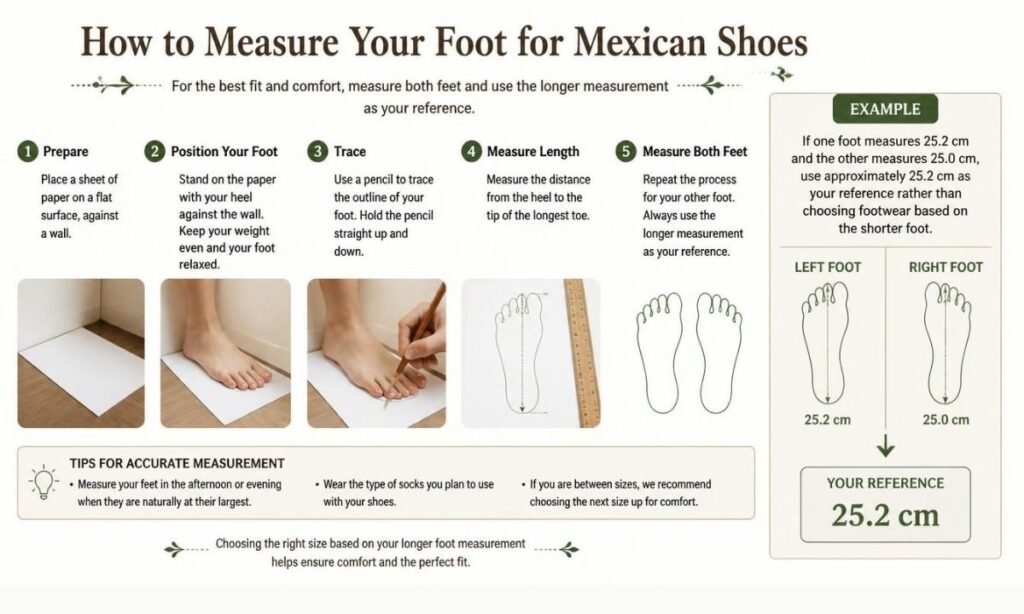
Place a sheet of paper on a hard, flat floor. Stand naturally on the paper while wearing the type of socks you expect to use with the shoes. Have someone trace around your foot if possible, because balancing while trying to draw around your own foot is a little circus act nobody really asked for.
Measure from the very back of the heel to the longest toe. Repeat the process for the other foot.
Use the longer measurement when selecting your size.
For example, if one foot measures 25.2 cm and the other measures 25.0 cm, use approximately 25.2 cm as your reference rather than choosing footwear based on the shorter foot.
Centimeters to Inches
If a Mexican seller provides only centimeters and you are more comfortable with inches, remember that:
1 inch = 2.54 cm
So:
- 18 cm ≈ 7.09 inches
- 19 cm ≈ 7.48 inches
- 24 cm ≈ 9.45 inches
- 31 cm ≈ 12.20 inches
- 34 cm ≈ 13.39 inches
This simple centimeter-to-inch conversion can make international shopping much easier.
Some older charts may also show unusual inch values such as 7.33 inches, 8.33 inches, 11.67 inches, or 12.67 inches. Always check whether the chart is describing foot length, insole length, or a converted size because those are not necessarily the same measurement.
Mexican Shoe Size Compared to US, UK, and European Sizes
The biggest mistake in international shoe sizing is assuming that one country’s number can simply be copied into another country’s chart.
The US shoe size system differs from both the UK and European systems. European sizing generally uses a different scale again, while Mexican footwear may be based more directly on centimeter measurements.
For that reason, a Mexican shoe size compared to US size should be handled separately from a Mexican-to-European comparison.
A useful approach is:
Mexican size → foot length in cm → destination sizing system
This is generally safer than:
Mexican size → random online conversion → purchase immediately
The second method is quicker, sure, but quick isn’t always clever.
What Is the Difference Between Mexican and US Shoe Sizes?
The main difference is the sizing scale.
The American shoe sizing system uses numerical scales that vary between men’s, women’s, and children’s shoes. Mexican sizing commonly relates more directly to centimeters.
This creates an apparent size difference even when two pairs fit feet of similar lengths.
For example, a Mexican size 31 can be associated with a US men’s size around 12.5, while a Mexican size 21 may correspond approximately to US women’s size 4. The numbers themselves look wildly different, but the measurements explain why.
This is why a direct size conversion should always be treated as approximate unless it comes directly from the shoe manufacturer.
Common Mexican Shoe Sizes and Their Measurements
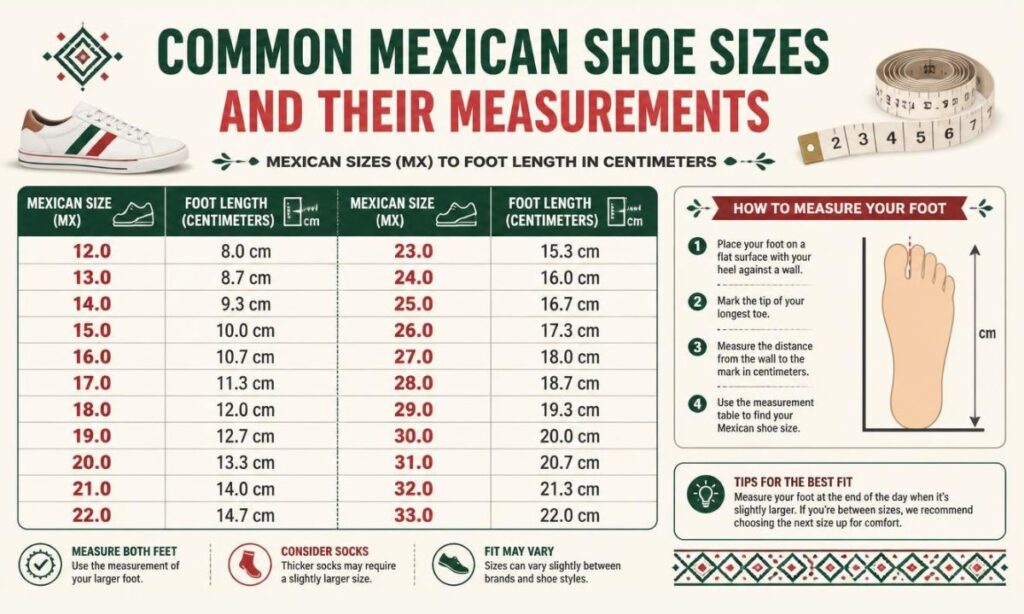
Several Mexican sizes appear repeatedly in international searches.
Mexican size 21 is around 21 cm in foot-length terms and may correspond approximately to US women’s size 4.
Mexican size 24–25 represents approximately 24–25 cm and is commonly encountered in smaller adult or larger youth footwear.
Mexican size 26.5–27.5 represents foot lengths around 26.5–27.5 cm and may be useful for shoppers between standard whole-number sizes.
Mexican size 31 represents roughly 31 cm and is often searched by men looking for larger footwear.
Mexican size 34 represents approximately 34 cm and falls into the extra-large end of many footwear charts.
The exact US equivalent can change according to gender, brand, shoe type, and manufacturing method, so these numbers should be used as reference points rather than guarantees.
Traditional Mexican Footwear and Sizing
Sizing becomes especially interesting when looking at traditional Mexican shoes.
Mexico has a long history of footwear craftsmanship, and different regions have developed distinctive styles. Mexican huaraches, for example, are recognizable for their woven or strapped leather construction and have been worn in various forms for generations.
Huaraches can fit differently from enclosed sneakers because the construction allows different amounts of flexibility around the foot. Handmade versions can also have subtle variations that are part of their character, not necessarily manufacturing defects.
Then there are Mexican pointy boots, sometimes known as Botas picudas mexicanas, which are famous for extremely elongated toes. These unusual boots became associated with regional dance and music scenes and can have exaggerated shapes that make ordinary shoe-size comparisons less useful.
Charro boots, cowboy boots, and other traditional styles may also use leather that changes slightly with wear.
When purchasing handmade footwear, ask whether the seller wants the measurement of your bare foot, the measurement of a well-fitting shoe, or your usual size. Those three answers are not interchangeable.
Mexican Shoe Craftsmanship
Footwear is more than a number on a box. Mexican craftsmanship is especially visible in handmade shoes, leather sandals, boots, and regional designs.
Many shoe artisans work with leather and traditional construction techniques, producing footwear that carries a distinctly local visual identity. Generational craftsmanship can influence everything from stitching patterns to leather selection.
Traditional Mexican cultural heritage can be seen in decorative details, colorful designs, handcrafted sandals, and boots associated with particular regional traditions.
Modern Mexican footwear, meanwhile, is not stuck in the past. Contemporary designers combine traditional techniques with modern designs, creating shoes that may look entirely different from classic traditional footwear while still reflecting Mexican artistic values.
So when shopping for Mexican handmade shoes, sizing is only one piece of the puzzle. Materials, construction, toe shape, width, and intended use all affect the final fit.
Mexican Pointy Boots and Tribal Boots
The famously dramatic Mexican pointy boots deserve their own little mention because they are almost impossible to mistake for ordinary footwear.
Botas tribaleras, also called tribal boots, can feature very long, curled, or exaggerated toes. They are often associated with customized designs, regional dance culture, and a highly expressive aesthetic.
These boots can make standard shoe fitting tricky because the visible length of the boot does not necessarily equal the useful space available to the foot.
In other words, don’t look at an enormous pointed toe and assume your foot needs an enormous size. Much of that dramatic extension is decorative.
How to Convert Mexican Shoe Size to US
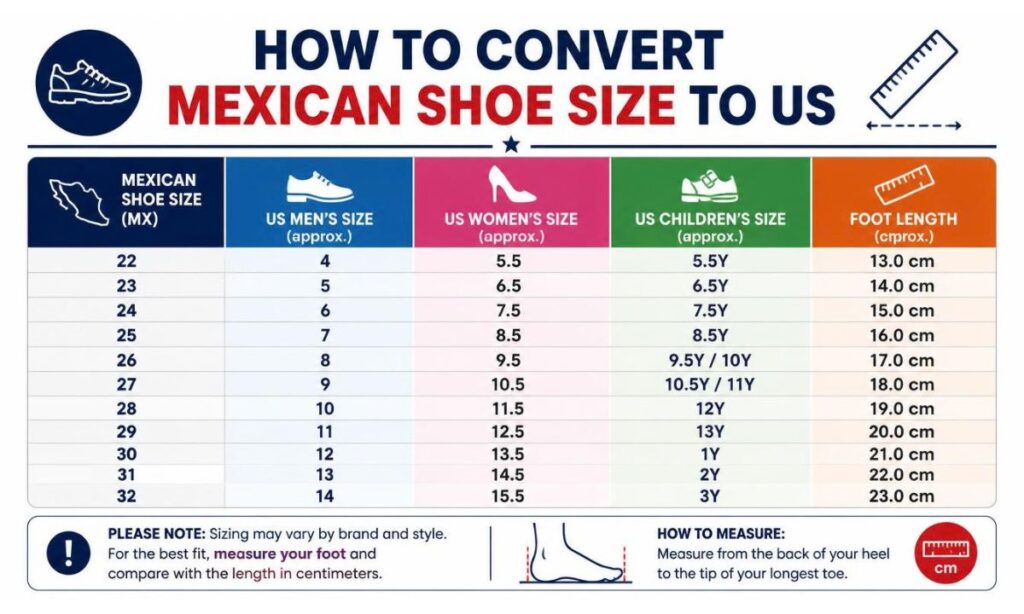
For practical Mexican shoe size conversion, use this process:
First, measure your foot in centimeters.
Second, identify the Mexican size recommended for that measurement.
Third, locate the manufacturer’s US conversion chart.
Fourth, compare the result with your usual US size.
Finally, check width and shoe style before placing the order.
An online shoe size converter can make this process faster, but it should be treated as a convenience rather than the final authority.
A shoe size calculator can provide a useful estimate, but manufacturer-specific charts usually deserve more trust because brands can use different lasts and fitting standards.
Can You Convert US Shoe Size to Mexican?
Yes, you can perform a US-to-Mexican shoe conversion, but it is generally better to convert through foot length rather than relying on a single universal equation.
Suppose you normally wear a US men’s size 10. Instead of simply searching for “US 10 = Mexican ?,” check the approximate foot length associated with your US size. Then compare that measurement with the Mexican seller’s chart.
This method accounts for the fact that a US men’s size and US women’s size do not represent the same numerical scale.
It also becomes useful when shopping across Mexico, the United States, Europe, and the UK, where sizing conventions can vary considerably.
Are Mexican Shoe Sizes Smaller Than US Sizes?
Not necessarily.
Mexican shoes are not inherently “smaller.” The confusion comes from the different numbering systems.
A Mexican size may have a larger-looking number because it is closely associated with centimeters, while a US shoe uses a different scale.
So asking whether Mexican sizes are smaller is a little like asking whether 30 centimeters is smaller than 12 inches. Once you convert the units, the comparison makes much more sense.
The same principle applies to shoe size standards and global shoe sizing. Numbers only become meaningful when you know the system behind them.
Tips for Buying Mexican Shoes Online
Buying footwear online requires a little more care because you cannot physically try the shoes on.
Before ordering, check whether the retailer provides a Mexican shoe size chart and whether the chart lists foot length in centimeters.
Look for information about width, materials, toe shape, and whether the shoes run narrow or wide. This is particularly important for Mexican leather boots, cowboy boots, and handmade shoes.
Read customer reviews carefully. A review saying “runs small” is much more useful when you know whether the person measured their feet and what size they ordered.
If the seller accepts questions, send your exact foot measurement. A good shoe seller should be able to recommend a size based on centimeters.
And if the seller provides only a mysterious size number with no measurement chart at all, pause before ordering. Mystery is lovely in novels. It is less charming when you’ve spent money on shoes.
A Simple Shoe Size Measurement Routine
For reliable foot measurement, measure your feet at the end of the day because feet can swell slightly after hours of walking and standing.
Wear the socks you normally use with the shoes.
Stand rather than sit while measuring.
Measure both feet.
Use the longer foot as your reference.
Then compare your result with the specific size chart provided by the manufacturer.
This routine improves your chances of getting the correct shoe size, particularly when buying from another country.
Why Foot Length Matters More Than the Label
The label tells you what the manufacturer calls the shoe. Your foot tells you whether the shoe will actually fit.
That distinction sounds obvious, but it gets forgotten constantly during international shoe shopping.
A Mexican size 27 from one brand may feel slightly different from a size 27 made by another company. A leather boot may have a different interior shape from a running shoe. A handmade huarache may stretch with use.
The safest approach is therefore to treat size numbers as references and measurements as evidence.
Your foot length in centimeters gives you a stable starting point even when the label changes from one country to another.
Frequently Asked Questions
What is a Mexican shoe size?
A Mexican shoe size commonly corresponds closely to the approximate foot length in centimeters, although individual brands may use slightly different sizing practices.
What is a Mexican size 31 in US?
A Mexican size 31 is approximately equivalent to US men’s size 12.5 in many conversion charts, but manufacturer-specific sizing should be checked.
What is a Mexican size 21 in US women’s?
A Mexican size 21 is commonly listed around US women’s size 4, although exact conversions can vary by brand.
What is Mexican size 34 in US?
Mexican size 34 is approximately associated with US men’s size 15.5 and may be around US women’s size 17 on some conversion charts.
Is Mexican shoe size the same as US?
No. The Mexican sizing system and US sizing system use different scales, so the numbers should not be treated as interchangeable.
How do Mexican shoe sizes work?
They commonly relate to foot length in centimeters. A Mexican size 26, for example, is generally associated with a foot around 26 cm long.
How do I measure my foot for Mexican shoes?
Trace your foot while standing on paper, measure from heel to longest toe, repeat for both feet, and use the longer measurement when checking the seller’s chart.
Are Mexican shoes sized in centimeters?
Many Mexican footwear charts use centimeter-based sizing, but labeling practices can vary, so always check the individual manufacturer’s information.
Conclusion
Understanding Mexican shoe size is much easier once you stop treating the number as a mysterious foreign version of your usual size. The key is to connect the number with foot length, especially in centimeters.
For international shoppers, a reliable Mexican shoe size chart, accurate measurement, and a manufacturer-specific conversion guide are far more useful than guessing from your normal US size.
Whether you’re looking for handmade huaraches, leather boots, modern Mexican ladies shoes, children’s footwear, or dramatic Botas tribaleras, the same basic rule applies: measure first, compare second, order third.
Remember that Mexican shoe size conversion is approximate because brands and footwear styles can differ. A chart is a guide, not a guarantee carved into stone.
If you are comparing Mexico with the US, UK, or Europe, use your actual centimeter measurement as the common language between the systems. It makes international shoe sizing considerably less confusing, and it can help you find a genuinely comfortable pair rather than a pair that merely has the right-looking number on the box.
In the end, the best shoe size isn’t the one that wins a conversion chart. It’s the one that lets your feet walk, work, dance, travel, and get through the day without complaining about your shopping decisions.