Choosing the right American flag sounds simple until you begin comparing sizes, measuring a flagpole, or trying to figure out which flag will look balanced outside your home. A flag that looks perfect on a porch might seem tiny beside a tall commercial building, while an oversized flag can put unnecessary strain on a residential pole when the wind picks up. Getting the measurements right makes a real difference.
This flag size chart explains common flag dimensions, recommended flagpole heights, and practical ways to select a flag for residential, commercial, and public displays. You’ll also learn about official American flag proportions, the meaning of the stars and stripes, and basic flag display etiquette.
Whether you’re buying your first flag for a house-mounted bracket or planning a large outdoor display, this guide will help you make a sensible choice without getting lost in a sea of measurements.
American Flag Size Chart: Standard Flag Dimensions
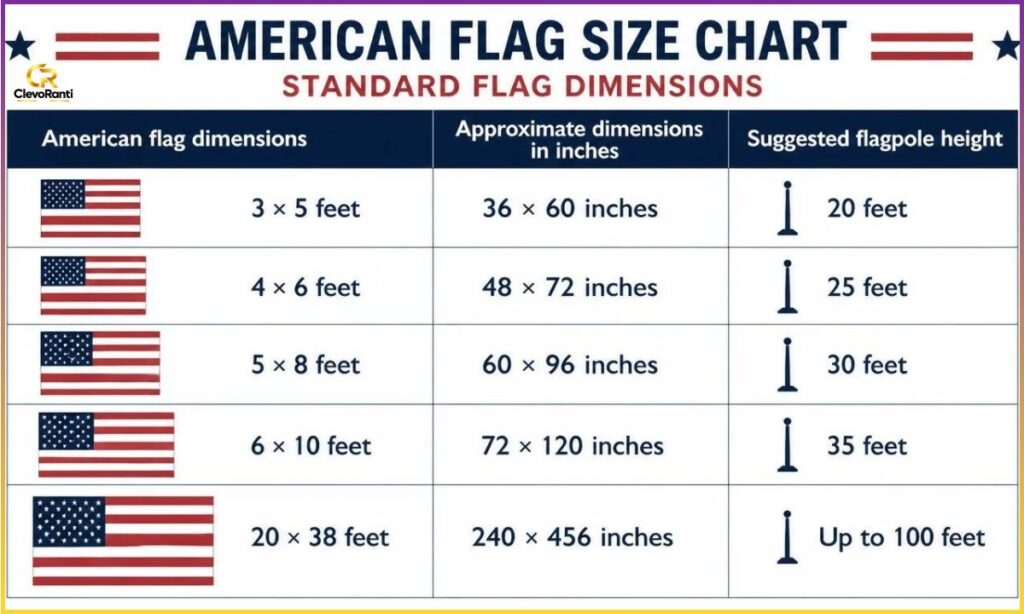
The most useful place to begin is with the relationship between flag dimensions and flagpole height. Although several sizes are widely available, the best choice depends on the pole’s design, mounting method, wind exposure, and the manufacturer’s recommendations.
Here is a practical American flag size chart based on common flag sizes and the example pole-height pairings provided for this guide.
| American flag dimensions | Approximate dimensions in inches | Suggested flagpole height |
|---|---|---|
| 3 × 5 feet | 36 × 60 inches | 20 feet |
| 4 × 6 feet | 48 × 72 inches | 25 feet |
| 5 × 8 feet | 60 × 96 inches | 30 feet |
| 6 × 10 feet | 72 × 120 inches | 35 feet |
| 20 × 38 feet | 240 × 456 inches | Up to 100 feet |
These are practical reference pairings rather than universal rules for every installation. A flagpole’s construction, the way the flag is attached, and local wind conditions can change which size is appropriate. Always check the pole manufacturer’s specifications before purchasing a large flag.
For many homes, a 3 × 5-foot flag is a familiar starting point. Larger properties and commercial locations may benefit from bigger flags, provided the pole and hardware can safely handle the additional fabric.
Understanding Standard American Flag Dimensions
A flag’s size is expressed as its length and height, sometimes called its width and height depending on how a seller lists the product. For a horizontally displayed American flag, the longer measurement runs from the staff side toward the fly end, while the shorter measurement runs from the top edge to the bottom edge.
The standard American flag size is not one single measurement used everywhere. A 3 × 5-foot flag is a common residential option, but other dimensions are suitable for indoor displays, schools, businesses, government facilities, and monumental flagpoles.
What does a 3 × 5-foot American flag look like?
A 3 × 5-foot flag measures 36 inches high and 60 inches long. Picture a flag roughly five feet across when fully extended: it is large enough to be noticed from the street without dominating the front of a typical house.
This size is commonly used with house-mounted brackets and smaller outdoor flagpoles. Still, the right fit depends on the angle of the bracket, nearby trees, the distance from the sidewalk, and the available clearance.
How large is a 4 × 6-foot flag?
A 4 × 6-foot flag measures 48 inches high and 72 inches long. It offers a more prominent display than a 3 × 5-foot version, making it a possible choice for larger homes, institutional entrances, and selected commercial settings.
Before choosing this size, consider how much room the flag has to move. A flag that brushes against a wall, roof edge, or tree branch may become damaged more quickly.
When should you choose a 5 × 8-foot flag?
A 5 × 8-foot flag measures 60 inches high and 96 inches long. Its broad appearance can work well on a substantial ground-mounted flagpole or at a spacious property entrance, provided the installation is designed for that fabric area.
Don’t select this size simply because a bigger flag looks more impressive. Wind load matters, and a large flag can put considerably more stress on the pole, rope, fittings, and mounting hardware.
What are 6 × 10-foot and extra-large American flags used for?
A 6 × 10-foot flag measures 72 inches high and 120 inches long. It is a substantial display that may suit larger commercial properties, institutions, or purpose-built flagpoles.
For monumental displays, a 20 × 38-foot flag measures 20 feet high and 38 feet long. This is an exceptionally large piece of fabric, requiring specialized equipment, appropriate structural support, and careful attention to wind conditions. It isn’t a practical choice for an ordinary residential pole.
American Flag Size Chart by Flagpole Height
Choosing a flag size for flagpole installation is easier when you consider both the pole’s height and the type of mounting system. A wall-mounted staff and a tall ground-mounted pole behave differently, so a simple height-to-size chart should be treated as a starting point rather than a rigid standard.
| Flagpole height | Example flag size | Typical application |
|---|---|---|
| 6–10 feet | 2 × 3 feet or 3 × 5 feet | Small garden or porch displays |
| 15–20 feet | 3 × 5 feet | Residential properties |
| 20–25 feet | 3 × 5 or 4 × 6 feet | Homes and small commercial properties |
| 25–30 feet | 4 × 6 or 5 × 8 feet | Larger properties |
| 30–35 feet | 5 × 8 or 6 × 10 feet | Commercial or institutional grounds |
| 50–100 feet | Engineered large-format selection | Monumental and public displays |
These ranges are general planning examples, not official specifications for every pole. A 20-foot pole may be designed for a different flag size than another pole of equal height. Check the manufacturer’s guidance, especially for poles exposed to strong winds.
What size flag should I use on a 20-foot pole?
A 3 × 5-foot flag is a reasonable starting point for many 20-foot residential flagpoles. A larger 4 × 6-foot flag might also be suitable for some installations, depending on the pole’s construction and rated wind load.
What size flag works on a 25-foot pole?
A 4 × 6-foot flag is one option to consider for a 25-foot pole. The correct choice depends on the manufacturer’s recommendations and whether the pole is installed in an exposed or sheltered location.
What size flag is appropriate for a 30-foot pole?
A 5 × 8-foot flag is a common planning option for a substantial pole of this height. However, the flag’s weight, fabric, attachment system, and local weather conditions still need to be considered.
Can I fly a 6 × 10-foot flag on a 35-foot pole?
Potentially, yes, if the pole and hardware are rated for it. A flag’s dimensions alone don’t establish whether an installation is safe, so review the pole specifications before moving up to a larger size.
American Flag Proportions Explained
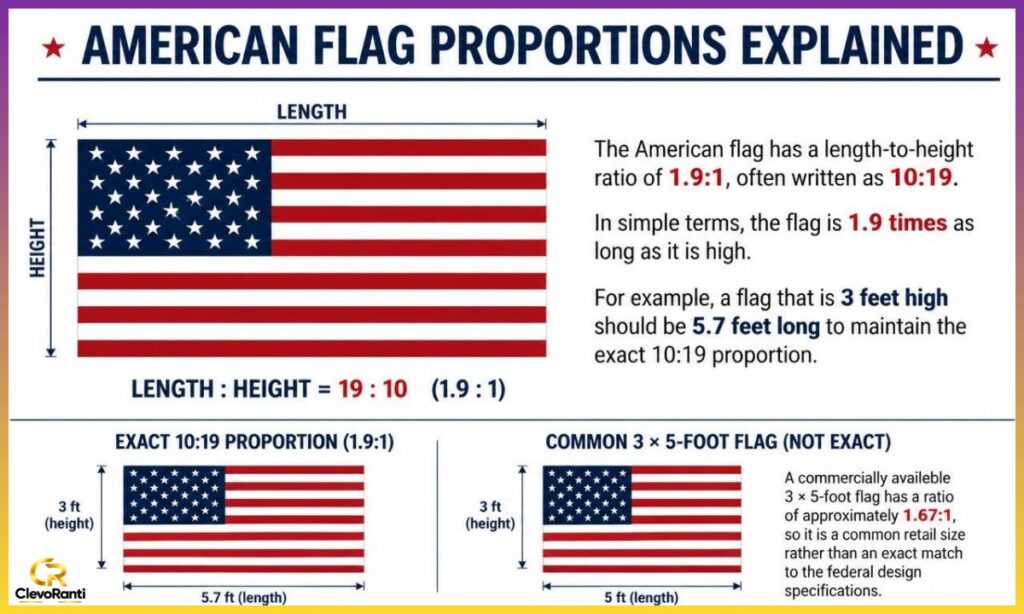
The United States flag dimensions follow a defined proportional design. The official proportions are important because they preserve the flag’s familiar appearance, whether it measures a few feet across or spans a monumental display.
The American flag has a length-to-height ratio of 1.9:1, often written as 10:19. In simple terms, the flag is 1.9 times as long as it is high.
For example, a flag that is 3 feet high should be 5.7 feet long to maintain the exact 10:19 proportion. A commercially available 3 × 5-foot flag has a ratio of approximately 1.67:1, so it is a common retail size rather than an exact match to the federal design specifications.
This distinction matters when comparing retail products with specifications for official government or military flags.
How to calculate American flag dimensions
You can use a simple calculation to check the proportions:
- To calculate the length, multiply the height by 1.9.
- To calculate the height, divide the length by 1.9.
For instance, a flag measuring 4 feet high would have a proportional length of 7.6 feet. If the length is 9.5 feet, the corresponding height is 5 feet.
These calculations help explain the American flag proportions, but always use the exact product specifications when ordering a flag for an official installation.
American Flag Sizes for Residential and Commercial Use
The right flag for a small porch isn’t necessarily the right choice for a school, office complex, or public building. The surroundings influence how large the flag appears, how far away people can see it, and how easily it can move in the wind.
Residential flag sizes
For most homeowners, a 3 × 5-foot flag is a practical choice. It is widely available and provides a recognizable display without requiring the space or equipment needed for an extra-large flag.
A 2 × 3-foot flag may be more suitable for a small balcony, garden, or compact wall-mounted bracket. Larger properties may accommodate 4 × 6-foot flags or other sizes, as long as the installation is appropriate.
When selecting an American flag size for house display, consider the following:
- The size and height of the house.
- The distance between the flag and the street.
- The length and angle of the mounting bracket.
- Nearby windows, branches, gutters, and other obstacles.
- The strength of the bracket and its attachment to the building.
A well-positioned flag looks intentional rather than crowded. Even a modest flag can make a strong visual statement when it has enough room to move freely.
Commercial flag sizes
Businesses, hotels, schools, and office buildings may use larger flags to make entrances more visible or create a welcoming public display. A 4 × 6-foot or 5 × 8-foot flag might work in some settings, while other properties need different dimensions.
The important thing is to match the flag to the scale of the building and the capacity of the pole. A flag that appears impressive in calm weather may create excessive strain during a storm.
Government and public buildings
Government buildings and public institutions may follow specific purchasing specifications, display policies, or agency requirements. Flag dimensions can vary according to the location and purpose of the display.
There isn’t one universal size that applies to every government building. Official installations should follow the applicable federal, state, local, or institutional guidance instead of relying solely on a general retail chart.
Indoor American Flag Display vs. Outdoor Flag Display
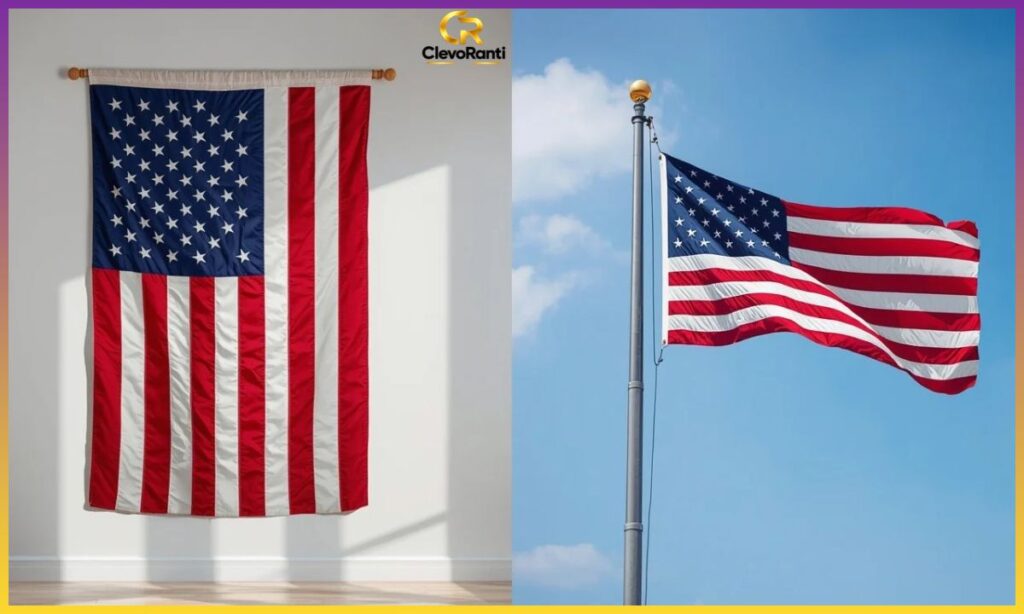
The difference between indoor American flag display and outdoor use is more than just fabric choice. Indoor flags are often selected for presentation, ceremony, and long-term appearance, while outdoor flags must withstand weather and repeated movement.
Indoor flag dimensions
An indoor flag for an office, classroom, auditorium, or ceremony may be smaller than an outdoor flag flying from a tall pole. The correct dimensions depend on the room, staff height, display stand, and viewing distance.
For example, a large flag can work in an auditorium with a high ceiling but feel overwhelming in a small meeting room. Before buying, measure the available vertical space and consider whether the flag will be mounted on a stand or displayed against a wall.
Outdoor American flag sizes
Outdoor flags are exposed to sunlight, rain, dirt, and wind. Their dimensions must be compatible with the pole, and their fabric should be suitable for the local environment.
A lightweight flag may move easily in gentle breezes, whereas a heavier fabric can place greater demands on the mounting system. No material is completely immune to weather damage, so inspect the flag regularly.
For outdoor use, look for reinforced stitching, suitable attachment points, and a fabric intended for the conditions in which it will be flown.
American Flag History: From Thirteen Colonies to Fifty Stars
The American flag is a national symbol with a history closely tied to the founding and development of the United States. Its design has changed as the country expanded, yet its stripes and stars remain instantly recognizable.
The early history of the flag includes designs such as the Grand Union Flag, also known as the Continental Colors. It was used during the Revolutionary War period before the familiar stars-and-stripes design became established.
On June 14, 1777, the Continental Congress adopted a resolution calling for a flag with thirteen stripes, alternating red and white, and thirteen white stars on a blue field. Those stars and stripes represented the thirteen original colonies.
The flag evolved as new states joined the Union. Legislation passed in 1818 established thirteen stripes to honor the original colonies while providing for a star to be added for each new state. The arrangement of the stars changed over time as the nation grew.
The modern flag has fifty stars representing the fifty states. Its present design took effect on July 4, 1960, following Hawaii’s admission to the Union.
The story is a reminder that the flag is not a frozen piece of history. Its changing design reflects the development of the country itself.
American Flag Symbolism: What Do the Colors, Stars, and Stripes Mean?
The American flag’s red, white, and blue design carries associations with national ideals and traditions. Its symbolism is often discussed during Independence Day celebrations, Memorial Day observances, veterans’ events, and other occasions that bring communities together.
What do the thirteen stripes represent?
The flag contains thirteen alternating stripes: seven red and six white. These stripes represent the thirteen original colonies that declared independence from British rule and formed the beginnings of the United States.
Their continued presence connects the modern nation with its revolutionary origins. The stripes remain unchanged even as the number of stars has increased.
What do the fifty stars represent?
Each of the fifty white stars represents one state in the Union. The stars sit in the blue canton, the rectangular field in the upper-left portion of the flag when it is displayed horizontally with the staff on the left.
The arrangement has changed as new states joined the country. Today, the fifty stars symbolize the union of the states under one national flag.
What do red, white, and blue symbolize?
The colors are commonly associated with traditional descriptions of American ideals:
- Red: Valor and bravery.
- White: Purity and innocence.
- Blue: Vigilance, perseverance, and justice.
These descriptions are widely repeated in explanations of American flag symbolism. They help express the ideals associated with the flag, although colors can carry different meanings in other cultural and historical contexts.
For many people, the flag also represents liberty, sacrifice, national unity, and the ongoing pursuit of equality. Individuals may connect with it in different ways because of their family histories, military service, community experiences, or personal understanding of American identity.
Proper American Flag Display Rules and Etiquette
Choosing the right size is only one part of displaying the flag respectfully. Placement, lighting, condition, and the way the flag is handled also matter.
The U.S. Flag Code provides guidance for displaying and caring for the national flag. Some provisions describe recommended etiquette, while other requirements may depend on the setting and applicable law.
How to display an American flag outside a house
When mounting a flag outside your home, choose a position where it can move freely without striking nearby objects. A sturdy bracket and properly secured mounting points help prevent damage to the property and flag.
For a wall-mounted flag, the staff is commonly angled outward from the building. Make sure the flag won’t become tangled around a light fixture, touch the ground, or repeatedly scrape against a rough surface.
For a ground-mounted pole, verify that the pole is properly installed and suitable for the selected flag size. If the location experiences strong winds, follow the manufacturer’s advice about lowering or removing the flag during severe weather.
Can an American flag be flown at night?
Yes. Under the U.S. Flag Code’s guidance, the flag may be displayed at night when properly illuminated. A suitable light can help keep the flag visible after sunset without creating unnecessary glare for neighbors or passing drivers.
If illumination isn’t available, the traditional guidance is to display the flag from sunrise to sunset, with exceptions provided by the Flag Code.
When should the American flag be raised and lowered?
The traditional practice is to raise the flag at sunrise and lower it at sunset. The flag may be displayed around the clock when properly illuminated, subject to the applicable display guidance.
During formal ceremonies, raising and lowering the flag can become a meaningful community ritual. Schools, public organizations, and civic groups may incorporate these moments into events that honor national history and service.
How should a damaged flag be maintained?
Inspect the flag periodically for frayed edges, torn seams, faded fabric, and damaged attachment points. Outdoor flags often wear out faster because of sun exposure and wind.
Cleaning should follow the manufacturer’s instructions for the fabric. If the flag is no longer in suitable condition for display, retire it respectfully in accordance with applicable flag etiquette and local guidance.
How to Choose the Right American Flag Size
If you’re still unsure which size to purchase, don’t focus on the numbers alone. A flag needs to look balanced in its setting and remain within the safe operating limits of its pole.
Consider these practical steps before ordering:
- Measure the flagpole: Confirm its height and the manufacturer’s recommended flag dimensions.
- Identify the mounting method: A house-mounted staff has different limitations from a freestanding pole.
- Consider wind exposure: Open fields, coastal properties, and elevated locations may experience stronger winds.
- Check the surroundings: Make sure the flag has enough clearance from trees, buildings, and overhead obstructions.
- Choose suitable fabric: Select material designed for indoor or outdoor use, depending on where the flag will be displayed.
- Review the specifications: Check the actual dimensions, attachment style, and care instructions before buying.
A flag size calculator can also be useful if you need to compare multiple dimensions. Simply enter the desired height or length, then use the 1.9:1 ratio to calculate proportional dimensions. Remember that commercially available sizes don’t always match the exact official proportions.
Explore More Blog : Unisex T Shirt Sizes
Frequently Asked Questions
What is the standard American flag size?
A 3 × 5-foot flag is a common residential size in the United States. Other sizes, including 4 × 6 feet and 5 × 8 feet, may be appropriate for different properties and installations.
What are the official proportions of the US flag?
The official design uses a length-to-height ratio of 1.9:1, or 10:19. Common retail flags may use slightly different proportions, so check the product specifications if exact dimensions are required.
What size flag should I buy for my house?
A 3 × 5-foot flag is a practical starting point for many homes. However, a smaller flag may suit a compact porch, while a larger property may accommodate a bigger display if the bracket or pole is rated for it.
How do I choose a flag size for a 20-foot flagpole?
A 3 × 5-foot flag is one possible choice for a 20-foot pole. Always confirm the pole manufacturer’s recommended size, since height alone doesn’t determine the safe flag dimensions.
How many stripes and stars are on the American flag?
The American flag has thirteen alternating red and white stripes and fifty white stars on a blue field. The stripes represent the original thirteen colonies, while the stars represent the fifty states.
What is the difference between indoor and outdoor flags?
Indoor flags are generally chosen for ceremonies, offices, and wall displays, while outdoor flags need fabric and construction suited to weather exposure. Both should be selected according to their intended display method.
Can I use an extra-large flag on a residential pole?
Only if the pole, hardware, and installation are designed to support it. Large flags can create substantial wind loads, so never assume that a taller pole automatically supports a heavier or wider flag.
Conclusion
Choosing an American flag becomes much easier when you understand the relationship between flag dimensions, flagpole height, display location, and weather exposure. A 3 × 5-foot flag is a familiar option for many homes, while larger flags can suit spacious properties and public installations when the supporting equipment is appropriate.
Use this flag size chart as a starting point, check the actual dimensions before ordering, and follow the manufacturer’s recommendations for safe installation. If you’re selecting a flag for an official or ceremonial setting, verify any applicable specifications as well.
Above all, remember that a flag’s value isn’t measured by its size alone. Whether it’s a small flag outside a family home or a monumental display above a public space, a thoughtfully chosen and respectfully maintained flag can represent history, service, freedom, and a shared sense of belonging.
If you’ve found a flag size that works especially well for your home or property, share your experience in the comments. Your practical advice may help another reader choose the right flag for their own display.