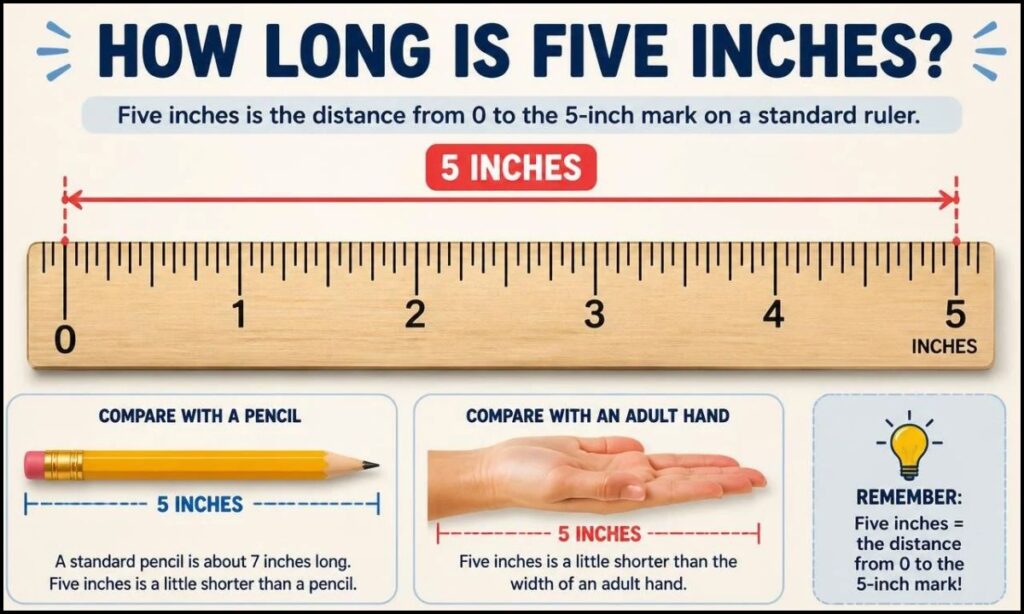
Have you ever looked at a small object and wondered whether it was five inches long? It happens more often than you might think. Maybe you’re shopping online, checking whether a phone will fit in your pocket, choosing a kitchen tool, or trying to estimate a measurement without a ruler nearby. Five inches may sound like a tiny distance, but once you start comparing it with familiar objects, it becomes much easier to picture.
So, how long is five inches in real life? Five inches equals 12.7 centimeters, 127 millimeters, or approximately 0.42 feet. It is about the length of a small smartphone, a pocket comb, or a few everyday stationery items placed end to end. Not every object has exactly the same dimensions, of course, but these familiar examples can give you a useful reference.
In this guide, we’ll explore what 5 inches looks like, how to convert this measurement into other units, and which everyday items can help you estimate it. You won’t need fancy measuring equipment to get a better idea of this surprisingly useful length.
How Long Is Five Inches in Different Measurement Units?
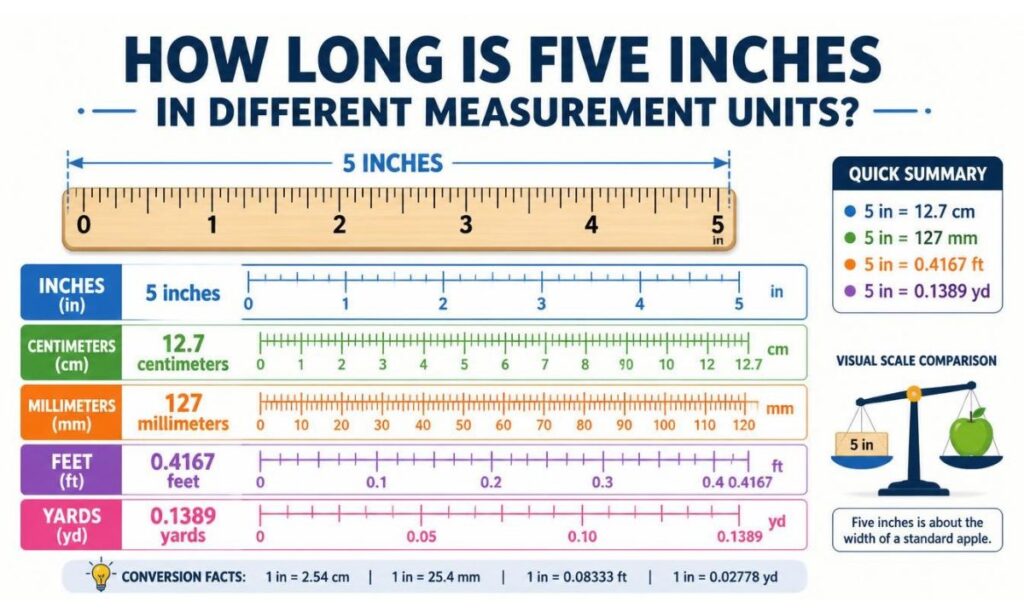
Before comparing five inches with everyday objects, let’s understand its actual size. The inch is a unit in the imperial measurement system, commonly used in the United States for measuring objects, clothing, screens, furniture, and many other things.
Five inches is a short distance, but it can make a noticeable difference when you’re comparing product dimensions or deciding whether something will fit in a particular space.
Here are the main conversions for a 5-inch measurement.
| Measurement unit | Equivalent |
| Inches | 5 inches |
| Centimeters | 12.7 cm |
| Millimeters | 127 mm |
| Meters | 0.127 m |
| Feet | 0.4167 ft |
| Yards | 0.1389 yd |
These values are useful when shopping on international websites or reading product descriptions that use different measurement systems. For instance, a product listed as 12.7 cm long has the same length as a five-inch object.
How to Convert Five Inches to Centimeters
To convert inches into centimeters, multiply the number of inches by 2.54.
For five inches, the calculation is:
5 × 2.54 = 12.7 cm
Therefore, 5 inches in cm equals 12.7 centimeters. This conversion is particularly useful when measuring school supplies, electronic accessories, small household objects, or craft materials.
How Many Millimeters Are in Five Inches?
One inch contains exactly 25.4 millimeters. Multiply that value by five, and you get 127 millimeters.
This conversion can be useful for technical measurements, small components, woodworking projects, and DIY activities where a little extra precision matters.
How Many Feet Is Five Inches?
Since one foot contains 12 inches, divide five by 12.
5 ÷ 12 = 0.4167 feet, approximately.
Five inches is therefore a little less than half a foot. It’s a handy comparison when you’re trying to imagine a short distance using familiar imperial units.
What Does 5 Inches Look Like in Real Life?
Numbers make sense on paper, but visual comparisons make measurements easier to remember. If someone tells you that an object measures five inches, you might still struggle to imagine it until you compare it with something you already know.
A five-inch object is roughly the length of a compact handheld item. It can fit comfortably in your hand, depending on its shape, and is much shorter than a standard sheet of paper.
Think about a small comb, a short pen, or a smartphone from an older generation. These are useful starting points for understanding five inches in everyday life.
Here are several objects that can help you picture the measurement.
15 Everyday Objects That Are About Five Inches Long
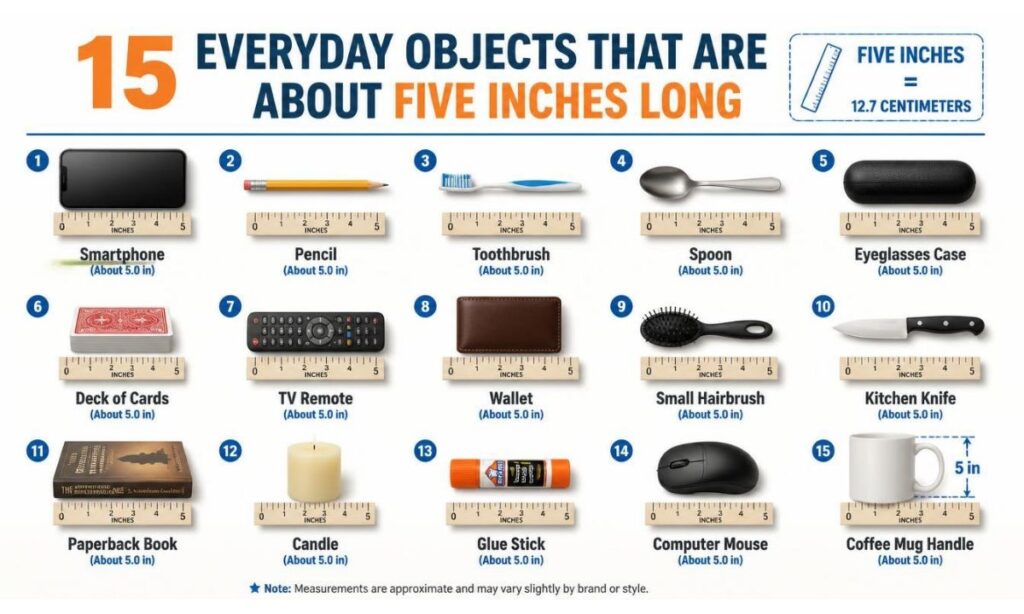
The following examples offer practical ways to estimate five inches without carrying a ruler everywhere. Some objects are close to five inches, while others are useful as combined measuring references.
1. An iPhone 13 Mini
The iPhone 13 mini is one of the most recognizable comparisons for a five-inch measurement. Its body is approximately 5.18 inches tall, making it just a little longer than five inches.
That tiny difference is easy to overlook when you’re imagining the length in your head. If you’ve ever held this compact smartphone, you already have a pretty good physical reference.
Remember that the phone’s advertised screen size is different from its overall body length. The display is measured diagonally, while the phone’s height runs from its top edge to its bottom edge.
2. An iPhone 7
The iPhone 7 measures approximately 5.44 inches tall. That makes it slightly longer than the five-inch mark, offering another familiar comparison.
Its overall height is close enough to help you visualize the size, although it shouldn’t be treated as an exact five-inch reference.
This example also illustrates why smartphone dimensions matter when comparing devices. A phone with a screen advertised as 5.5 inches does not necessarily have a body that is 5.5 inches long.
3. Two Adult Thumbs Placed End to End
Your hands can serve as a quick measuring guide when a ruler isn’t available. For some adults, placing two thumbs end to end may produce a length close to five inches.
However, thumb length varies from person to person. Someone with smaller hands might get a noticeably shorter result, while another person’s thumbs may extend beyond the five-inch mark.
Use this method for rough estimation rather than precision work. It’s a convenient trick when you’re trying to picture a measurement, but it won’t replace an actual measuring tool.
4. Seven US Pennies in a Row
A US penny measures approximately 0.75 inches in diameter. Place seven pennies in a straight line, touching edge to edge, and their combined length will be about 5.25 inches.
That’s only a quarter-inch longer than five inches, so the arrangement provides a useful visual comparison.
This method works best when the coins are aligned carefully. Even small gaps between pennies can change the total, and overlapping them would shorten the measurement.
5. A BIC Cristal Pen
A standard BIC Cristal is approximately 5.7 inches long, including its cap. That’s longer than five inches, but still close enough to help you imagine the distance.
If you have one on your desk, hold it in your hand and picture a little less than its full length. This provides a simple reference without needing to memorize complicated numbers.
Pen dimensions can vary by model, so check the specific product if accuracy is important.
6. A Standard Soda Can
A standard 12-ounce soda can is approximately 4.83 inches tall. That makes it almost exactly five inches high.
This is one of the easiest everyday comparisons because soda cans are common in kitchens, offices, restaurants, and convenience stores.
Place a can upright on a flat surface and imagine extending its top edge by a tiny amount. You’d have a good approximation of five inches.
Keep in mind that mini cans, tall cans, and specialty beverage containers have different dimensions.
7. A Standard Paper Clip
A standard paper clip is often around one inch long, although sizes vary. Lining up five similar clips end to end can create an approximate five-inch reference.
This is especially handy for students, office workers, and people who enjoy small DIY projects. You can use the clips to estimate a short distance on a desk or notebook.
The trick is to align the clips in a straight line rather than placing them in their usual curved or overlapping arrangement. Otherwise, your estimate might be off.
8. A Golf Tee
Many standard golf tees measure around 2.75 inches long. Put two together end to end, and their combined length becomes approximately 5.5 inches.
This is slightly longer than five inches, but it’s a helpful reference if you play golf or have sports equipment at home.
Golf tees are also useful for understanding how small measurements add up. Two objects that seem short individually can create a length close to half a foot when combined.
9. A Teaspoon
Some teaspoons measure close to five inches from the tip of the handle to the end of the bowl. Others are longer or shorter, depending on the design.
A teaspoon can provide a convenient household comparison because it’s easy to find one in a kitchen drawer. Simply look at its full length rather than focusing only on the bowl.
This example is especially useful when estimating the dimensions of small kitchen accessories, although you should measure the actual spoon if you need an exact result.
10. Five Tea Light Candles Stacked Together
Tea light candles are short, often measuring roughly 0.6 to 0.8 inches in height. Five stacked vertically could total around three to four inches, depending on their size.
That means tea lights are not an exact five-inch reference, but they can help you understand small vertical measurements.
For safety, don’t light candles that are stacked together. This is simply a measurement comparison, and actual burning should always follow the manufacturer’s instructions.
11. A Pocket Comb
Many pocket combs are designed to measure around five inches, making them one of the most useful references for this length.
Unlike a larger hairbrush, a pocket comb is compact enough to fit into a small bag, desk drawer, or travel kit. Its narrow shape also makes the full length easy to see.
If you own one, check it against a ruler once. After that, you’ll have a familiar object to use for rough length estimation whenever you need it.
12. A Nail File
Some compact nail files measure close to five inches, although professional and salon-style versions come in many lengths.
A nail file is another everyday object that can help you visualize a short measurement without much effort. Its elongated shape makes it easier to compare with a ruler or other straight objects.
Just remember that the dimensions depend on the brand and style. A compact travel file may be much shorter than a full-size manicure tool.
13. Two Standard Playing Cards Side by Side
A standard US playing card measures approximately 2.5 inches wide and 3.5 inches tall. Place two cards side by side along their shorter dimensions, and their combined width is approximately five inches.
This creates a particularly useful visual reference because the cards have relatively standardized dimensions.
Playing cards are also easy to find at home, and you can use them to estimate the width of a small object or the length of a space on a tabletop.
14. A Table Tennis Ball Comparison
A standard table tennis ball has a diameter of approximately 40 millimeters, or 1.57 inches. Three balls placed in a straight row would span roughly 4.72 inches.
That’s a little less than five inches, making the arrangement a useful approximation.
This comparison is especially helpful for people who play table tennis or have ping pong balls available at home. Since the balls are round, remember to measure the straight distance across their row rather than following their curved surfaces.
15. A Small Garden Snail
A garden snail, such as Cornu aspersum, can help illustrate how five inches compares with a living creature. However, garden snails vary considerably in size, and many are much shorter than five inches.
The shell diameter is not the same as the animal’s full extended length, either. A snail may extend its body while moving, changing the overall measurement.
So, while snails make an interesting nature-based comparison, they’re not a dependable reference for exactly five inches. A ruler or a known-size object is a better choice when precision matters.
How to Measure Five Inches Without a Ruler
Sometimes you need a quick estimate, but the nearest ruler seems to have disappeared into the mysterious universe of desk drawers. Fortunately, you can use several common objects to approximate five inches.
These methods are helpful for casual measurements, shopping decisions, school projects, and simple household tasks.
Use a Dollar Bill as a Reference
A US dollar bill is approximately 6.14 inches long and 2.61 inches wide.
Its width is a little over half of five inches, while its full length is slightly more than six inches. You can use either dimension as a reference if you know how to compare the bill with the object you’re estimating.
For example, imagine a length that’s somewhat shorter than the bill’s long edge. That gives you a rough idea of five inches.
Line Up Five One-Inch References
If you have paper clips or another object that measures close to one inch, place five of them end to end.
This creates a simple five-inch size comparison. It won’t be exact unless the individual objects are accurately measured, but it’s a useful method when you’re estimating rather than manufacturing something.
Use a Smartphone You Know
A compact phone can be a handy reference if you’ve already checked its physical dimensions.
For example, the iPhone 13 mini is about 5.18 inches tall. Comparing an object with that phone makes it easy to estimate whether it’s shorter or longer than five inches.
Avoid using the diagonal screen measurement for this purpose. Screen sizes are measured diagonally, and that figure does not tell you the phone’s full height.
Estimate With Your Hand
Your hand can help you visualize five inches, but it should be treated as a personal reference rather than a universal measuring tool.
Some people can approximate the distance by comparing it with their thumb or palm. Others may find their hand is much larger or smaller than expected.
For better results, measure a section of your hand with a ruler once. Then you can use that known dimension for future estimates.
How Long Is Five Inches on a Ruler?
Reading five inches on a ruler is simple once you understand the markings.
On a standard inch ruler, each large numbered mark represents one inch. Starting at the zero mark, count five full inches to find the five-inch line.
Follow these steps:
- Place the starting edge of your object at the ruler’s zero mark.
- Keep the object straight along the ruler’s edge.
- Locate the number 5 on the scale.
- Check whether the object’s opposite edge reaches the five-inch mark.
If the object starts at the one-inch mark instead of zero, remember to subtract the starting position from the ending position. For instance, an object that begins at one inch and ends at six inches is five inches long.
This small detail matters more than people realize. Starting at the ruler’s physical edge instead of its zero mark can lead to an incorrect measurement if the ruler has a small margin before the first marking.
How Big Is Five Inches Compared With Six Inches?
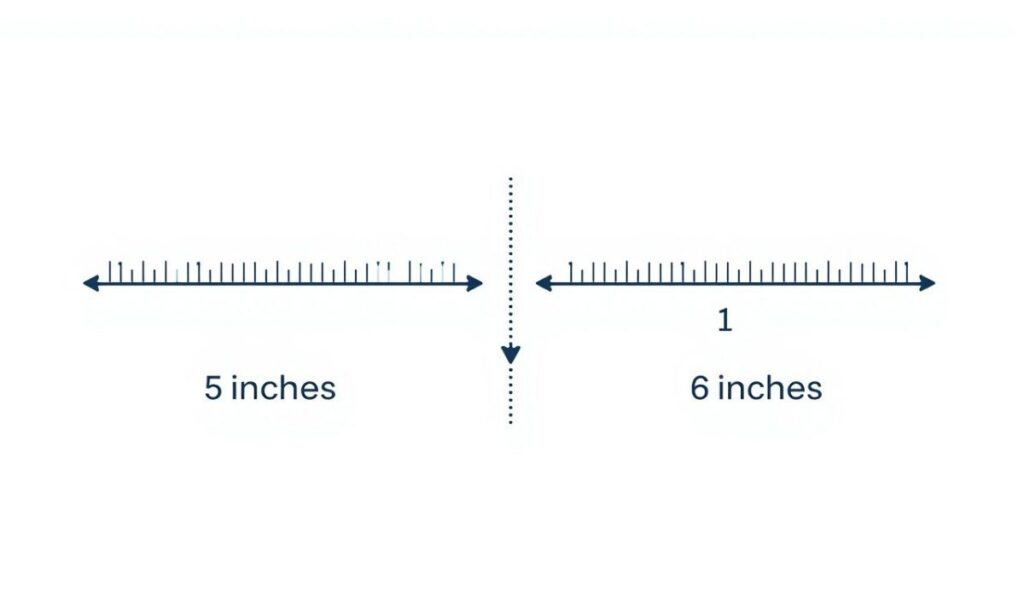
Five inches and six inches may seem nearly identical when you’re picturing them mentally, but the difference is one full inch, or 2.54 centimeters.
| Measurement | Centimeters | Millimeters |
| 5 inches | 12.7 cm | 127 mm |
| 6 inches | 15.24 cm | 152.4 mm |
| Difference | 2.54 cm | 25.4 mm |
That extra inch can matter when choosing a phone case, measuring a shelf opening, selecting a small tool, or checking whether an accessory fits in a bag.
For example, an object that’s five inches long may fit into a compact storage space, while a six-inch version could be too large. The difference is easy to overlook in an online product listing, especially when the measurements are displayed in different units.
When a close fit is important, measure the available space instead of relying entirely on visual comparisons.
Where Is a Five-Inch Measurement Useful?
Five inches isn’t just a number you encounter in measurement guides. It can be useful in several everyday situations.
Shopping Online
Product listings often provide dimensions in inches, centimeters, or millimeters. Knowing that five inches equals 12.7 centimeters makes it easier to compare products from different countries.
This is especially useful for accessories, small electronics, stationery, and storage containers.
Home Organization
Small spaces can be surprisingly difficult to estimate by sight. A five-inch measurement might determine whether a box fits in a drawer or whether an organizer leaves enough room for other items.
If the fit is tight, use an actual measuring tape rather than estimating.
Arts and Crafts
Craft projects often require accurate short measurements for paper, fabric, decorations, or small wooden pieces.
Understanding 5 inches in real life helps you visualize the size before cutting or assembling materials. However, if a project requires precision, always measure the material directly.
School and Office Tasks
Students may need to measure drawings, stationery, or project materials. Office workers may estimate the size of labels, small packages, and desk accessories.
A few familiar reference objects can make these tasks quicker, especially when you don’t need a perfectly exact result.
Explore More Blog : 11v11 Soccer Field Dimensions
Frequently Asked Questions
How long is five inches in centimeters?
Five inches equals exactly 12.7 centimeters. To convert inches to centimeters, multiply the inch measurement by 2.54.
How many millimeters are in five inches?
Five inches equals 127 millimeters. One inch is exactly 25.4 millimeters, so multiplying 25.4 by five gives 127.
What does five inches look like?
Five inches is approximately the height of a standard 12-ounce soda can or slightly shorter than an iPhone 13 mini. These everyday objects can help you visualize the length without needing a ruler.
Can I measure five inches without a ruler?
Yes, you can estimate five inches using familiar objects such as a compact comb, a known-size smartphone, or five paper clips placed end to end. These methods provide approximate results rather than guaranteed precision.
Is five inches considered small?
It depends on the object. Five inches is relatively short for a ruler or a kitchen utensil, but it can be a substantial length for a compact accessory or a small electronic component.
Is a soda can five inches tall?
A standard 12-ounce soda can is approximately 4.83 inches tall, which is very close to five inches. Different can sizes and designs may have different heights.
How do I find five inches on a ruler?
Start at zero and locate the numbered mark labeled 5. The distance from zero to that mark is five inches. Make sure the object begins at zero for an accurate reading.
How many feet is five inches?
Five inches equals approximately 0.4167 feet. Since a foot contains 12 inches, divide five by 12 to convert the measurement.
Conclusion
So, how long is five inches? It’s 12.7 centimeters, 127 millimeters, and just under half a foot. While the number itself is easy to understand, comparing it with familiar objects makes the measurement far more memorable.
A standard soda can, a compact smartphone, a pocket comb, or two playing cards placed side by side can all help you picture a length close to five inches. Some examples are more accurate than others, so it’s worth checking the actual dimensions whenever precision matters.
The next time you’re shopping online, working on a craft project, or trying to estimate the size of something around your home, you’ll have a few practical references in mind. And if you have another everyday object that makes a great five-inch comparison, share it in the comments. You might help someone else make sense of a measurement that once seemed difficult to picture.