Understanding 11v11 soccer field dimensions is important whether you’re building a soccer pitch, coaching a team, preparing for a tournament, or simply trying to understand the game better. An 11-a-side match might look straightforward from the stands, but every line, measurement, and marked area has a specific purpose that keeps the game organized.
Imagine standing on the halfway line and looking toward the opposite goal. The distance players must cover, the space available for passing, and the position of the penalty area all influence how a match unfolds. Even a small difference in pitch width can change how teams attack, defend, and create scoring opportunities.
Unlike some sports that use a fixed playing surface, soccer allows certain variations in field size. However, official competitions must follow the relevant rules established by the International Football Association Board (IFAB) and the requirements of their governing organizations.
In this guide, we’ll explore standard 11v11 soccer field dimensions, FIFA recommendations, measurements in yards, feet, and meters, field markings, goal sizes, and the differences between professional, high school, college, and youth pitches.
Quick Summary: 11v11 Soccer Field Dimensions
A full-size 11v11 soccer field accommodates 11 players from each team, including the goalkeeper. Its dimensions depend on the competition level and the rules governing the match.
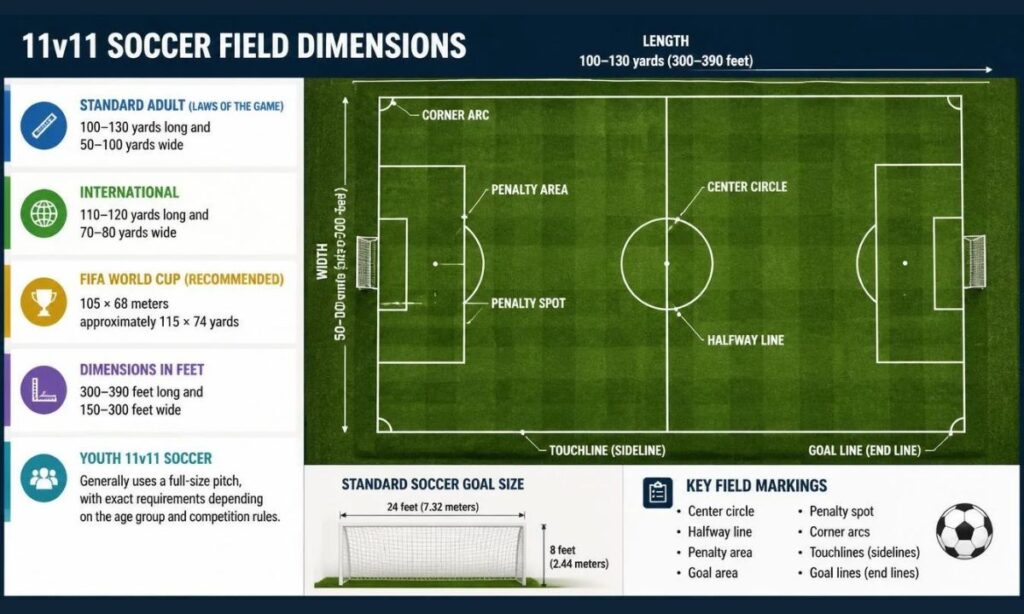
- Standard adult soccer field: 100–130 yards long and 50–100 yards wide for most matches under the Laws of the Game.
- International soccer field dimensions: 110–120 yards long and 70–80 yards wide.
- Recommended FIFA World Cup field size: 105 × 68 meters, approximately 115 × 74 yards.
- Soccer field dimensions in feet: 300–390 feet long and 150–300 feet wide for the general permitted range.
- Standard soccer goal size: 24 feet wide and 8 feet high.
- Key field markings: Center circle, halfway line, penalty area, goal area, penalty spot, corner arcs, touchlines, and goal lines.
- Youth 11v11 soccer: Generally uses a full-size pitch, with exact requirements depending on the age group and competition rules.
These figures provide a useful starting point, but always check the competition’s official regulations before marking a field or organizing a match.
What Are the Official 11v11 Soccer Field Dimensions?
The official 11v11 soccer field dimensions are not limited to one exact length and width. Under the current 2026/27 IFAB Laws of the Game, a standard adult pitch must measure 90–120 meters long and 45–90 meters wide. For international matches, the permitted range narrows to 100–110 meters long and 64–75 meters wide.
Here is a quick comparison of the main measurements.
| Field measurement | Length | Width |
| Standard adult pitch | 90–120 m (100–130 yd) | 45–90 m (50–100 yd) |
| International pitch | 100–110 m (110–120 yd) | 64–75 m (70–80 yd) |
| Recommended World Cup layout | 105 m (115 yd) | 68 m (74 yd) |
Note: Metric figures are the official reference measurements in the Laws of the Game. Yard conversions are rounded.
A pitch that measures 105 × 68 meters is a widely used professional standard. It offers enough room for players to spread out, create passing angles, and build attacks while keeping the playing area manageable for a high-intensity match.
One important distinction: 11v11 describes the number of players, not a single mandatory field size. The exact pitch dimensions depend on the competition and its regulations.
11v11 Soccer Field Dimensions in Feet
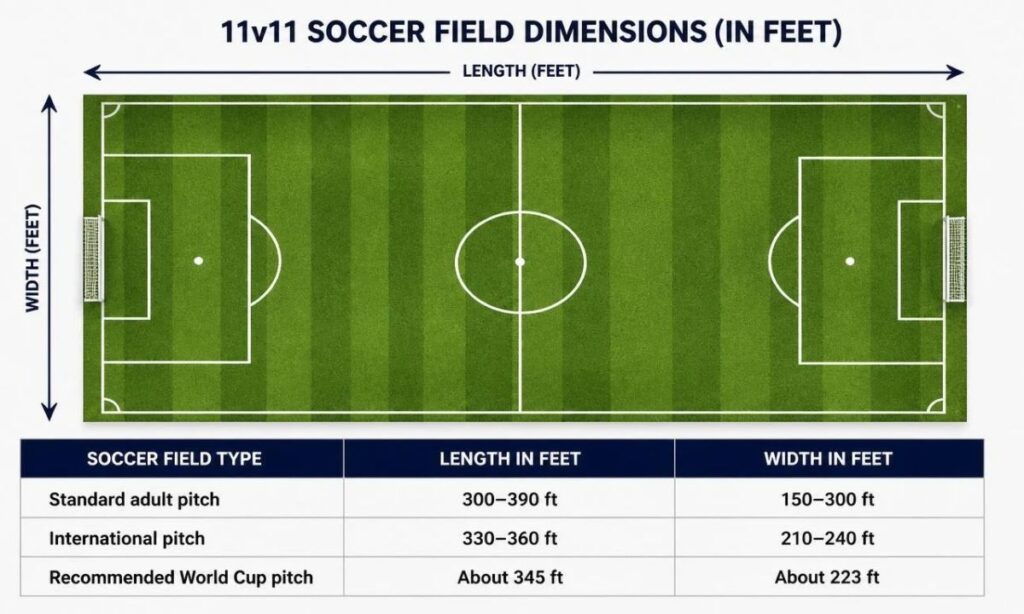
If you’re planning a field in the United States, feet may be easier to work with than meters or yards. The following conversions help you picture the available playing space.
| Soccer field type | Length in feet | Width in feet |
| Standard adult pitch | 300–390 ft | 150–300 ft |
| International pitch | 330–360 ft | 210–240 ft |
| Recommended World Cup pitch | About 345 ft | About 223 ft |
These figures are rounded conversions of the standard dimensions. For an international field, the exact permitted measurements are approximately 328–361 feet long and 210–246 feet wide when converted directly from meters.
The recommended World Cup pitch measures 105 × 68 meters, or approximately 344.5 × 223.1 feet. That is a substantial playing surface, and it becomes even more impressive when you imagine 22 players moving across it at full speed.
When measuring an actual field, use the governing competition’s prescribed dimensions rather than relying only on rounded conversions.
Why Are Soccer Fields Different Sizes?
Have you ever watched two professional soccer matches and noticed that one pitch looks much wider than the other? You’re not imagining things. Soccer regulations allow a range of field dimensions, and several practical considerations influence the final layout.
Available Land and Stadium Design
A club cannot always build its ideal pitch without considering the space available. Existing stadiums, surrounding buildings, seating arrangements, drainage systems, and access routes can influence the playing area’s dimensions.
A smaller club might work with a compact site, while a major stadium may have enough room for a larger playing surface. The chosen dimensions must still comply with the applicable competition rules.
Playing Style and Tactical Preferences
Pitch dimensions can influence the way teams approach a game. A wider field may give wingers and attacking fullbacks more room to stretch the opposition, while a narrower field can reduce space between defenders.
However, a team’s tactics aren’t determined by pitch size alone. Player ability, coaching decisions, opposition strengths, and match conditions all play their part.
Player Age and Development
Children generally benefit from playing on smaller pitches before moving to full-size adult fields. A smaller surface allows young players to develop ball control, passing, positioning, and decision-making without covering distances that are too demanding for their age.
As players mature, they can gradually transition to larger pitches and the demands of 11-a-side soccer.
Maintenance and Budget
Maintaining a full-size natural-grass field requires regular mowing, watering, drainage work, line marking, and surface repairs. Artificial turf has different maintenance needs, but installation and upkeep also involve costs.
For schools, community clubs, and training facilities, the usable land and maintenance budget can influence the choice of surface and field configuration.
Soccer Field Layout and Markings Explained
A soccer pitch is more than a green rectangle with two goals. Its markings determine where play begins, where certain restarts take place, and how referees apply the rules.
The principal parts of a standard soccer field layout include the following:
- Touchlines: The two longer boundary lines along the sides of the field.
- Goal lines: The shorter boundary lines at each end, between the corner areas.
- Halfway line: The line dividing the playing field into two equal halves.
- Center mark: The point at the exact center of the pitch.
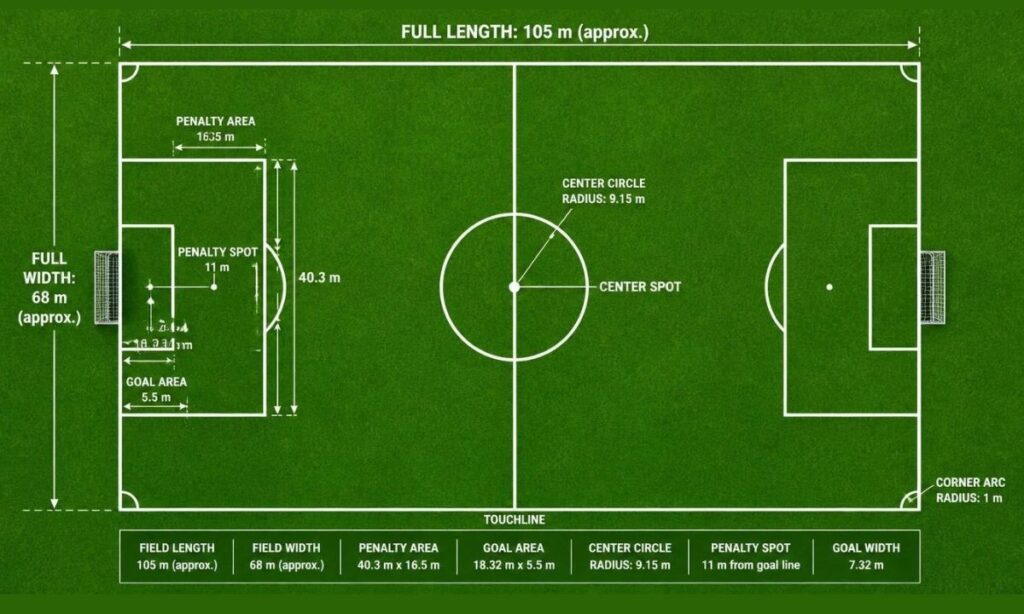
- Center circle: The circle around the center mark, with a radius of 9.15 meters (10 yards).
- Penalty area: The larger rectangular area surrounding each goal.
- Goal area: The smaller rectangular area inside each penalty area.
- Penalty mark: The spot from which penalty kicks are taken.
- Penalty arc: The curved marking outside the penalty area.
- Corner arcs: The quarter-circles from which corner kicks are taken.
These markings have defined dimensions under IFAB Law 1. The rules also specify that the field must be rectangular, the touchlines must be longer than the goal lines, and all field lines must have a consistent width of no more than 12 centimeters (5 inches).
Center Circle and Halfway Line
The halfway line separates the pitch into two halves, giving each team its own side at the beginning of a match. The center mark identifies the precise middle of the field.
Around this point is the center circle, which has a radius of 10 yards. During a kickoff, opposing players must remain outside the circle until the ball is in play, as required by the Laws of the Game.
This marking may look simple, but it plays an important role in keeping restarts orderly.
Penalty Area and Goal Area
The penalty area is often called the 18-yard box because its boundaries extend 18 yards into the field from the goal line.
The area is defined by lines extending 16.5 meters (18 yards) from the inside of each goalpost and joining across the pitch. Within this zone, the goalkeeper has special permission to handle the ball, subject to the Laws of the Game. Certain direct free-kick offenses committed by defenders inside their own penalty area can also result in a penalty kick.
Inside the penalty area sits the smaller goal area, commonly called the six-yard box. Its lines extend 5.5 meters (6 yards) from the inside of each post and 5.5 meters into the field.
Goal kicks are taken from within the goal area under the applicable rules.
Penalty Spot and Penalty Arc
The penalty spot is positioned 11 meters (12 yards) from the midpoint between the goalposts. This is where a penalty kick is taken.
The penalty arc lies outside the penalty area. It forms part of a circle with a radius of 9.15 meters (10 yards), measured from the penalty mark. During a penalty kick, players other than the kicker and goalkeeper must respect the required distances and positioning rules.
Touchlines, Goal Lines, and Corner Arcs
The touchlines mark the long sides of the pitch, while the goal lines mark its ends. The entire ball must cross a boundary line for it to be out of play.
A goal is scored when the whole ball passes over the goal line between the goalposts and beneath the crossbar, provided no infringement has occurred.
Each corner contains a quarter-circle with a radius of 1 meter (1 yard). The corner flagpost is positioned at the corner, and the ball must be placed within the corner area for a corner kick.
Small markings, big consequences. These lines are essential to referees, players, and everyone watching the game.
What Are the Standard Soccer Goal Dimensions?
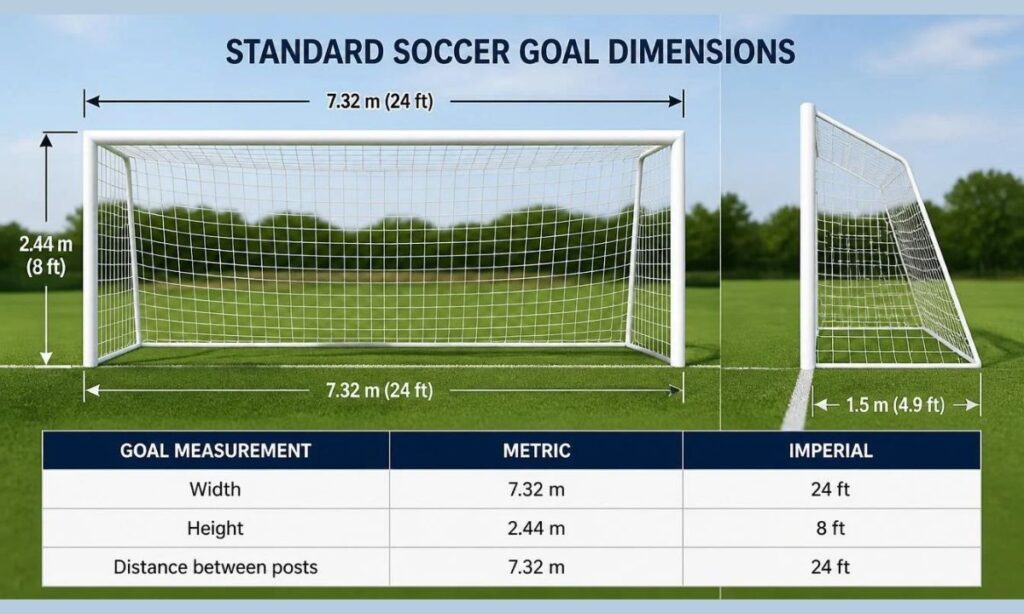
The standard 11v11 soccer goal dimensions are 7.32 meters (24 feet) wide and 2.44 meters (8 feet) high. These measurements apply to adult goals under the Laws of the Game. The width is measured between the inside edges of the goalposts, and the height is measured from the ground to the underside of the crossbar.
| Goal measurement | Metric | Imperial |
| Width | 7.32 m | 24 ft |
| Height | 2.44 m | 8 ft |
| Distance between posts | 7.32 m | 24 ft |
Both goalposts and the crossbar must have the same width and depth, which must not exceed 12 centimeters (5 inches). Goals must also be securely anchored to reduce the risk of accidents.
Youth competitions may use smaller goals, depending on the age group and league requirements. Always check the relevant rules before purchasing or installing goal equipment.
Youth, High School, and College Soccer Field Dimensions
Not every 11-a-side match takes place on a professional-size pitch. School districts, colleges, youth leagues, and community clubs may follow different field-size requirements.
Youth Soccer Field Dimensions
Youth soccer fields are usually smaller than adult pitches, especially for children learning the game.
| Age group or format | Approximate field dimensions |
| Under-6 to under-8 | Smaller fields, often for small-sided games |
| Under-10 to under-12 | Intermediate dimensions, depending on format |
| Under-13 and older | May transition to full-size 11v11 fields |
These are general development stages, not universal regulations. Many youth leagues use 4v4, 7v7, or 9v9 formats before introducing 11v11 soccer. The exact dimensions depend on the governing body’s rules.
The main idea is to give young players enough room to learn without making the game unnecessarily difficult. A child who can receive a pass, turn, and make a decision comfortably on a smaller field may struggle when suddenly expected to cover an adult-size pitch.
High School Soccer Field Dimensions
In the United States, high school soccer field requirements depend on the applicable state association and the rules it adopts.
The National Federation of State High School Associations (NFHS) provides soccer rules for school competitions, but field specifications and local requirements should be checked for the particular season and jurisdiction.
A field measuring around 100–120 yards long and 55–80 yards wide falls within the broad range often encountered in school soccer. However, these figures should not be treated as a universal requirement for every high school.
College Soccer Field Dimensions
College soccer fields are also subject to competition-specific regulations. NCAA rules and the requirements of individual conferences or facilities should be consulted when preparing a field for an official match.
Many college matches use pitches close to 115 yards long and 70–75 yards wide, although the permitted dimensions depend on the relevant rules.
If you’re marking a college field, don’t assume that a nearby professional stadium uses the same specifications. Verify the current competition manual first.
FIFA and World Cup Soccer Field Dimensions
The recommended World Cup playing-field size is 105 meters long and 68 meters wide, equivalent to approximately 115 yards by 74 yards. This size is widely used for elite professional soccer and provides a consistent setting for international competition.
At this size, teams have room to build attacks from the back, switch the ball across the field, and use the wings to create opportunities. Defenders must cover substantial distances, while midfielders need the stamina to move between attacking and defensive responsibilities.
The World Cup dimensions are particularly useful as a reference when designing a new adult pitch. Still, the required measurements for a particular tournament must be confirmed against its current competition regulations.
Bundesliga Soccer Field Dimensions
Many Bundesliga pitches use the familiar 105 × 68-meter layout. However, professional league requirements should be checked directly rather than assuming every stadium has identical measurements.
The German Bundesliga, like other major leagues, operates under competition-specific stadium and field requirements. The official pitch size for a given club or season should be confirmed using the league’s regulations.
Natural Grass, Artificial Turf, and Hybrid Surfaces
The playing surface can influence how a soccer field performs in different weather conditions.
Offers a traditional playing surface and natural feel, but requires mowing, watering, drainage, and regular maintenance.
Uses synthetic fibers and can provide a durable surface in facilities that experience heavy use.
Combines natural grass with synthetic reinforcement to improve durability in high-traffic areas.
Surface choice depends on climate, budget, playing frequency, maintenance capacity, and competition rules. Whichever material is selected, the field must provide a suitable and safe playing environment.
Soccer Field Dimensions Compared With Other Sports
A full-size soccer pitch requires considerably more space than a tennis court or basketball court. Comparing sports surfaces helps explain why building an 11v11 facility requires careful planning.
| Sports surface | Typical dimensions |
| Soccer | Varies; recommended elite size is 105 × 68 m |
| American football | 120 × 53⅓ yards, including end zones |
| Basketball | 94 × 50 ft for a standard NBA court |
| Tennis doubles | 78 × 36 ft |
American football’s 120-yard length includes two 10-yard end zones, so its playing dimensions are not directly equivalent to soccer’s. Basketball and tennis courts are much smaller, reflecting the different movement patterns and rules of those sports.
How to Measure an 11v11 Soccer Field
If you’re preparing a pitch for a club, school, or local tournament, accurate measurements are essential. A field may look rectangular to the eye while still having uneven boundaries or incorrectly positioned markings.
Follow these steps to measure a field correctly.
- Confirm the required size. Check the competition rules before deciding on the length and width.
- Measure the touchlines. Establish the long boundaries first, ensuring both are equal in length.
- Check the goal lines. Measure the width at both ends and confirm the corners are square.
- Verify the diagonals. For a rectangle, the two corner-to-corner diagonals should be equal.
- Mark the halfway line. Find the midpoint of each touchline and connect those points.
- Position the center mark and circle. Measure the circle’s radius accurately.
- Mark both penalty areas and goal areas. Use the official distances from the goal line and goalposts.
- Install the goals and corner flags. Confirm their dimensions, alignment, and secure anchoring.
- Inspect the final layout. Check line widths, boundary measurements, and all critical markings before play begins.
One useful tip: IFAB specifies that field measurements are taken from the outside edges of the lines because the lines themselves form part of the areas they enclose.
For a competition field, professional surveying or specialist field-marking equipment can help reduce measurement errors.
Explore More Blog : Normal Living Room Size
Frequently Asked Questions
How big is an 11v11 soccer field?
A standard adult soccer field can measure 90–120 meters long and 45–90 meters wide under IFAB rules. International matches have a narrower permitted range of 100–110 meters long and 64–75 meters wide.
What is the most common professional soccer field size?
A widely used professional standard is 105 × 68 meters, approximately 115 × 74 yards. It is also the recommended playing-field size for the FIFA World Cup.
Is every 11v11 soccer field the same size?
No. The number 11v11 refers to the players on the field for each team, not the pitch dimensions. The permitted size varies according to the competition and its rules.
How many feet long is an international soccer field?
An international soccer field is approximately 328–361 feet long, based on the official metric range of 100–110 meters. Its width is approximately 210–246 feet.
How large is the penalty box?
The penalty area extends 16.5 meters (18 yards) into the field from the goal line. Its side boundaries are positioned 16.5 meters from the inside of each goalpost.
What are the dimensions of a standard soccer goal?
A regulation adult soccer goal is 7.32 meters (24 feet) wide and 2.44 meters (8 feet) high, measured between the inside edges of the posts and from the ground to the underside of the crossbar.
Can a school use a full-size 11v11 soccer field?
Yes, provided the field meets the applicable requirements for its competition. Schools should verify local association rules, available space, goal specifications, and required field markings.
Conclusion
Understanding 11v11 soccer field dimensions makes it easier to appreciate how the game is organized, from the distance between the goals to the precise position of the penalty spot. While adult pitches can vary within the permitted limits, international matches follow a narrower range, and 105 × 68 meters remains a widely used reference size for elite soccer.
The field’s markings are just as important as its overall dimensions. The center circle regulates kickoff positioning, the penalty area defines important goalkeeper privileges and penalty-kick situations, and the boundary lines establish when the ball leaves the field.
Whether you’re planning a new sports facility, coaching a team, or simply learning more about soccer, always use the rules for your particular competition as the final reference. A correctly measured pitch creates a fairer, safer, and more enjoyable environment for everyone who steps onto it.