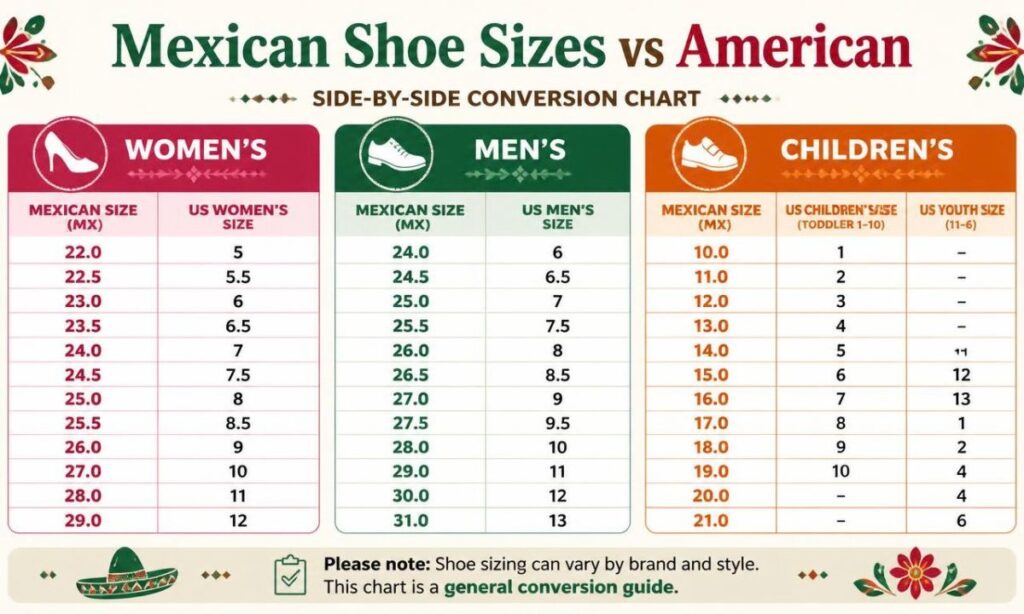
Buying shoes from another country can feel like solving a small puzzle, especially when the numbers on the shoe box don’t match the sizes you know. You might wear a US men’s size 9 comfortably, for example, but a Mexican shoe store may label its footwear with a completely different number. Suddenly, a simple shopping trip becomes a guessing game, and nobody wants to discover that their new boots are too tight after waiting days for delivery.
Understanding Mexican Shoe Sizes vs American sizing makes international shopping much easier. Whether you’re buying traditional Mexican leather boots, stylish huaraches, everyday sneakers, or shoes for your children, knowing how the two sizing systems relate can help you make a better choice.
The important thing to remember is that Mexican shoe sizes commonly follow a centimeter-based approach, while American shoe sizing uses separate numerical scales for men, women, and children. However, sizing conventions vary between manufacturers, so a conversion chart should be treated as a useful starting point rather than an absolute guarantee.
Let’s explore the differences, compare approximate sizes, and learn how to find a comfortable fit without the unnecessary confusion.
Mexican Shoe Sizes vs American Shoe Sizes: What’s the Difference?
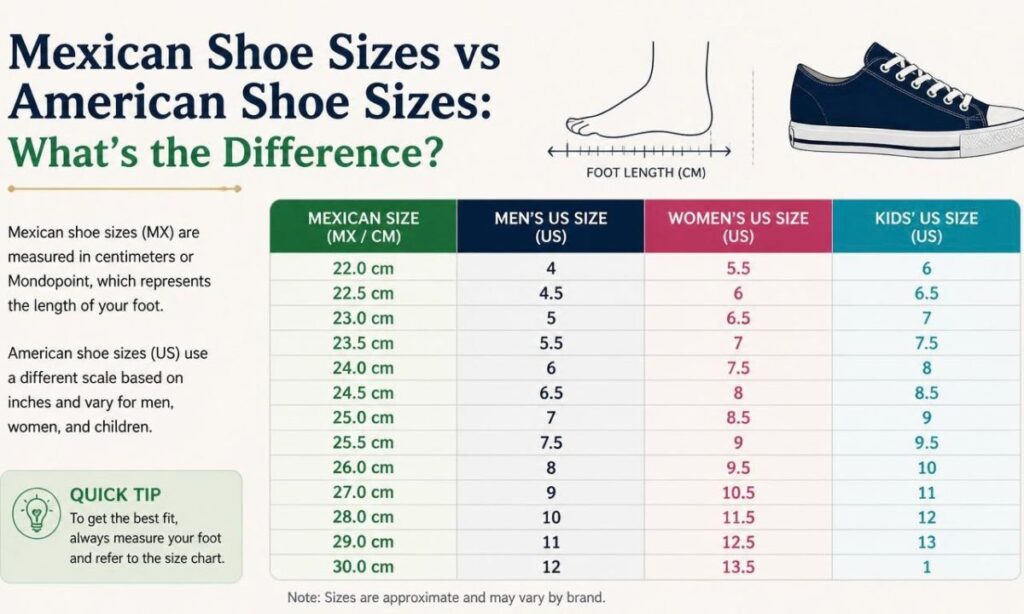
The main difference between Mexican and American shoe sizing is how the numbers are assigned. Mexican footwear commonly uses numbers related to foot length in centimeters, although some brands use different conventions or labeling practices. American sizing generally uses numerical scales that differ for men’s, women’s, and children’s shoes.
For example, a Mexican shoe labeled size 27 may refer to a length around 27 centimeters under a centimeter-based convention. It does not automatically mean US size 27, because the American system uses an entirely different scale.
Here are the main differences worth understanding:
- Mexican shoe sizes: Commonly associated with centimeter measurements, depending on the manufacturer.
- American shoe sizes: Use different numerical scales for men, women, and children.
- Foot length: A useful starting point for comparing sizes across countries.
- Shoe construction: The shape, width, toe box, and materials can affect the final fit.
- Brand-specific sizing: Two shoes with the same labeled size may fit differently.
Think of shoe sizing as a language. Centimeters describe a physical measurement, while a shoe size is a label used to help shoppers choose footwear. Translating one label into another isn’t always straightforward, but measuring your feet makes the process much more reliable.
Mexican to US Shoe Size Conversion Chart
A Mexican shoe size conversion chart can help you estimate which American size to try. Because Mexican labeling practices differ, the following table uses approximate comparisons for adult footwear based on common centimeter-oriented sizing and typical US size charts.
These comparisons are illustrative, not a universal conversion standard. Always check the particular manufacturer’s chart before ordering.
| Approximate foot length | Approximate US men’s size | Approximate US women’s size |
|---|---|---|
| 22 cm | 4 | 5–5.5 |
| 23 cm | 5 | 6–6.5 |
| 24 cm | 6 | 7–7.5 |
| 25 cm | 7 | 8–8.5 |
| 26 cm | 8 | 9–9.5 |
| 27 cm | 9 | 10–10.5 |
| 28 cm | 10 | 11–11.5 |
| 29 cm | 11 | 12–12.5 |
| 30 cm | 12 | 13–13.5 |
| 31 cm | 13 | 14–14.5 |
Note: These are broad estimates. The table compares approximate foot lengths with typical US sizing; it does not establish an official equivalence for every Mexican shoe labeled with the same number.
A Mexican size 27, for instance, may correspond to footwear intended for a foot around 27 cm long if the manufacturer follows that convention. In a typical US chart, that measurement could fall around men’s size 9 or women’s size 10–10.5. The precise equivalent depends on the brand and its sizing method.
The best approach is to compare actual foot measurements, not just the numbers printed on the labels.
Mexican Men’s Shoe Sizes vs American Men’s Shoe Sizes
Men shopping for Mexican shoes will often find that the sizing numbers look different from the American sizes they’re used to. Mexican men’s shoe sizes may be based on centimeters, while US men’s sizes typically follow a separate numerical scale.
Suppose you normally wear US men’s size 10. Rather than assuming that Mexican size 10 will fit, measure your foot and compare the result with the manufacturer’s sizing chart. Depending on the brand’s convention, you might need to look for a Mexican label around 28 cm or another size recommended by its chart.
This matters especially when buying leather boots, dress shoes, and handmade footwear. A pointed boot can have a long-looking silhouette without providing the same amount of usable space for your toes.
When shopping for men’s shoes, keep these details in mind:
- Measure both feet because one may be slightly longer.
- Check whether the chart lists foot length or the shoe’s internal length.
- Pay attention to width, particularly for work boots and dress shoes.
- Look for brand-specific advice about half sizes.
- Read reviews mentioning whether the footwear runs small, large, narrow, or wide.
A good fit should feel secure around the heel while leaving enough space for your toes. You shouldn’t have to convince yourself that painfully tight shoes will somehow become comfortable after a few wears.
Mexican Women’s Shoe Sizes vs American Women’s Shoe Sizes
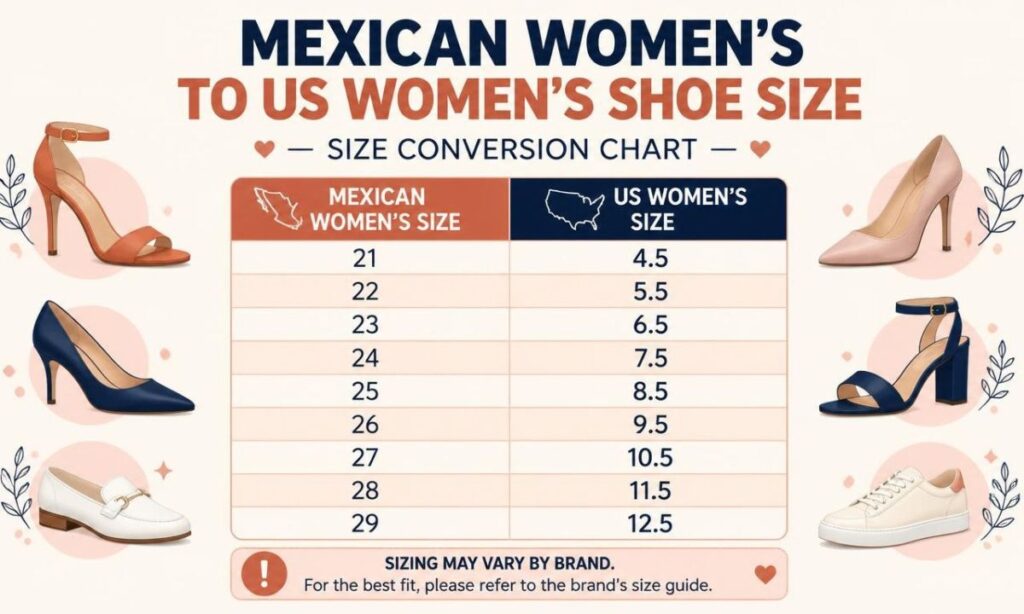
Women’s footwear requires a little extra care because US women’s sizes do not use the same scale as US men’s sizes. A number that appears familiar on a Mexican shoe label may therefore be confusing if you compare it directly with an American women’s size.
For instance, a foot measuring approximately 24 cm might fall around US women’s size 7–7.5 in a typical chart. However, the exact equivalent can vary with the brand, shoe design, and sizing convention.
This is particularly important when ordering sandals, heels, flats, or traditional Mexican huaraches. Open footwear may allow some adjustment through straps, while closed shoes need enough room across the toes and around the instep.
Before making a purchase, consider the following:
- Measure your foot from the back of the heel to the longest toe.
- Compare the measurement with the women’s chart supplied by the seller.
- Check whether the shoe is narrow, regular, or wide.
- Look for information about the shape of the toe box.
- Consider the thickness of socks if you are buying boots or sneakers.
If a listing provides both a centimeter measurement and a US size, use both pieces of information. They can help you identify inconsistencies before you spend money on a pair that might not fit.
Mexican Kids’ Shoe Sizes vs American Kids’ Shoe Sizes
Children’s shoes are another area where size conversions can be tricky. Young feet grow quickly, and a pair that fits perfectly at the beginning of the school term may become uncomfortable sooner than parents expect.
Mexican kids’ shoe sizes may follow a centimeter-oriented convention, but manufacturers don’t all label children’s footwear identically. American children’s sizes also differ from adult sizes and commonly progress through infant, toddler, and youth ranges.
For example, if a child’s foot measures 18 cm, use that measurement to find the appropriate size on the manufacturer’s chart rather than guessing from an American label alone.
Parents can make shopping easier by following a few practical steps:
- Measure the child’s feet while standing, if possible.
- Check both feet and use the larger measurement.
- Measure again if the last measurement was taken several months ago.
- Leave appropriate growing room according to the brand’s guidance.
- Make sure the heel stays in place while walking.
- Check that the toes can move naturally inside the shoe.
Avoid buying shoes that are excessively large simply because a child will eventually grow into them. Too much extra space can make walking awkward, while shoes that are too small can cause discomfort.
How to Convert Mexican Shoe Sizes to US Sizes
Converting Mexican shoe sizes to American sizes is easiest when you start with foot length. If you have a reliable centimeter measurement, you can use it to identify a likely size in a US chart.
Here is a simple process to follow.
Measure Your Foot in Centimeters
Place a sheet of paper against a wall on a hard, level floor. Stand on the paper with your heel lightly touching the wall, then mark the end of your longest toe.
Measure from the edge of the paper to the mark. Repeat the process for your other foot and use the larger measurement when comparing sizes.
For example, your longer foot might measure 26.5 cm. That measurement is more useful than guessing based on the size of your old sneakers, particularly if you are switching brands or countries.
Check the Manufacturer’s Mexican Size Chart
Find the exact chart supplied by the shoe brand or retailer. Determine whether its Mexican size labels represent foot length, a particular regional sizing convention, or another measurement.
Do not assume that every label follows the same rule. A reliable brand chart is more useful than a generic online converter that doesn’t explain its method.
Find the Closest US Equivalent
Use your measurement to identify the approximate US men’s, women’s, or children’s size. Choose the chart that matches the person and type of shoe you’re buying.
If your foot falls between two listed measurements, check the brand’s recommendations for half sizes and fit. Some shoes have more generous toe boxes than others, so the best choice is not always the one with the nearest number.
Check Width and Shoe Shape
Length is only one part of a comfortable fit. Foot width, arch shape, instep height, and the shoe’s design also matter.
This is especially true for boots and structured leather shoes, which may feel different from flexible sneakers. A conversion chart can narrow your options, but trying the shoes on or checking a retailer’s return policy provides additional confidence.
How to Measure Your Feet for Mexican Shoes
Accurate measurement is one of the simplest ways to avoid an expensive sizing mistake. You don’t need specialized equipment; a piece of paper, a pencil, and a ruler are usually enough.
Follow these steps:
- Place a sheet of paper on a hard floor with one edge against a wall.
- Stand on it with your heel touching the wall naturally.
- Mark the end of your longest toe.
- Measure the distance from the wall-side edge of the paper to the mark.
- Repeat the process with your other foot.
- Record the larger measurement in centimeters and inches.
- Compare the result with the exact chart for your chosen shoe.
For reference, 1 inch equals 2.54 centimeters. To convert centimeters to inches, divide the centimeter measurement by 2.54.
For example, 25.4 cm equals 10 inches. This is a straightforward conversion of length, though it does not mean that a 10-inch foot automatically corresponds to a particular shoe size in every country.
It’s also helpful to measure later in the day, when feet may be slightly larger than they are first thing in the morning. Wear the socks you intend to use with the shoes if the design calls for them.
What Is Mexican Shoe Size 31 in the USA?
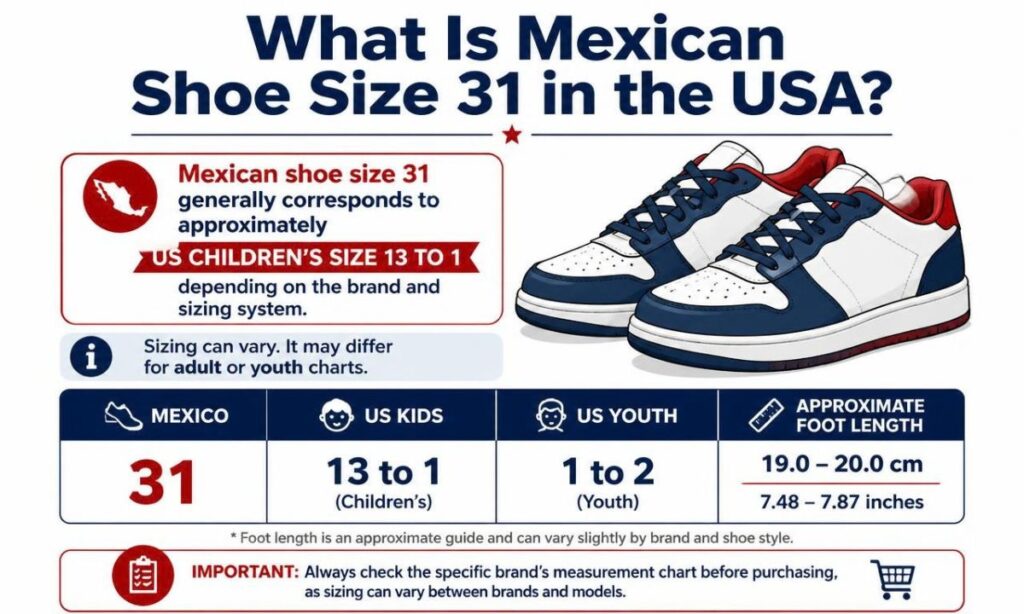
A Mexican shoe labeled size 31 may refer to a measurement around 31 cm if the manufacturer uses a centimeter-based labeling convention. On many typical US men’s charts, a foot length around 31 cm may correspond approximately to men’s size 13 or larger, depending on the chart.
However, the number alone is not enough to guarantee an exact match. Some brands may use different labeling systems, and the length of a shoe is not necessarily identical to the length of the foot it is designed to fit.
If you’re considering Mexican size 31, check the seller’s measurement chart and confirm whether the listed centimeters refer to foot length or another dimension. This small step can save you the hassle of exchanging a pair of boots or sneakers.
Why Do Mexican and American Shoe Sizes Differ?
Shoe sizes differ because countries and manufacturers have developed different systems for labeling footwear. Some systems use measurements based on centimeters or millimeters, while others rely on numerical scales that progress according to their own conventions.
The American system also distinguishes between men’s, women’s, and children’s sizes. As a result, the same foot length can correspond to different US size labels depending on the category.
Manufacturing adds another layer of variation. Even within one country, brands may use different lasts, toe shapes, width standards, and fit preferences. A sneaker designed for running may feel very different from a pointed leather boot carrying a similar size label.
This explains why a simple formula cannot always deliver a perfect conversion. It can help you identify a starting point, but the manufacturer’s sizing information remains essential.
Traditional Mexican Footwear and Finding the Right Fit
Mexican footwear includes a wide variety of styles, from everyday leather shoes to distinctive traditional designs. Understanding the style you’re buying can help you judge fit more effectively.
Huaraches are woven leather sandals traditionally associated with Mexican craftsmanship. Their open construction and adjustable straps can make fitting different from that of a closed shoe.
Charro boots are associated with Mexican charro traditions and equestrian attire. Depending on their design, they may require particular attention to the instep, calf, heel, and toe area.
Botas picudas mexicanas, sometimes called Mexican pointy boots, are recognized for their exaggerated pointed toes. The extended tip can make the shoe appear much longer than the space available for the foot itself.
Botas tribaleras are another distinctive style associated with Mexican dance and regional fashion scenes. Their unusual shapes and decorative details mean that shoppers should examine the manufacturer’s fit advice rather than relying on appearance alone.
These designs reflect the diversity of Mexican footwear and its craftsmanship. A beautifully made shoe still needs to fit properly, though, and traditional styling does not eliminate the need to check measurements.
Tips for Buying Mexican Shoes Online
Shopping online opens the door to footwear you may not find locally, but it also makes careful sizing more important. You can’t immediately try on the shoes, and returning an international order may be expensive.
Before completing your purchase, take a moment to check the following:
- Read the sizing chart: Use the chart on the actual product page whenever possible.
- Confirm the sizing convention: Find out whether the Mexican number refers to foot length or another scale.
- Review customer feedback: Look for comments about fit, width, and whether the shoes run large or small.
- Check the materials: Natural leather may soften with wear, but a shoe that is too short should not be expected to stretch into the correct size.
- Inspect the return policy: International shipping and exchanges can add unexpected costs.
- Ask the seller questions: If the chart is unclear, request the recommended size for your measured foot length.
You can also use an online shoe size converter as a secondary reference. A tool such as Giga Calculator may help with basic measurement conversions, but a generic calculator cannot replace a manufacturer’s footwear chart.
The most useful approach combines a measured foot length, a brand-specific size chart, and a little research into the particular shoe.
Common Mistakes When Comparing Mexican and American Shoe Sizes
Even experienced shoppers can make sizing mistakes when buying shoes from another country. Most are easy to avoid once you understand how the systems differ.
Assuming the same number means the same size
A Mexican size 27 is not automatically the equivalent of US size 27. The labels come from different sizing conventions, so always verify the measurement.
Using only your current American shoe size
Your current size is a useful clue, but different brands may fit differently. Measure your feet when purchasing unfamiliar footwear.
Confusing foot length with shoe length
A foot measuring 27 cm does not mean that the shoe’s internal length should be exactly 27 cm. Footwear needs appropriate room, and the amount varies by style and manufacturer.
Ignoring width
A shoe can have the correct length but still feel tight across the forefoot. Check width options and product descriptions where available.
Assuming all Mexican footwear follows one standard
Mexican manufacturers do not necessarily use one universal labeling convention. Check the brand’s chart before ordering.
Expecting leather shoes to stretch dramatically
Leather may soften or conform somewhat with use, but significant length problems generally won’t disappear. A comfortable fit from the beginning is a much safer goal.
Explore More Blog : 11 Inch Example
Frequently Asked Questions About Mexican Shoe Sizes vs American
Are Mexican shoe sizes smaller than American sizes?
Not necessarily. The two systems use different numerical conventions, so their labels cannot be compared directly. The actual relationship depends on the manufacturer’s sizing chart and the type of footwear.
How do I convert Mexican shoe size to US shoe size?
Measure your foot in centimeters, then compare that measurement with the manufacturer’s Mexican and American size charts. Use the chart for the correct category: men’s, women’s, or children’s footwear.
What is Mexican shoe size 21 in US women’s sizes?
If the label follows a centimeter-based convention, size 21 may refer to a foot measurement around 21 cm. That is generally associated with a small US women’s size, but an exact equivalent requires the manufacturer’s chart.
What is Mexican shoe size 24 in US women’s sizes?
A measurement of 24 cm may correspond approximately to US women’s size 7–7.5 in a typical chart. However, the result varies with the sizing convention, brand, and shoe design.
What is Mexican shoe size 19 in US men’s sizes?
If Mexican size 19 represents a foot length of 19 cm, it would generally be associated with children’s sizing rather than adult men’s footwear. Confirm the manufacturer’s convention before attempting a conversion.
Conclusion
Choosing footwear should be about more than finding a number that looks familiar. Your shoes carry you through ordinary mornings, long walks, busy workdays, family gatherings, and all the little adventures that fill a life. Comfort deserves a place in the decision.
When comparing Mexican Shoe Sizes vs American labels, begin with an accurate measurement. Use a reliable conversion chart, verify the manufacturer’s sizing convention, and consider the particular style of shoe you’re buying. Remember that Mexican size numbers may reflect centimeters, but not every brand follows an identical labeling method.
If you’re shopping for yourself, a family member, or a friend, these extra few minutes can make a real difference. A good fit is not just about getting the size right; it’s about being able to walk comfortably and confidently in the footwear you choose.
Have you purchased Mexican shoes before, or discovered a sizing difference that surprised you? Share your experience or favorite sizing tip in the comments. Your advice might help another shopper find the right pair without the guesswork.