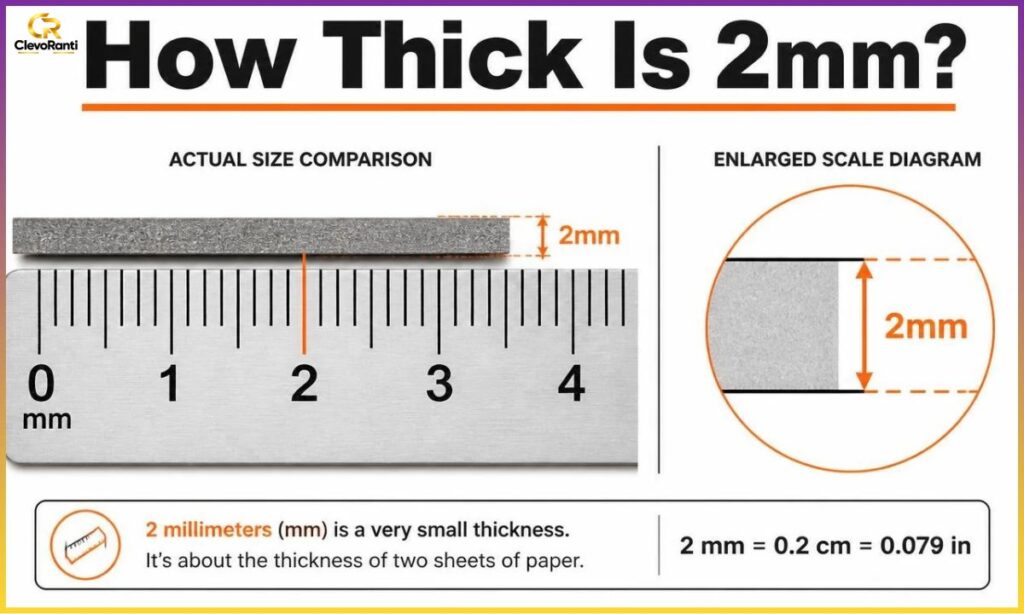
Have you ever looked at a tiny gap, a thin piece of metal, or a little gemstone and wondered how thick it actually is? Small measurements can be surprisingly difficult to picture, especially when someone says something is just two millimeters thick.
It sounds almost invisible at first, but 2 millimeters is a real, noticeable measurement that appears in everyday objects, jewelry, household repairs, and even precision engineering.
Understanding how thick is 2mm becomes much easier when you compare it with familiar things. A US nickel coin, for example, is approximately 1.95 millimeters thick, making it an excellent reference point. Two millimeters is also close to the thickness of about 20 sheets of ordinary printer paper, depending on the paper weight.
Although the measurement seems tiny, those extra millimeters can make a meaningful difference. They matter when choosing jewelry, installing tiles, designing miniature components, or checking whether a small part will fit into a narrow space. A little measurement error can turn a perfect fit into an annoying problem.
In this guide, we’ll explore what 2mm looks like, how it compares with common objects, how to convert it into inches and centimeters, and how to estimate this measurement without a ruler. By the end, you’ll have several practical reference points to help you recognize two millimeters in real life.
What Does a 2mm Thickness Look Like in Real Life?
Two millimeters is a small measurement equal to two-thousandths of a meter. In the metric system, a millimeter is one-thousandth of a meter, so two millimeters is simply twice that amount.
To make the measurement easier to understand, here are the essential conversions.
| Measurement unit | Equivalent of 2mm |
| Millimeters | 2 mm |
| Centimeters | 0.2 cm |
| Meters | 0.002 m |
| Inches | 0.0787 inches |
| Feet | 0.00656 feet |
| Yards | 0.00219 yards |
The most useful conversion for people accustomed to the Imperial measurement system is 2mm in inches, which equals approximately 0.0787 inches. That’s slightly less than one-tenth of an inch.
Imagine dividing a single inch into ten equal sections. Each section would measure 0.1 inches, and two millimeters would be a little shorter than one of those sections. The difference isn’t enormous, but it becomes important when working with small parts or narrow openings.
A measurement this small may not seem impressive on paper, yet it can affect how jewelry fits, how closely two surfaces sit together, and how accurately a manufactured component performs.
How Big Is 2mm in Real Life?
When you want to understand how big is 2mm, the easiest approach is to stop thinking about abstract numbers and start looking at physical objects.
Two millimeters is small enough to fit comfortably within the width of a fingernail, yet large enough to measure with a standard metric ruler. It is not an invisible distance, although judging it accurately without a reference can be difficult.
Consider these familiar comparisons:
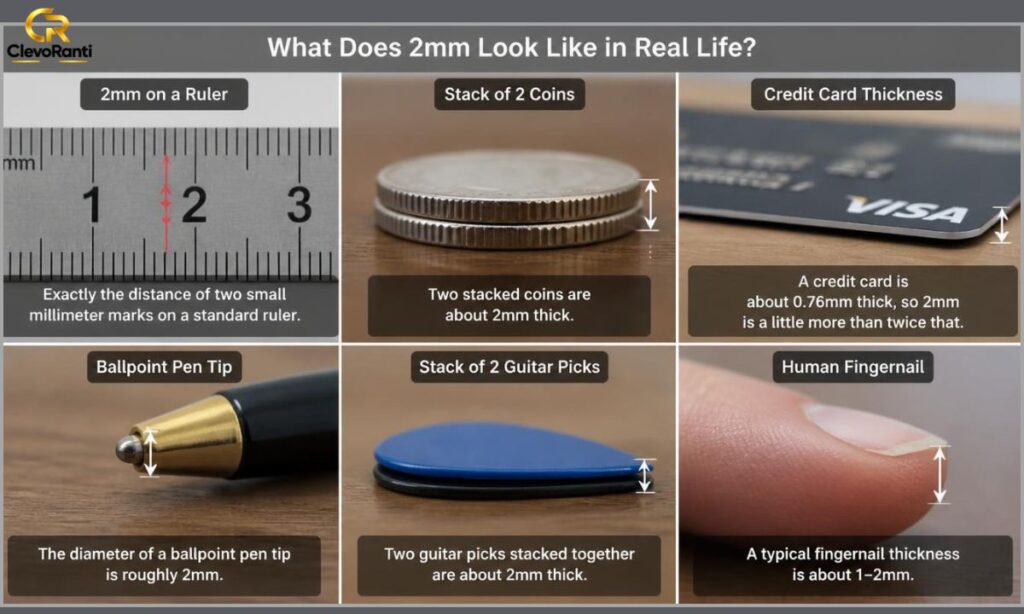
- A US nickel is approximately 1.95mm thick, making it almost exactly a two-millimeter reference.
- Twenty sheets of ordinary printer paper may form a stack close to 2mm thick.
- Three standard credit cards stacked together measure approximately 2.28mm, slightly thicker than the target.
- Two stacked credit cards measure approximately 1.52mm, which is thinner than 2mm.
- A small mustard seed may measure around 1–2mm across, depending on its variety.
- Some tiny insects have body dimensions close to 2mm, although their size varies considerably by species.
These examples are useful because they give your eyes something familiar to work with. You may not carry a metric ruler everywhere, but you’ve probably handled a coin, a bank card, or a sheet of paper today.
Remember that an object’s thickness, width, and length are different measurements. A rice grain might be several millimeters long while being much narrower, so its overall length should not be confused with a two-millimeter thickness.
How Long Is 2mm?
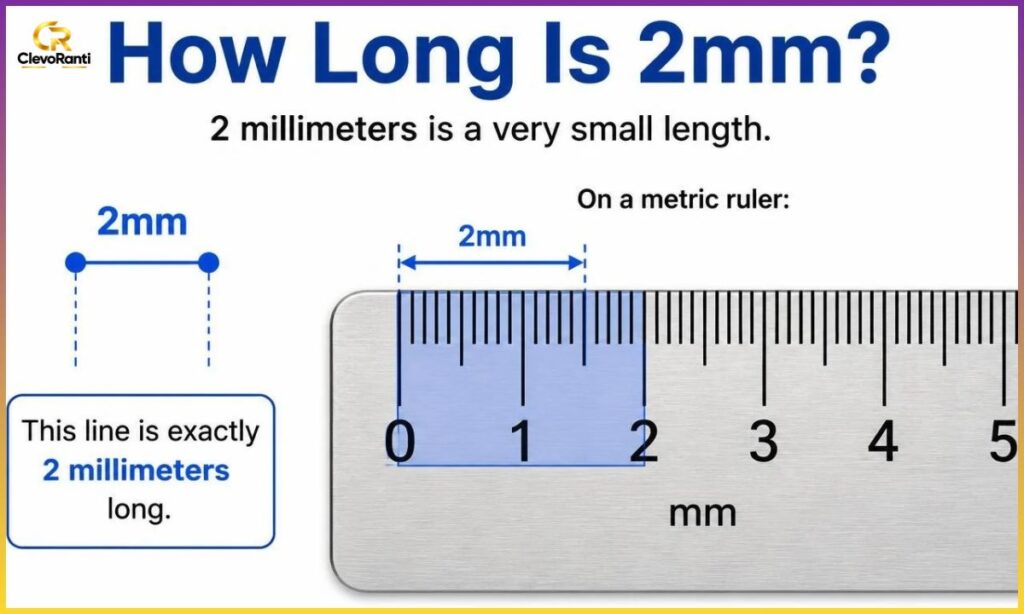
The question how long is 2mm depends on which dimension you’re measuring. Two millimeters can describe the length of a tiny object, the width of a narrow strip, or the thickness of a flat material.
As a linear distance, 2mm is equal to 0.2 centimeters or 0.0787 inches. If you draw a straight line between two points separated by this distance, the line will be shorter than one-tenth of an inch.
Here’s another way to imagine it. Look at a metric ruler and find the centimeter markings. Each centimeter is divided into ten millimeter increments. Two millimeters occupy just two of those tiny divisions.
That may sound easy, but estimating the distance by eye can be tricky. Small markings tend to blur together when you look from an angle, especially if the ruler has thin lines or poor contrast.
For a quick estimate, remember that ten millimeters make one centimeter. Two millimeters therefore represent one-fifth of a centimeter, a simple relationship that’s useful when switching between metric units.
What Does 2mm Look Like Compared With Everyday Objects?
Visual comparisons are often more helpful than calculations, particularly when you’re trying to picture a tiny measurement in your head. The following everyday objects provide useful reference points for understanding 2mm thickness.
A US Nickel Coin
A US nickel is approximately 1.95mm thick, making it one of the closest everyday comparisons available. Its thickness differs from two millimeters by only about 0.05mm.
Hold a nickel between your fingers and inspect its edge. That narrow metal side gives you a practical sense of how much space two millimeters occupies.
This comparison is especially handy for DIY projects or casual estimates. However, a coin isn’t a precision measuring instrument, and its edge should not replace a ruler when exact dimensions matter.
Twenty Sheets of Printer Paper
Ordinary printer paper is often around 0.1mm thick, although the actual thickness varies with paper weight, coating, and manufacturing. Under that assumption, twenty sheets stacked together would measure approximately 2mm.
Try stacking twenty sheets and looking at the edge rather than the broad surfaces. The height of the stack provides a surprisingly useful picture of two millimeters.
Paper is a good reference because it is easy to find at home or in an office. Still, don’t assume every twenty-sheet stack will have exactly the same height.
Three Credit Cards
A standard bank card is approximately 0.76mm thick. Stacking three cards produces a combined thickness of around 2.28mm, which is slightly more than two millimeters.
Two cards, by comparison, measure about 1.52mm. Adding a third card takes the stack beyond the target.
This is a convenient comparison if you have a few expired cards available. Just avoid using your actual bank cards in a way that could bend, scratch, or damage them.
A Mustard Seed
Some mustard seeds measure roughly 1–2mm across, depending on the variety and individual seed. Black mustard (Brassica nigra), brown mustard, and yellow mustard can differ in size.
A seed near the upper end of that range can help you imagine a tiny object measuring two millimeters across. But seeds are natural objects, not standardized measuring references, so one seed may be noticeably larger or smaller than another.
This is a useful visual comparison, especially if you cook or keep spices in your kitchen.
How to Measure 2mm Without a Ruler
Sometimes you need to estimate a tiny distance when your measuring tools are nowhere nearby. Fortunately, several everyday objects can provide a rough reference for measuring 2mm without a ruler.
The important thing is to treat these methods as estimates rather than exact measurements. If you’re repairing a watch, fitting a component, or cutting an expensive material, use a proper measuring tool whenever possible.
Use a Nickel as a Reference
A US nickel is approximately 1.95mm thick. Since this is extremely close to two millimeters, it works well as a visual comparison.
If you need to imagine a gap or a small component measuring 2mm, picture the thickness of the nickel’s edge. You can also place the coin beside the object to compare its proportions.
This approach is convenient for rough estimates, but it cannot reliably measure a gap hidden inside a machine or between two surfaces.
Stack Sheets of Paper
If you have ordinary printer paper, stack approximately twenty sheets and inspect the edge. Depending on the paper, the stack may be close to 2mm thick.
For a better estimate, use paper from the same pack rather than mixing different types. Heavy paper, lightweight copy paper, and coated sheets can have noticeably different thicknesses.
If you need a more accurate result, measure a larger stack with a ruler or caliper and divide the total thickness by the number of sheets.
Compare Stacked Cards
Three standard credit cards are approximately 2.28mm thick. Two cards are closer to 1.52mm.
These stacks bracket the two-millimeter measurement, helping you develop a sense of the difference. However, card thickness varies by manufacturer, and raised lettering or chips can affect local thickness.
For a quick mental reference, the desired measurement falls between the two-card and three-card stacks.
Use a Coin and Visual Judgment
Other coins can help with rough size comparisons, but their thicknesses vary. For example, a US dime is approximately 1.35mm thick, so two stacked dimes measure around 2.7mm rather than 2mm.
That difference is worth remembering. Stacking two small coins may look like a close approximation, but it can produce a noticeably thicker result than expected.
If accuracy matters, a digital caliper or a metric ruler with clearly marked millimeter graduations is the better choice.
How to Read 2mm on a Metric Ruler
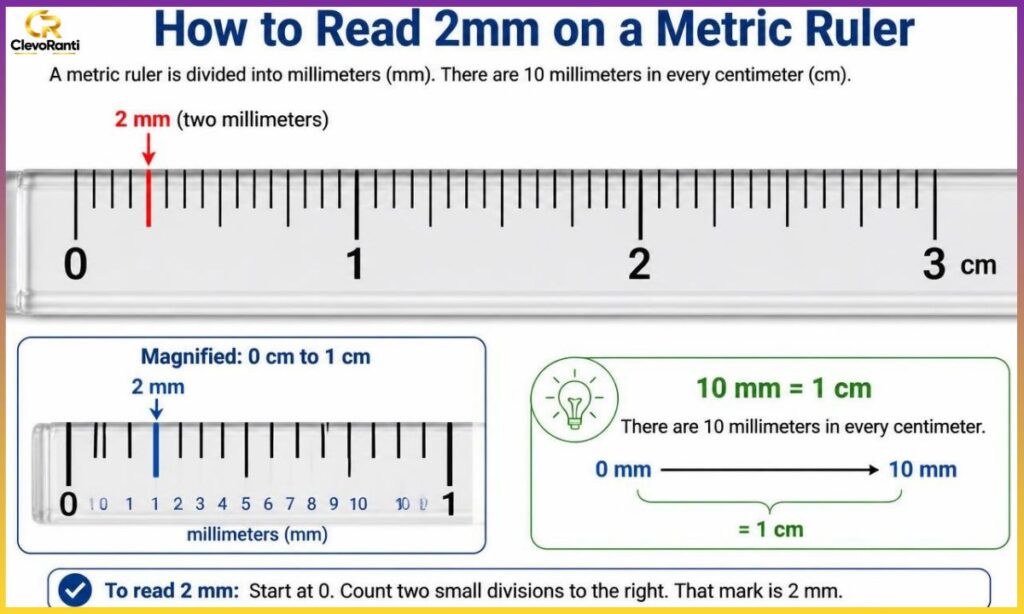
A metric ruler is one of the simplest tools for measuring small dimensions. Most standard metric rulers divide each centimeter into ten smaller sections, with every section representing one millimeter.
To find 2mm on a ruler, follow these steps:
- Locate the zero mark at the beginning of the scale.
- Find the first centimeter marking, which represents 10mm.
- Count backward from the 10mm mark or forward from zero to identify the second small graduation.
- Align the object’s edge with zero when measuring its length, or use the ruler’s scale to estimate its thickness.
- Keep your eye directly above the markings to avoid reading the scale from an angle.
For example, if a small strip begins at zero and ends at the second millimeter marking, its measured length is 2mm.
Measuring thickness can require a little more care. A ruler may show the object’s height, but its edge and markings can be too thick for reliable measurements at this scale. A digital caliper is often more suitable when precision matters.
Everyday Objects That Are Approximately 2mm Thick
Small objects are useful measurement references because they show how frequently tiny dimensions appear in ordinary life. Still, it’s important to distinguish between objects that are actually close to 2mm thick and objects that are merely two millimeters wide or long.
Here are several useful examples.
Pencil Lead and Mechanical Pencil Lead
Mechanical pencil leads are available in several diameters, including 0.5mm, 0.7mm, and 2mm. A 2mm lead is much thicker than the fine lead commonly used in everyday mechanical pencils.
Two-millimeter graphite leads are often found in drafting pencils and certain sketching tools. They can be sharpened to produce different line widths, making them useful for drawing, shading, and technical work.
A standard 0.5mm lead, on the other hand, is only one-quarter the diameter of a 2mm lead. This difference becomes quite noticeable when comparing the two side by side.
SIM Card Thickness
A standard SIM card is approximately 0.76mm thick, similar to a typical payment card. It is therefore much thinner than 2mm.
SIM cards are designed to fit into compact trays and mobile phone components. Adding unnecessary thickness would interfere with the fit, so precise manufacturing dimensions are important.
Although a SIM card can be a convenient reference for understanding small-scale design, it should not be described as a two-millimeter-thick object.
Ceramic Tile Spacers
Tile spacers are available in several sizes, including 2mm. These small plastic pieces help maintain consistent gaps between tiles during installation.
A 2mm tile spacer typically controls the width of the grout joint rather than representing a material that is 2mm thick. That distinction matters when you’re planning a bathroom renovation, kitchen backsplash, or tiled floor.
X-shaped and T-shaped spacers help keep adjacent tiles evenly separated. Choosing the correct spacer size can make the finished surface look more consistent and professional.
Matchsticks
A wooden matchstick can provide a rough visual reference for small dimensions, but its thickness varies by product and design. Some may be close to two millimeters across, while others are thicker or thinner.
If you use a matchstick as a comparison, inspect the wooden shaft rather than the head. The match head is wider and contains combustible material, so it is not a reliable reference for the shaft’s dimensions.
Tiny Watch and Eyeglass Screws
Miniature screws are common in watch repair, eyeglass frames, and other precision assemblies. Some screws have diameters or head dimensions around two millimeters, but their exact specifications differ.
For example, a screw’s nominal diameter, head width, and total length are separate measurements. A screw described as 2mm may refer to its thread diameter rather than its thickness across the head.
When replacing miniature hardware, check the manufacturer’s specifications instead of relying on visual similarity alone.
How 2mm Appears in Jewelry and Gemstones
Jewelry is a particularly good example of how small measurements influence appearance. A difference of one or two millimeters can change the way a ring looks, how a gemstone sits, or how noticeable an earring appears.
A 2mm Gemstone
A round gemstone with a diameter of 2mm is tiny, but it can still create a bright point of sparkle. The stone’s appearance depends on its cut, clarity, color, material, and setting.
A 2mm diamond is not the same as a diamond that is 2mm thick. Gemstones are often described by their face-up diameter, while their depth is a separate dimension.
This distinction is important when shopping for small diamonds, sapphires, or other stones. Always check whether the specification describes diameter, depth, or total dimensions.
Thin Ring Bands
A ring band measuring 2mm wide can appear delicate and understated. This width is common in minimalist jewelry, where a slim profile helps the gemstone or the overall shape stand out.
However, band width and band thickness are different. A ring may be 2mm wide across the finger while having a different thickness through the metal.
Jewelry designers consider both dimensions when balancing appearance, comfort, and structural strength. The correct choice depends on the metal, ring size, design, and intended daily use.
Earring Posts
Small stud earrings often use narrow posts designed to pass through a pierced earlobe. Their diameter varies by design, and some may be close to two millimeters while many are thinner.
The post diameter should not be confused with the decorative front of the earring, which may be considerably wider.
For people buying replacement jewelry, checking the actual post specification is more useful than estimating its size from a photograph.
Why 2mm Matters in Technology and Engineering
Two millimeters may seem insignificant when compared with a phone, computer, or household appliance. In engineering, though, small measurements can influence the fit, performance, and durability of an entire assembly.
Smartphone Screens and Components
Modern smartphones contain compact displays, sensors, connectors, and structural components that must fit within a narrow body. A phone’s overall thickness is often around 7–9mm, depending on the model, which is several times greater than 2mm.
Some individual internal components may be much thinner. Their dimensions must be carefully coordinated so that the display, battery, frame, and other parts fit together correctly.
A two-millimeter difference in a component’s position can be significant when space is limited. Engineers account for dimensional tolerances, thermal expansion, material properties, and structural strength during the design process.
Precision Engineering
In precision engineering, dimensional accuracy is not simply about making an object look right. A part must fit and function within its specified tolerances.
A component designed for a 2mm opening may not fit properly if the opening is too narrow. Conversely, excessive clearance can allow movement, vibration, or unwanted leakage in some applications.
Manufacturers use tools such as micrometers, digital calipers, gauges, and coordinate-measuring equipment to verify critical dimensions.
The required precision depends on the application. A craft project may tolerate a small difference, while a miniature mechanical assembly might require much tighter control.
Technical Drawings and Manufacturing
Technical drawings communicate dimensions so that designers, engineers, and manufacturers can work from the same specifications. A measurement such as 2mm needs to identify the correct feature, whether that is a hole diameter, plate thickness, gap width, or component length.
The drawing may also specify a tolerance, indicating how much variation is acceptable. For example, a nominal 2mm feature with a stated tolerance is not necessarily required to measure exactly 2.000mm.
Understanding this principle helps explain why precision tools are necessary when tiny differences affect the finished product.
How 2mm Is Used in Home Improvement and Crafts
Small dimensions appear in home renovation and creative projects more often than you might expect. Tile gaps, decorative materials, thin sheets, and small fasteners all require attention to size.
Tile Installation and Grout Gaps
A 2mm tile gap can create a narrow, neat grout joint. This is often chosen for particular tile styles, but the appropriate spacing depends on tile dimensions, edge consistency, manufacturer instructions, and installation requirements.
Large variations in tile size or shape may require wider joints. Outdoor installations and some natural stone applications may also have specific spacing needs.
Before buying spacers, check the tile manufacturer’s recommendations and make sure the intended joint width suits the material.
Craft Supplies and Thin Materials
Craft projects sometimes use 2mm foam sheets, plastic components, wood strips, or decorative boards. Such materials can provide a little rigidity without adding too much bulk.
The correct thickness depends on what the project needs. A thin foam piece might work for a lightweight model, while a metal component may provide greater stiffness at a similar thickness.
When measuring craft materials, consider whether the listed dimension describes the material’s thickness, width, or overall length.
Paper and Packaging
Paper thickness becomes important when designing packaging, book covers, inserts, or folded crafts. Although standard printer paper is often close to 0.1mm thick, cardstock and specialty papers can be substantially thicker.
A stack measuring approximately 2mm might contain twenty sheets of lightweight paper, fewer sheets of heavier paper, or a different number of coated sheets.
For a project that needs a specific overall height, measure the complete stack rather than assuming every sheet has the same thickness.
Natural Examples: Mustard Seeds, Ants, and Rice Grains
Nature offers many tiny objects that help us understand millimeter-scale dimensions. However, living organisms and natural materials vary, so these comparisons are best used as visual guides rather than exact measurements.
Mustard Seeds
Some mustard seeds measure around 1–2mm in diameter. Black mustard, brown mustard, and yellow mustard seeds can vary in size, shape, and color.
A seed near two millimeters across gives you a useful picture of how small the measurement is. Its diameter, however, should not be confused with its thickness when the seed is viewed from a different angle.
Mustard seeds are used in many cuisines, and their size makes them an easy example of a tiny object that most people recognize.
Small Ants
Certain small ant species have body lengths around 1.5–2mm, while many other ants are much larger. Their overall size depends on the species and the individual ant.
An ant measuring two millimeters from head to abdomen is about as long as the target measurement, but that doesn’t mean its body is two millimeters thick.
This is a useful distinction when visualizing millimeters: length, width, and thickness can differ considerably even in the same tiny creature.
Rice Grains
Rice grains vary by type. Basmati and jasmine rice are generally long-grain varieties, so their length is much greater than two millimeters. Their width is smaller, but it still varies by grain and processing.
A grain of rice can help demonstrate how a small object has multiple dimensions. It is not a dependable reference for exact 2mm thickness, though, because its shape is elongated and its width is not standardized.
If you need a true two-millimeter comparison, a coin edge or a metric ruler is usually more useful.
Is 2mm Visible to the Naked Eye?
Yes, 2mm is visible to the naked eye under ordinary viewing conditions. It is a small measurement, but most people can see a two-millimeter line or gap when it has a clear boundary and adequate contrast.
Visibility is not the same as accurate measurement, however. You might notice that a gap exists without being able to tell whether it is 1.5mm, 2mm, or 2.5mm.
Lighting, eyesight, surface color, viewing distance, and the shape of the object all influence how easily you can judge a small dimension. A dark gap between light-colored tiles may be easier to see than a narrow gap between two similar metal surfaces.
If you need to distinguish between closely spaced measurements, use a ruler with clear graduations or a suitable precision tool. Your eyes are excellent for recognizing small features, but they aren’t a substitute for measurement when accuracy matters.
What Is the Difference Between 1mm and 2mm?
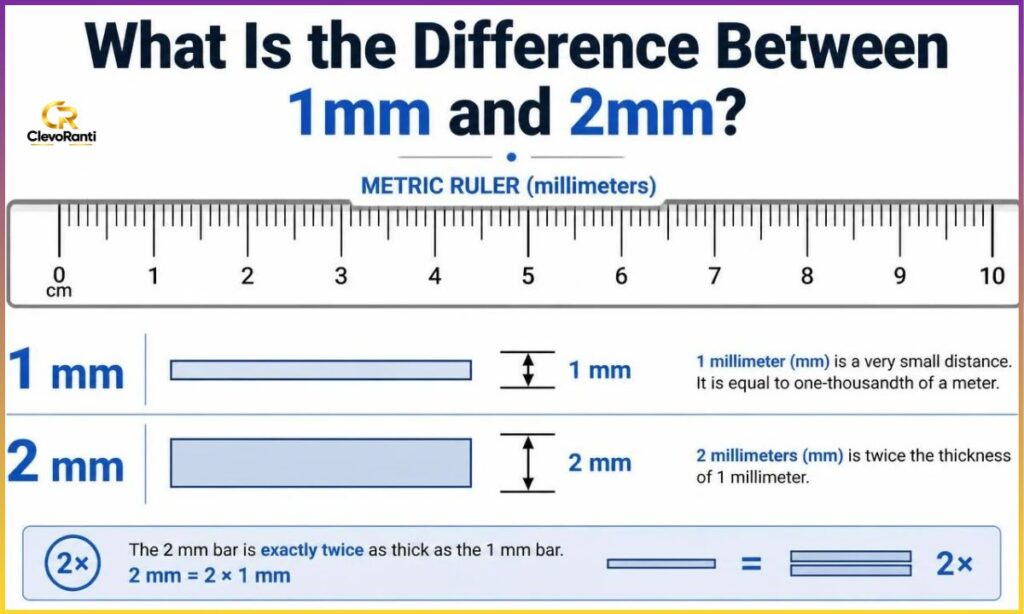
One millimeter is half the length or thickness of two millimeters. The numerical difference is just 1mm, but the proportional difference is 100%: a two-millimeter measurement is twice a one-millimeter measurement.
That difference can be surprisingly noticeable in small objects.
For example, a 2mm mechanical pencil lead is four times the diameter of a 0.5mm lead. A 2mm gap is also twice as wide as a 1mm gap, which may affect the appearance of a narrow joint or opening.
In manufacturing, doubling a dimension does not always mean doubling the object’s strength or performance. Those properties depend on shape, material, loading conditions, and the direction in which forces act.
When comparing small objects, make sure you’re comparing the same dimension. A 2mm-wide component cannot be meaningfully described as twice as thick as a 1mm-long component because width and length are different measurements.
How to Choose the Right Measuring Method
The best method depends on why you need to know the measurement. A quick visual estimate is fine for casual comparisons, but technical tasks deserve a more dependable approach.
- For everyday estimates: Use a US nickel as a close reference or compare a small object with a stack of paper.
- For crafts and DIY projects: Use a metric ruler with clearly marked millimeter graduations.
- For jewelry and miniature hardware: Consider digital calipers or a suitable precision measuring tool.
- For engineering and manufacturing: Follow the specified measurement method and tolerance requirements.
- For tile installation: Check the recommended grout joint width and use appropriately sized spacers.
When measuring thickness, make sure the tool contacts the correct surfaces without compressing or bending the material. Soft foam, paper, fabric, and other flexible materials can give misleading readings if they’re squeezed too firmly.
It also helps to measure more than once. If the object is irregular, take readings at several points and note any differences. A little care can prevent costly mistakes, particularly when fitting parts together.
Explore More Blog : Standard Flag Sizes
Frequently Asked Questions
How thick is 2mm in inches?
Two millimeters equals approximately 0.0787 inches. This is slightly less than one-tenth of an inch, making it a very small but visible thickness.
How many centimeters is 2mm?
Two millimeters equals 0.2 centimeters. Since one centimeter contains ten millimeters, you divide two by ten to get the answer.
What is 2mm in meters?
Two millimeters equals 0.002 meters. This conversion is useful when working with engineering specifications or calculations that use meters as the standard unit.
How thick is a US nickel in millimeters?
A US nickel is approximately 1.95mm thick, which is extremely close to two millimeters. It is one of the most convenient everyday objects for visualizing this measurement.
How thick are two dimes stacked together?
A US dime is approximately 1.35mm thick. Two stacked dimes measure around 2.7mm, which is thicker than 2mm.
How thick is printer paper?
Ordinary printer paper is often around 0.1mm thick, although the actual value depends on the paper type and weight. Approximately twenty sheets may create a stack close to 2mm.
How thick is a credit card?
A standard payment card is approximately 0.76mm thick. Two stacked cards measure around 1.52mm, while three measure approximately 2.28mm.
How big is a 2mm gemstone?
A round gemstone with a 2mm diameter is small and delicate. Its visible size depends on its cut and setting, and the diameter should not be confused with the stone’s depth or thickness.
Can I measure 2mm without a ruler?
You can estimate it using a nickel, a stack of paper, or several bank cards. However, these comparisons are approximate, so use a ruler, digital caliper, or micrometer when exact dimensions are important.
Is 2mm considered thin?
Yes, 2mm is generally considered thin for many household materials and small components. Whether it is sufficiently thin or thick depends on the material and its intended use.
What is a simple way to visualize 2mm?
Picture the thickness of a US nickel, which measures approximately 1.95mm. That coin provides a close real-life reference for understanding two millimeters.
Conclusion
Understanding how thick is 2mm becomes much easier when you connect the number to things you can actually see and touch. Two millimeters equals 0.2 centimeters, 0.002 meters, and approximately 0.0787 inches. It’s a small distance, yet it appears in coins, paper stacks, jewelry, tile spacing, and precision components.
The thickness of a US nickel, at roughly 1.95mm, is one of the closest everyday comparisons. A stack of approximately twenty sheets of printer paper and three standard credit cards can also help you picture the measurement, although their actual dimensions vary.
The most important lesson is to distinguish between length, width, diameter, and thickness. An object may be two millimeters long without being two millimeters thick, and that difference matters when you’re measuring, buying materials, or working on a detailed project.
For casual estimates, everyday objects provide useful reference points. For anything that requires a reliable fit or precise result, a metric ruler or digital caliper is the better choice.
Now that you have several ways to visualize two millimeters, think about where this tiny measurement appears in your own daily life. Have you used a 2mm tile spacer, worked with miniature screws, or chosen a gemstone by its diameter? Share your favorite measurement comparison or practical tip in the comments to help other readers make sense of these small but surprisingly important dimensions.